<?xml version="1.0" encoding="utf-8"?><feed xmlns="http://www.w3.org/2005/Atom" xml:lang="fr"><generator uri="https://jekyllrb.com/" version="3.10.0">Jekyll</generator><link href="https://www.reindaxia.tn/blog/feed.xml" rel="self" type="application/atom+xml" /><link href="https://www.reindaxia.tn/" rel="alternate" type="text/html" hreflang="fr" /><updated>2026-10-23T12:53:16+01:00</updated><id>https://www.reindaxia.tn/blog/feed.xml</id><title type="html">Reindaxia Engineering &amp;amp; Consulting</title><subtitle>Articles de Reindaxia : qualité des projets, inspection et FAT, mechanical completion, audits ISO 9001, management de projet, marchés publics et contrats FIDIC, en Tunisie, en Afrique du Nord et en Afrique.</subtitle><entry><title type="html">ISO 9001:2026 : ce qui change vraiment, et ce qui ne change pas</title><link href="https://www.reindaxia.tn/blog/iso-9001-2026-ce-qui-change.html" rel="alternate" type="text/html" title="ISO 9001:2026 : ce qui change vraiment, et ce qui ne change pas" /><published>2026-09-24T00:00:00+01:00</published><updated>2026-09-24T00:00:00+01:00</updated><id>https://www.reindaxia.tn/blog/iso-9001-2026-ce-qui-change</id><content type="html" xml:base="https://www.reindaxia.tn/blog/iso-9001-2026-ce-qui-change.html"><![CDATA[<blockquote>
  <p><strong>En bref.</strong> La sixième édition d’ISO 9001 a été publiée le 16 septembre 2026, onze ans après la précédente. Ce n’est pas une refonte : l’architecture de 2015 et ses principes restent en place. Les évolutions portent sur le rôle de la direction, avec l’entrée de la culture qualité et du comportement éthique dans les exigences, sur une lecture plus claire des risques et des opportunités, sur l’intégration du changement climatique et sur l’alignement avec la structure commune des normes de management. Pour une organisation dont le système fonctionne réellement, la transition est un travail de quelques mois. Pour un système qui n’existe que sur le papier, elle sera plus inconfortable, et c’est sans doute voulu.</p>
</blockquote>

<h2 id="un-peu-de-contexte">Un peu de contexte</h2>

<p>ISO 9001 est révisée selon un cycle régulier par le sous-comité 2 du comité technique ISO/TC 176. L’édition 2015 avait été une rupture : nouvelle structure en dix articles commune à toutes les normes de management, disparition du manuel qualité obligatoire et du représentant de la direction, approche par les risques. Les révisions suivantes de normes sœurs, ISO 14001 et ISO 45001 notamment, ont ensuite fait évoluer cette structure commune, devenue la <strong>structure harmonisée</strong>. En 2024, un amendement transversal a ajouté le changement climatique à l’analyse du contexte de toutes ces normes, ISO 9001 comprise.</p>

<p>La révision de 2026 s’inscrit dans cette continuité. L’ISO la présente elle-même comme une série d’<strong>ajustements ciblés</strong> destinés à améliorer la clarté, l’usage et la pertinence de la norme, sans toucher à son cadre ni à ses principes. La norme de vocabulaire qui l’accompagne, ISO 9000, a été rééditée quelques mois plus tôt, en mai 2026.</p>

<h2 id="1-la-culture-qualité-et-léthique-entrent-dans-les-exigences">1. La culture qualité et l’éthique entrent dans les exigences</h2>

<p>C’est le changement le plus commenté, et à juste titre. Dans l’article 5 consacré au leadership, la direction doit désormais <strong>promouvoir une culture de la qualité et un comportement éthique</strong>. Corollaire logique, l’article 7.3 sur la sensibilisation demande que le personnel soit conscient de cette culture et des principes éthiques qui la sous-tendent.</p>

<p>Ces notions n’étaient pas absentes de l’édition 2015 ; elles figuraient dans les principes de management de la qualité et dans ISO 9004. Ce qui change, c’est leur statut : ce qui relevait de la recommandation devient une exigence auditable.</p>

<p>Comment un auditeur vérifiera-t-il une culture ? Pas en demandant une charte affichée dans le hall. La note de la norme décrit la culture qualité comme un ensemble de valeurs partagées, d’attitudes et de pratiques établies. Ce sont donc les pratiques qui seront regardées :</p>

<ul>
  <li>la façon dont une non-conformité est remontée, et ce qui arrive à celui qui la remonte ;</li>
  <li>la cohérence entre ce que la direction dit de la qualité et les arbitrages qu’elle rend lorsque la qualité entre en conflit avec le délai ou le coût ;</li>
  <li>la manière dont sont traitées les pressions pour signer un document, un procès-verbal ou un certificat avant que les conditions soient réunies.</li>
</ul>

<p>Ce dernier point parlera à tous ceux qui ont travaillé en inspection ou en réception de chantier. L’éthique, en management de la qualité, commence souvent là.</p>

<h2 id="2-risques-et-opportunités--enfin-séparés">2. Risques et opportunités : enfin séparés</h2>

<p>L’édition 2015 traitait ensemble « les risques et opportunités », ce qui a produit dans beaucoup d’entreprises des registres où les opportunités n’étaient que des risques retournés. L’édition 2026 réorganise l’article 6.1 pour distinguer les actions face aux <strong>risques</strong> de celles qui visent à saisir des <strong>opportunités</strong>.</p>

<p>La nuance n’est pas cosmétique. Un risque appelle une réduction de probabilité ou de gravité ; une opportunité appelle une décision d’investir du temps ou des moyens pour en tirer parti. Les traiter dans le même tableau conduisait à négliger les secondes. Il reste vrai, comme en 2015, que la norme n’impose aucune méthode formelle de management des risques : un registre élaboré n’est pas exigé, une réflexion documentée à la mesure de l’organisation suffit.</p>

<p>L’ISO insiste par ailleurs sur l’usage de cette réflexion pour éclairer les <strong>décisions stratégiques</strong>. Le lien entre la politique qualité, le contexte et l’orientation stratégique de l’organisation est rendu plus explicite à l’article 5.2.</p>

<h2 id="3-le-changement-climatique-désormais-dans-le-texte">3. Le changement climatique, désormais dans le texte</h2>

<p>L’amendement de 2024 a ajouté à l’article 4.1 une phrase courte : l’organisme doit déterminer si le changement climatique est un enjeu pertinent. Une note à l’article 4.2 précise que les parties intéressées peuvent avoir des exigences liées au climat. L’édition 2026 intègre ces ajouts dans son texte.</p>

<p>Il ne s’agit pas de transformer ISO 9001 en norme environnementale. La question posée est celle de l’effet du climat sur la capacité à fournir des produits et services conformes : températures extrêmes sur un chantier, disponibilité de l’eau pour une épreuve hydraulique, exigences de clients sur l’empreinte carbone, contraintes réglementaires nouvelles. Pour une entreprise industrielle en Afrique du Nord, la réponse est rarement « non pertinent ».</p>

<h2 id="4-structure-harmonisée-et-annexe-a">4. Structure harmonisée et annexe A</h2>

<p>Le texte reprend la dernière version de la structure harmonisée, ce qui facilite l’intégration avec ISO 14001, ISO 45001 ou ISO 27001 dans un système de management unique. La planification des modifications du système, à l’article 6.3, gagne en précision dans ce cadre.</p>

<p>L’<strong>annexe A</strong>, informative, a été largement enrichie. Elle explique l’intention des exigences, la terminologie et les concepts. Elle ne crée aucune obligation nouvelle, mais elle devient la référence naturelle en cas de désaccord d’interprétation entre un audité et un auditeur. Nous recommandons de la lire en entier avant d’ouvrir le chantier de transition.</p>

<h2 id="5-ce-qui-ne-change-pas">5. Ce qui ne change pas</h2>

<p>Il faut le dire clairement, car l’inquiétude est fréquente : l’essentiel de la norme demeure. Les exigences opérationnelles de l’article 8 (planification, exigences des clients, conception, maîtrise des prestataires externes, production, libération, éléments de sortie non conformes) ne connaissent que des ajustements de rédaction. L’évaluation des performances, l’audit interne, la revue de direction et l’amélioration restent structurés comme en 2015. La norme reste neutre vis-à-vis des technologies : il n’y a pas d’exigence spécifique sur l’intelligence artificielle ou la numérisation.</p>

<p>Un système conforme à l’édition 2015, vivant et réellement appliqué, est donc déjà conforme à la plus grande partie de l’édition 2026.</p>

<h2 id="6-la-transition">6. La transition</h2>

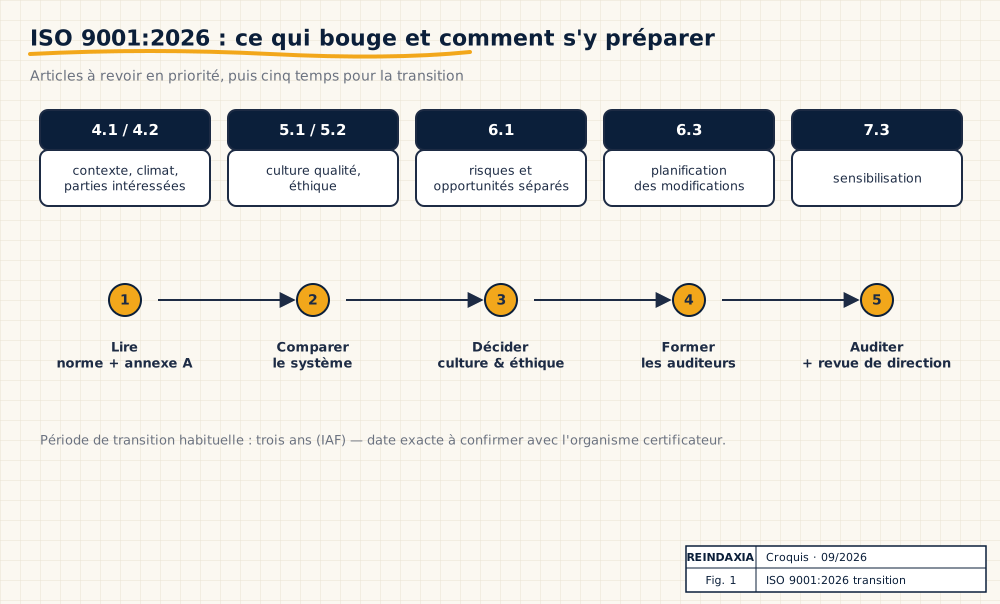
<p>Les nouvelles éditions de normes certifiables s’accompagnent habituellement d’une période de transition de trois ans fixée par l’IAF, le forum international de l’accréditation. Les organismes de certification annoncent ce calendrier pour ISO 9001:2026, sous réserve de la décision officielle de l’IAF. Il faut aussi compter avec un délai initial pendant lequel les organismes eux-mêmes font étendre leur accréditation ; les premiers certificats à la nouvelle édition seront donc progressifs. La date exacte applicable à chaque entreprise est à confirmer auprès de son organisme certificateur.</p>

<p>En pratique, nous proposons de procéder en cinq temps :</p>

<ol>
  <li><strong>Lire</strong> la norme et son annexe A, de préférence avec ISO 9000:2026 pour la terminologie.</li>
  <li><strong>Comparer</strong> le système existant aux exigences nouvelles ou modifiées : articles 4.1 et 4.2, 5.1, 5.2, 6.1, 6.3, 7.3, et les définitions.</li>
  <li><strong>Décider</strong> comment la direction rend visible la culture qualité et l’éthique : messages, arbitrages, traitement des alertes, indicateurs, revue de direction.</li>
  <li><strong>Former</strong> les auditeurs internes à la nouvelle édition, pour qu’ils sachent auditer une culture autrement qu’en cochant une case.</li>
  <li><strong>Conduire</strong> un audit interne complet sur la base de l’édition 2026 et une revue de direction avant l’audit de transition.</li>
</ol>

<p><img src="/assets/blog/iso-9001-2026-transition.svg" alt="Transition ISO 9001:2026" />
<em>Figure 1. Les articles à revoir en priorité et les cinq temps de la transition.</em></p>

<h2 id="7-ce-que-nous-en-pensons">7. Ce que nous en pensons</h2>

<p>Cette révision est modeste dans sa forme et ambitieuse dans son intention. En inscrivant la culture et l’éthique dans les exigences, ses auteurs rappellent qu’un système qualité ne se juge pas à la qualité de ses procédures mais à ce que font les gens quand personne ne vérifie. C’est une exigence plus difficile à satisfaire qu’un nouvel enregistrement, et plus difficile à auditer aussi. Les organisations qui avaient fait d’ISO 9001 un exercice documentaire le sentiront. Celles qui s’en servent pour piloter leur activité y trouveront une confirmation de leur démarche.</p>

<h2 id="sources-et-références">Sources et références</h2>

<ul>
  <li>ISO 9001:2026, <em>Systèmes de management de la qualité — Exigences</em>, sixième édition, septembre 2026.</li>
  <li>ISO 9000:2026, <em>Systèmes de management de la qualité — Principes essentiels et vocabulaire</em>.</li>
  <li>ISO 9001:2015/Amd 1:2024, <em>Actions relatives au changement climatique</em>.</li>
  <li>ISO, communiqué de publication d’ISO 9001:2026, 16 septembre 2026.</li>
  <li>ISO 9004:2018, <em>Management de la qualité — Qualité d’un organisme — Lignes directrices pour obtenir des performances durables</em>.</li>
  <li>ISO 19011, <em>Lignes directrices pour l’audit des systèmes de management</em>.</li>
</ul>

<hr />

<p>Reindaxia accompagne la transition vers ISO 9001:2026 : diagnostic des écarts, formation d’auditeurs internes à la nouvelle édition, audit à blanc avant l’audit de certification. <a href="/contact.html?besoin=audit">Planifier votre transition</a>.</p>]]></content><author><name>Reindaxia Engineering &amp; Consulting</name></author><category term="Audits et ISO 9001" /><summary type="html"><![CDATA[Lecture commentée de la nouvelle édition d'ISO 9001 publiée en septembre 2026 : culture qualité et comportement éthique, risques et opportunités, changement climatique, structure harmonisée, annexe A. Ce que les auditeurs regarderont et comment préparer la transition.]]></summary></entry><entry><title type="html">Gestion des connaissances : pourquoi les organisations oublient, et comment elles apprennent</title><link href="https://www.reindaxia.tn/blog/gestion-des-connaissances-projet-iso-pmbok-retour-experience.html" rel="alternate" type="text/html" title="Gestion des connaissances : pourquoi les organisations oublient, et comment elles apprennent" /><published>2026-08-17T00:00:00+01:00</published><updated>2026-08-17T00:00:00+01:00</updated><id>https://www.reindaxia.tn/blog/gestion-des-connaissances-projet-iso-pmbok-retour-experience</id><content type="html" xml:base="https://www.reindaxia.tn/blog/gestion-des-connaissances-projet-iso-pmbok-retour-experience.html"><![CDATA[<blockquote>
  <p><strong>En bref.</strong> Les grandes catastrophes industrielles ont rarement une cause inconnue. Dans la plupart des cas, quelqu’un, quelque part, savait : un ingénieur parti au siège, une recommandation d’étude de danger jamais appliquée, un incident précédent classé sans suite. Ce qui a manqué, ce n’est pas la connaissance, c’est le chemin qui la conduit au bon endroit au bon moment. Cet article rappelle ce que la recherche et les normes disent de ce chemin, l’illustre par quatre accidents documentés et par des constats de chantier et d’audit anonymisés, et montre ce qui distingue une organisation qui archive de celle qui apprend.</p>
</blockquote>

<h2 id="les-organisations-nont-pas-de-mémoire">Les organisations n’ont pas de mémoire</h2>

<p>En 1993, Trevor Kletz, l’un des fondateurs de la sécurité des procédés moderne, publiait un livre au titre provocateur : <em>Lessons from Disaster: How Organisations Have No Memory and Accidents Recur</em>. Sa thèse tenait en une phrase : les personnes ont une mémoire, les organisations n’en ont pas. Quand ceux qui ont vécu un accident partent, la leçon part avec eux, et l’accident revient, parfois dans la même usine, parfois une génération plus tard.</p>

<p>Trente ans après, la thèse n’a pas vieilli. Elle s’applique aussi bien à une raffinerie qu’à une entreprise de travaux de vingt personnes. Elle explique pourquoi un même défaut de réception réapparaît d’un chantier à l’autre, pourquoi un audit relève l’absence d’une norme que tout le monde utilise, et pourquoi un registre de leçons apprises peut contenir des centaines de lignes sans qu’aucune pratique n’ait changé.</p>

<h2 id="ce-que-dit-la-recherche">Ce que dit la recherche</h2>

<h3 id="savoir-plus-que-ce-que-lon-peut-dire">Savoir plus que ce que l’on peut dire</h3>

<p>Le philosophe et chimiste Michael Polanyi a formulé en 1966 une idée devenue centrale : « nous savons plus que ce que nous pouvons dire ». Une partie essentielle du savoir professionnel est <strong>tacite</strong> : le soudeur qui entend que l’arc n’est pas stable, le chef de quart qui sent qu’une colonne « ne tourne pas comme d’habitude », l’inspecteur qui sait où regarder sur un massif fraîchement décoffré. Ce savoir ne se trouve dans aucune procédure.</p>

<h3 id="le-cycle-de-conversion-des-connaissances">Le cycle de conversion des connaissances</h3>

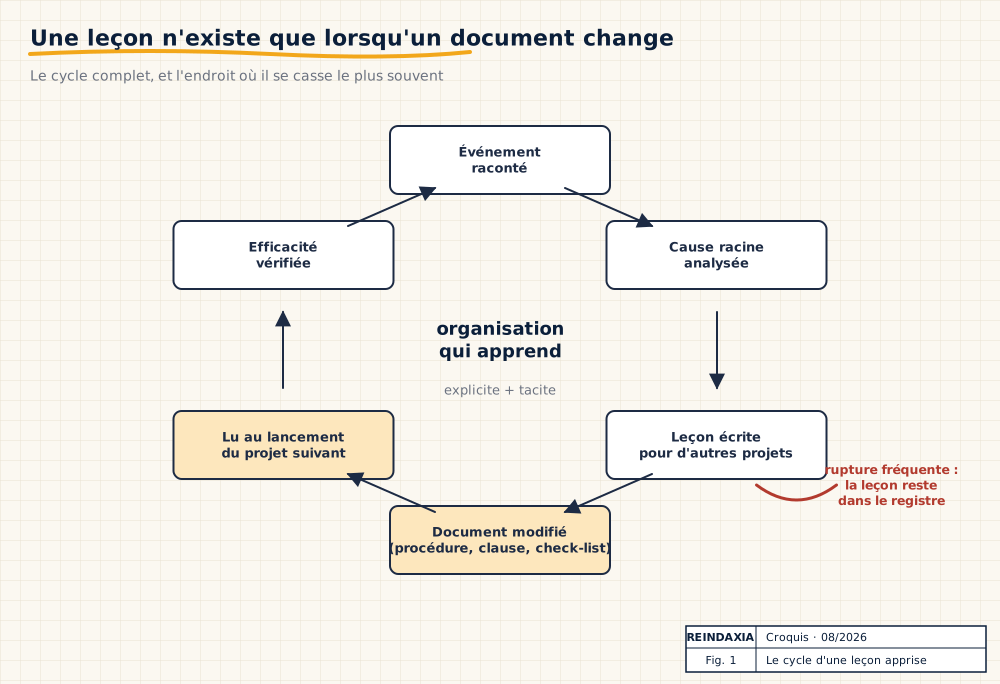
<p>Ikujiro Nonaka et Hirotaka Takeuchi (1995) ont décrit comment ce savoir circule dans une organisation, à travers quatre conversions : du tacite au tacite par le compagnonnage (<strong>socialisation</strong>), du tacite à l’explicite par l’écriture, le schéma, la règle (<strong>externalisation</strong>), de l’explicite à l’explicite par la combinaison de documents (<strong>combinaison</strong>), et de l’explicite au tacite quand une règle écrite devient un réflexe (<strong>internalisation</strong>). Un registre de leçons apprises ne couvre qu’une partie du cycle. Sans compagnonnage en amont et sans appropriation en aval, il reste une archive.</p>

<h3 id="corriger-lerreur-ou-corriger-la-règle">Corriger l’erreur ou corriger la règle</h3>

<p>Chris Argyris et Donald Schön (1978) ont distingué deux niveaux d’apprentissage. En <strong>simple boucle</strong>, l’organisation corrige l’écart : on remplace la pièce défectueuse. En <strong>double boucle</strong>, elle interroge la règle, l’hypothèse ou l’organisation qui a permis l’écart : pourquoi la pièce a-t-elle été acceptée ? La plupart des systèmes de retour d’expérience fonctionnent en simple boucle. Les accidents qui suivent montrent pourquoi ce n’est pas suffisant.</p>

<h3 id="la-normalisation-de-la-déviance">La normalisation de la déviance</h3>

<p>Enfin, la sociologue Diane Vaughan, en étudiant l’accident de la navette Challenger (1996), a montré comment un écart toléré une fois devient progressivement la norme : chaque vol réussi malgré l’anomalie renforce la conviction qu’elle est acceptable. Ce mécanisme est l’ennemi direct de l’apprentissage, parce qu’il transforme un signal en habitude.</p>

<h2 id="ce-que-disent-les-normes">Ce que disent les normes</h2>

<h3 id="iso-9001--les-connaissances-organisationnelles">ISO 9001 : les connaissances organisationnelles</h3>

<p>Depuis 2015, ISO 9001 demande à l’organisme de déterminer les connaissances nécessaires à ses processus et à la conformité de ses produits et services, de les tenir à jour et de les rendre disponibles (paragraphe 7.1.6). La note de l’exigence cite explicitement les enseignements tirés des échecs et des projets réussis, et les sources externes comme les normes. Deux autres exigences en sont le prolongement direct : la maîtrise des informations documentées d’origine externe, c’est-à-dire la disponibilité des normes applicables (7.5.3), et les actions correctives, qui doivent traiter les causes et vérifier leur efficacité (10.2).</p>

<h3 id="iso-45001--les-événements-passés-et-lévolution-des-connaissances">ISO 45001 : les événements passés et l’évolution des connaissances</h3>

<p>ISO 45001 va plus loin sur un point précis. Son processus d’identification des dangers doit prendre en compte les <strong>événements indésirables passés notables, internes ou externes à l’organisme</strong>, et <strong>l’évolution des connaissances et des informations sur les dangers</strong> (6.1.2.1). Autrement dit, la norme exige d’apprendre aussi des accidents des autres.</p>

<h3 id="iso-30401-et-le-pmbok">ISO 30401 et le PMBOK</h3>

<p>ISO 30401:2018 propose des exigences pour un système de management des connaissances et insiste sur la culture, le leadership et le cycle complet de la connaissance. Le <em>PMBOK Guide</em> du PMI, dans sa huitième édition (2025), fait du processus <em>Manage Project Knowledge</em> un élément du domaine de la gouvernance. Il distingue connaissances explicites et tacites, rappelle qu’une connaissance codifiée perd son contexte, et cite parmi les outils les revues après action, les rétrospectives et la mise en récit. Il signale aussi l’apport et les risques de l’intelligence artificielle pour capter et retrouver le savoir.</p>

<p>Ces textes convergent : la connaissance est une ressource à gérer, au même titre que les compétences ou les équipements. Les accidents suivants montrent ce qui arrive quand elle ne l’est pas.</p>

<h2 id="quatre-accidents-documentés">Quatre accidents documentés</h2>

<h3 id="longford-1998--le-savoir-parti-au-siège">Longford, 1998 : le savoir parti au siège</h3>

<p>Le 25 septembre 1998, sur l’usine de traitement de gaz de Longford, en Australie, une perte prolongée de circulation d’huile maigre refroidit un rebouilleur de dééthaniseur jusqu’à environ −42 °C, alors qu’il fonctionne normalement vers 100 °C. Lors du redémarrage, l’huile chaude réintroduite provoque la rupture fragile de la boîte de l’échangeur. Plus de dix tonnes d’hydrocarbures s’échappent, s’enflamment ; deux personnes meurent, huit sont blessées, et l’État de Victoria est privé de gaz pendant plus de deux semaines.</p>

<p>Les analyses de l’accident ont relevé une formation insuffisante aux situations anormales, une identification des dangers qui n’avait pas reconnu le risque de basse température, et un élément organisationnel devenu un cas d’école : les ingénieurs expérimentés avaient été transférés au siège, à Melbourne, quelques années plus tôt, sans que ce changement d’organisation ait fait l’objet d’une analyse de ses effets. Les opérateurs, seuls face à une situation inhabituelle, ne disposaient plus de ceux qui savaient ce qu’un acier refroidi à cette température devient. Le sociologue Andrew Hopkins en a tiré un ouvrage de référence, <em>Lessons from Longford</em> (2000).</p>

<p><strong>Ce que le cas enseigne.</strong> Une réorganisation est une modification. Déplacer, réduire ou remplacer une équipe d’experts change la quantité de connaissance disponible là où les décisions se prennent.</p>

<h3 id="geismar-2013--le-rebouilleur-que-les-plans-ne-montraient-pas">Geismar, 2013 : le rebouilleur que les plans ne montraient pas</h3>

<p>Le 13 juin 2013, dans une usine d’oléfines en Louisiane, un fractionnateur de propylène dispose de deux rebouilleurs, l’un en service, l’autre en attente. Pour permettre le nettoyage du premier, un opérateur ouvre l’eau chaude côté tubes du rebouilleur en attente. Trois minutes plus tard, la calandre éclate : le propane et le propylène liquides, piégés entre des vannes fermées, se sont dilatés sous l’effet de la chaleur. L’explosion et l’incendie font deux morts et plus de 160 blessés ; l’unité reste arrêtée dix-huit mois.</p>

<p>L’enquête du Chemical Safety Board américain a mis en évidence une chaîne de connaissances perdues. Des vannes d’isolement avaient été ajoutées en 2001 sans analyse adéquate de la modification. Les plans de tuyauterie et d’instrumentation n’avaient pas été mis à jour, si bien que l’analyse de danger suivante avait supposé les deux rebouilleurs toujours en service. Une recommandation de 2006, demandant de plomber ces vannes en position ouverte, n’avait pas été appliquée correctement. Aucune procédure spécifique n’existait pour la permutation des rebouilleurs. En fermant les vannes, l’exploitation avait isolé l’équipement de la soupape qui le protégeait.</p>

<p><strong>Ce que le cas enseigne.</strong> La connaissance existait : dans une recommandation, dans la tête de ceux qui avaient installé les vannes. Elle n’a pas atteint le plan, puis la procédure, puis l’opérateur. C’est exactement ce que la gestion des modifications et la maîtrise documentaire doivent garantir.</p>

<h3 id="texas-city-2005--les-avertissements-précédents">Texas City, 2005 : les avertissements précédents</h3>

<p>Le 23 mars 2005, lors du redémarrage d’une unité d’isomérisation d’une raffinerie texane, une colonne déborde et un ballon de purge, conçu dans les années 1950 et non raccordé à une torche, rejette un geyser d’hydrocarbures à l’atmosphère. L’explosion tue quinze personnes et en blesse environ 180. Les victimes se trouvaient dans des bâtiments provisoires installés trop près de l’unité.</p>

<p>L’enquête a relevé que le même ballon avait connu plusieurs rejets sérieux de matières inflammables au cours des dix années précédentes, sans enquête efficace ni modification. Les opérateurs avaient pris l’habitude de remplir la colonne au-delà de la plage de l’indicateur lors des démarrages. Le nombre de formateurs avait été fortement réduit et aucun superviseur expérimenté n’encadrait le démarrage.</p>

<p><strong>Ce que le cas enseigne.</strong> Un incident sans gravité est une information gratuite. Une organisation qui ne l’analyse pas paie plus tard le prix complet.</p>

<h3 id="columbia-2003--le-signal-devenu-habitude">Columbia, 2003 : le signal devenu habitude</h3>

<p>Le 1er février 2003, la navette Columbia se désintègre lors de sa rentrée dans l’atmosphère : un morceau de mousse isolante détaché du réservoir au décollage avait endommagé le bord d’attaque d’une aile. Les détachements de mousse avaient été observés lors de nombreux vols précédents. Faute de conséquence grave, ils avaient été progressivement classés comme un problème de maintenance plutôt que comme un danger. La commission d’enquête a conclu que les causes organisationnelles pesaient autant que la cause physique, et que l’organisation n’avait pas tiré toutes les leçons de Challenger, dix-sept ans plus tôt.</p>

<p><strong>Ce que le cas enseigne.</strong> La répétition d’un écart sans conséquence n’est pas une preuve de sécurité. C’est la normalisation de la déviance décrite par Vaughan.</p>

<h2 id="ce-que-nous-voyons-sur-le-terrain">Ce que nous voyons sur le terrain</h2>

<p>Ces accidents sont extrêmes. Les mêmes mécanismes se retrouvent, à une autre échelle, dans les constats quotidiens des chantiers et des audits. Les exemples qui suivent sont réels et anonymisés.</p>

<h3 id="un-massif-de-béton-nest-pas-un-détail">Un massif de béton n’est pas un détail</h3>

<p>Sur un projet de lignes électriques en Afrique centrale, le maître d’œuvre a adressé à l’entreprise une lettre de non-conformité après des visites inopinées sur les chantiers d’implantation des poteaux. Il relevait l’absence de vibreur alors que le béton des massifs était gâché sur tôle ; la réalisation différée de la partie hors sol des massifs, qui doit être coulée en continuité avec la partie enterrée ; l’absence d’éprouvettes permettant de vérifier la résistance du béton ; et l’absence d’essais de convenance alors que la provenance des granulats avait changé. Le maître d’œuvre annonçait des contrôles au scléromètre et la démolition des massifs jugés insuffisants.</p>

<p>Rien de tout cela n’était inconnu. La vibration, la continuité du bétonnage, le contrôle de la résistance sur éprouvettes et la validation d’une formulation lorsque ses constituants changent sont des exigences classiques du contrat et des normes d’exécution et de spécification du béton (EN 13670, EN 206, EN 12390). Un ingénieur expérimenté sait aussi qu’un scléromètre donne une estimation de la dureté de surface et non une résistance : en cas de doute, ce sont des carottages qui trancheront, avec le coût et le délai qu’ils impliquent. La connaissance était disponible ; elle n’était pas présente sur le chantier au moment du coulage.</p>

<h3 id="les-constats-dun-audit-de-certification">Les constats d’un audit de certification</h3>

<p>Lors d’un audit combiné qualité, environnement et santé-sécurité d’une entreprise de travaux électriques, l’auditeur a relevé plusieurs non-conformités qui, lues ensemble, racontent la même histoire :</p>

<ul>
  <li>l’identification des dangers ne couvrait ni les animaux sauvages ni les conditions climatiques extrêmes des chantiers, ni les déplacements ; les dangers vécus sur les chantiers précédents n’avaient pas été réinjectés dans l’analyse ;</li>
  <li>la norme d’installation électrique utilisée au quotidien par les équipes n’était pas disponible dans l’entreprise, faute de veille normative ;</li>
  <li>des piquets de terre livrés par un fournisseur avaient été installés sans contrôle à réception, et se sont révélés non conformes ;</li>
  <li>les règles de consignation électrique n’étaient pas appliquées de manière effective sur un chantier, et la ceinture de sécurité d’un véhicule avait été volontairement neutralisée par ses utilisateurs ;</li>
  <li>la veille réglementaire existait, mais l’évaluation de conformité qui devait en découler n’avait pas été faite.</li>
</ul>

<p>Chacun de ces écarts a reçu une correction rapide. La question intéressante est ailleurs : pourquoi des connaissances aussi élémentaires, une norme, un contrôle à réception, une règle de consignation, n’étaient-elles pas en place ? Les analyses de causes retenues par l’entreprise convergent : processus non formalisés, responsabilités non désignées, supervision de terrain insuffisante. C’est, à petite échelle, le diagnostic de Longford et de Texas City.</p>

<h3 id="la-même-cause-dun-projet-à-lautre">La même cause, d’un projet à l’autre</h3>

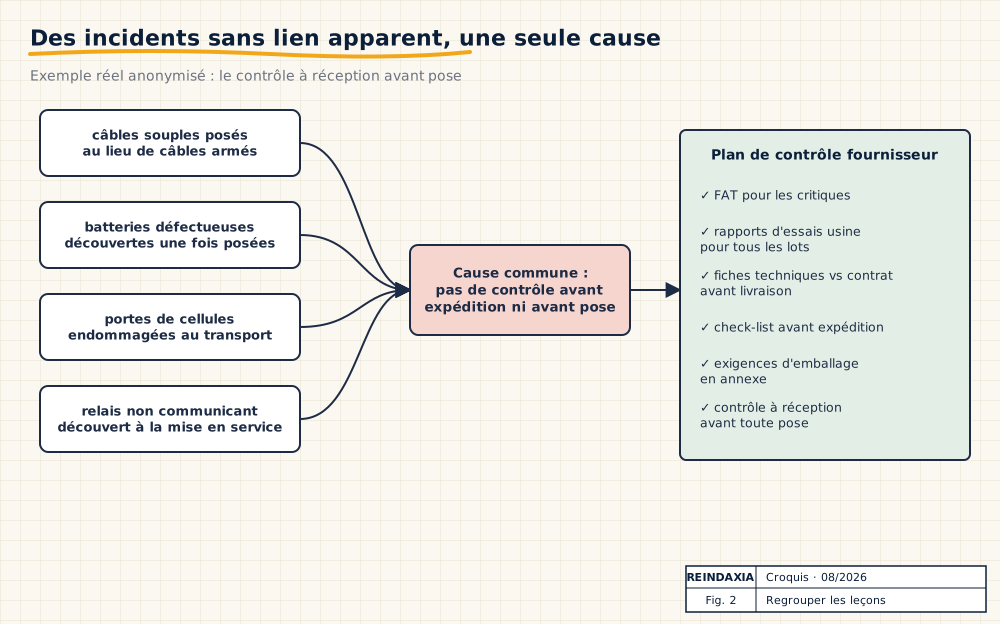
<p>Sur des projets d’électrification d’une autre entreprise, nous avons vu des câbles souples posés à la place de câbles armés, des batteries défectueuses découvertes une fois installées, des cellules endommagées par un emballage insuffisant, un relais de protection incapable de communiquer avec la supervision à la mise en service. Quatre incidents sans rapport apparent, une seule cause : aucun contrôle avant expédition ni avant pose pour les équipements que le client n’avait pas exigé de réceptionner en usine. Les piquets de terre de l’audit précédent appartiennent à la même famille. Une leçon formulée au niveau du symptôme, « vérifier les câbles », ne protège que contre la répétition exacte du même incident. Formulée au niveau de la cause, « contrôler tout matériel critique à son arrivée, avant pose, contre les exigences du contrat », elle protège contre une famille entière.</p>

<h2 id="pourquoi-la-connaissance-narrive-pas-là-où-elle-est-utile">Pourquoi la connaissance n’arrive pas là où elle est utile</h2>

<p>Les cas ci-dessus, du plus grave au plus ordinaire, révèlent cinq mécanismes récurrents.</p>

<ol>
  <li><strong>Le départ des personnes.</strong> Mutation, réorganisation, fin de contrat, départ à la retraite : le savoir tacite part avec ceux qui le portent (Longford, réduction des formateurs à Texas City).</li>
  <li><strong>La modification non tracée.</strong> Un changement physique ou organisationnel n’est pas reporté dans les documents ; la connaissance suivante est fausse (Geismar).</li>
  <li><strong>L’incident non exploité.</strong> Un événement sans gravité n’est ni analysé ni partagé (Texas City, Columbia).</li>
  <li><strong>La leçon mal formulée.</strong> Écrite au niveau du symptôme, elle ne s’applique jamais au cas suivant (nos projets d’électrification).</li>
  <li><strong>L’absence au moment de l’action.</strong> La règle existe, mais ni la personne compétente ni le contrôle ne sont présents au moment où le travail se fait (béton des massifs, consignation).</li>
</ol>

<p><img src="/assets/blog/km-cycle-lecon-apprise.svg" alt="Cycle d'une leçon apprise" />
<em>Figure 1. Le cycle complet d’une leçon apprise, et l’endroit où il se casse le plus souvent.</em></p>

<h2 id="ce-qui-fait-réellement-apprendre-une-organisation">Ce qui fait réellement apprendre une organisation</h2>

<p>Aucun de ces mécanismes ne se corrige par un logiciel. Ils se corrigent par quatre éléments que l’on retrouve dans toutes les organisations qui apprennent.</p>

<h3 id="une-organisation-qui-sait-qui-sait">Une organisation qui sait qui sait</h3>

<p>Chaque domaine critique a un référent identifié, et toute réorganisation qui touche ces référents est traitée comme une modification, avec une analyse de ses effets. Les nouveaux arrivants travaillent en binôme avec des anciens sur les opérations sensibles. Le compagnonnage n’est pas un luxe : c’est le seul canal efficace pour le savoir tacite.</p>

<h3 id="un-système-de-management-qui-ferme-la-boucle">Un système de management qui ferme la boucle</h3>

<p>La gestion des modifications garantit que tout changement physique ou organisationnel est analysé et reporté dans les documents. La maîtrise documentaire garantit que la bonne norme et la bonne révision sont disponibles là où l’on travaille. Les actions correctives traitent les causes, en double boucle, et leur efficacité est vérifiée sur le projet suivant. Les audits internes vérifient que ces boucles tournent réellement. C’est exactement la structure qu’imposent ISO 9001, ISO 14001 et ISO 45001 ; encore faut-il la faire vivre plutôt que l’afficher.</p>

<h3 id="des-experts-expérimentés-là-où-les-décisions-se-prennent">Des experts expérimentés là où les décisions se prennent</h3>

<p>Les accidents de Longford et de Texas City ont en commun l’absence, au moment critique, de personnes expérimentées. Sur un chantier, c’est l’ingénieur qui sait qu’un béton gâché sur tôle sans vibration ne donnera pas la résistance prévue, ou qu’un scléromètre ne remplace pas une éprouvette. Ce savoir s’acquiert en années de terrain ; il se partage par la présence, la revue des méthodes et la formation des équipes.</p>

<h3 id="un-contrôle-qualité-qui-intercepte-avant-quil-ne-soit-trop-tard">Un contrôle qualité qui intercepte avant qu’il ne soit trop tard</h3>

<p>Le contrôle à réception, les points d’arrêt d’un plan d’inspection, les essais de convenance, les éprouvettes : ce sont les moments où une connaissance générale se transforme en vérification concrète. Ils coûtent peu au regard de ce qu’ils évitent : une démolition de massifs, un remplacement de câbles, une mise en service retardée, ou pire.</p>

<p><img src="/assets/blog/km-regrouper-les-lecons.svg" alt="Regrouper les leçons" />
<em>Figure 2. Quatre incidents sans lien apparent, une seule cause, une seule pratique nouvelle.</em></p>

<h2 id="un-format-de-fiche-qui-fonctionne">Un format de fiche qui fonctionne</h2>

<table>
  <thead>
    <tr>
      <th>Champ</th>
      <th>Contenu attendu</th>
    </tr>
  </thead>
  <tbody>
    <tr>
      <td>Référence, date, émetteur, processus</td>
      <td>Traçabilité, et lien avec le système de management</td>
    </tr>
    <tr>
      <td>Contexte</td>
      <td>Ce qu’il faut savoir pour comprendre, sans nom de client ni de personne</td>
    </tr>
    <tr>
      <td>Événement</td>
      <td>Les faits, chiffrés si possible</td>
    </tr>
    <tr>
      <td>Cause racine</td>
      <td>Analysée (cinq pourquoi, arbre des causes), pas supposée</td>
    </tr>
    <tr>
      <td>Conséquences réelles et potentielles</td>
      <td>Coût, délai, sécurité, réputation</td>
    </tr>
    <tr>
      <td>Leçon</td>
      <td>Formulée pour s’appliquer à d’autres projets</td>
    </tr>
    <tr>
      <td>Document ou pratique modifié</td>
      <td>Procédure, check-list, clause type, plan de contrôle, formation</td>
    </tr>
    <tr>
      <td>Responsable et échéance</td>
      <td>Une personne, une date</td>
    </tr>
    <tr>
      <td>Vérification d’efficacité</td>
      <td>Comment saura-t-on que la leçon a été appliquée sur le projet suivant</td>
    </tr>
  </tbody>
</table>

<h2 id="quatre-indicateurs-honnêtes">Quatre indicateurs honnêtes</h2>

<ul>
  <li>la part des leçons ayant conduit à la modification d’un document identifié ;</li>
  <li>le délai entre l’enregistrement d’une leçon et la mise à jour du document correspondant ;</li>
  <li>la part des projets ayant tenu une revue des leçons pertinentes à leur lancement ;</li>
  <li>le nombre de causes racines réapparues sur un projet ultérieur.</li>
</ul>

<p>Le dernier est le plus révélateur. Une organisation qui apprend le voit baisser.</p>

<h2 id="ce-que-nous-retenons">Ce que nous retenons</h2>

<p>Kletz avait raison : les organisations n’ont pas de mémoire propre. Elles n’ont que celle de leurs membres, de leurs documents et de leurs contrôles. Les accidents de Longford, Geismar, Texas City et Columbia ne sont pas des histoires lointaines ; leurs mécanismes se retrouvent chaque semaine sous forme d’un massif mal vibré, d’une norme introuvable, d’un piquet de terre non contrôlé. La différence entre une organisation qui subit ces écarts et une organisation qui les fait disparaître tient à quatre choses : savoir qui sait, faire tourner les boucles du système de management, garder des experts expérimentés au plus près des décisions, et contrôler avant qu’il ne soit trop tard.</p>

<h2 id="références">Références</h2>

<ul>
  <li>Polanyi, M. (1966). <em>The Tacit Dimension</em>. University of Chicago Press.</li>
  <li>Argyris, C. et Schön, D. (1978). <em>Organizational Learning: A Theory of Action Perspective</em>. Addison-Wesley.</li>
  <li>Nonaka, I. et Takeuchi, H. (1995). <em>The Knowledge-Creating Company</em>. Oxford University Press.</li>
  <li>Kletz, T. (1993). <em>Lessons from Disaster: How Organisations Have No Memory and Accidents Recur</em>. IChemE.</li>
  <li>Vaughan, D. (1996). <em>The Challenger Launch Decision</em>. University of Chicago Press.</li>
  <li>Hopkins, A. (2000). <em>Lessons from Longford: The Esso Gas Plant Explosion</em>. CCH Australia.</li>
  <li>U.S. Chemical Safety and Hazard Investigation Board, <em>Investigation Report: Refinery Explosion and Fire, BP Texas City</em> (2007) et <em>Williams Geismar Olefins Plant Reboiler Rupture and Fire</em> (2016).</li>
  <li>Columbia Accident Investigation Board, <em>Report</em>, Volume 1, 2003.</li>
  <li>IChemE Safety Centre, fiches de synthèse des accidents de Longford (1998) et de Geismar (2013).</li>
  <li>ISO 9001:2015, paragraphes 7.1.6, 7.5.3 et 10.2 ; ISO 45001:2018, paragraphe 6.1.2.1 ; ISO 30401:2018.</li>
  <li>Project Management Institute (2025). <em>A Guide to the Project Management Body of Knowledge (PMBOK® Guide)</em>, huitième édition.</li>
  <li>EN 206, EN 13670, EN 12390-3, EN 12504-1 et EN 12504-2 (spécification, exécution et essais du béton).</li>
</ul>

<hr />

<p>Reindaxia aide les entreprises à transformer leurs retours d’expérience en pratiques : analyse de causes, mise à jour des procédures et des plans de contrôle, audits internes, accompagnement de terrain par des ingénieurs expérimentés. <a href="/contact.html?besoin=projet">Parlons de votre projet</a>.</p>]]></content><author><name>Reindaxia Engineering &amp; Consulting</name></author><category term="Management de projet et contrats" /><summary type="html"><![CDATA[La gestion des connaissances dans l'industrie et les projets : ce qu'en disent la recherche (Polanyi, Nonaka, Argyris, Kletz), ISO 9001, ISO 45001, ISO 30401 et le PMBOK 8e édition, et ce que montrent des accidents documentés (Longford, Geismar, Texas City, Columbia) et des constats de terrain anonymisés. Mécanismes de l'oubli organisationnel et conditions d'un apprentissage réel.]]></summary></entry><entry xml:lang="en"><title type="html">The DAAB as a dispute avoidance tool: using the board before positions harden</title><link href="https://www.reindaxia.tn/blog/fidic-daab-dispute-avoidance-adjudication-board-prevention.html" rel="alternate" type="text/html" title="The DAAB as a dispute avoidance tool: using the board before positions harden" /><published>2026-07-06T00:00:00+01:00</published><updated>2026-07-06T00:00:00+01:00</updated><id>https://www.reindaxia.tn/blog/fidic-daab-dispute-avoidance-adjudication-board-prevention</id><content type="html" xml:base="https://www.reindaxia.tn/blog/fidic-daab-dispute-avoidance-adjudication-board-prevention.html"><![CDATA[<blockquote>
  <p><strong>In short.</strong> The 2017 FIDIC contracts replaced the ad hoc dispute board of many earlier projects with a standing Dispute Avoidance/Adjudication Board, appointed at the start and visiting the site regularly. Its decisions are binding unless overturned. But its most useful power is the one most rarely used: informal assistance, at the joint request of the parties, on issues that have not yet become disputes. This article explains how the board works and how to use it as a prevention tool, particularly on public projects where the board is often seen as an avoidable cost.</p>
</blockquote>

<h2 id="the-board-that-met-twice">The board that met twice</h2>

<p>The contract provided for a three-member board. It was appointed eight months late, after the contractor reminded the employer twice. It met once for an introductory visit. The parties, satisfied that “there was no dispute”, cancelled the next visits to save fees.</p>

<p>Eighteen months later the project had accumulated a delay claim, a disagreement on the valuation of a major variation and a defects dispute. All three were referred to the board within a few weeks of each other. The members, who had seen the site once at an early stage, had to learn the project from the submissions. The decisions took the full time allowed, were challenged by both sides, and the matter moved towards arbitration.</p>

<p>The members themselves said afterwards that two of the three issues could probably have been resolved with an informal discussion a year earlier, when they first appeared in the progress reports.</p>

<h2 id="from-adjudication-to-avoidance">From adjudication to avoidance</h2>

<p>Earlier FIDIC editions already used dispute boards, but the 1999 Red Book board was often set up only when a dispute arose. The 2017 edition makes three changes:</p>

<ul>
  <li>the board is a <strong>standing body</strong>, appointed at the start of the contract and remaining in place until the end;</li>
  <li>its name reflects a dual role: <strong>avoidance</strong> first, <strong>adjudication</strong> if needed;</li>
  <li>its work is framed by detailed <strong>Procedural Rules</strong> and a tripartite <strong>DAAB Agreement</strong>, annexed to the conditions.</li>
</ul>

<p>FIDIC’s Golden Principles insist on this point: disputes should go to a dispute board before arbitration, unless that conflicts with the governing law.</p>

<h2 id="appointment-and-costs">Appointment and costs</h2>

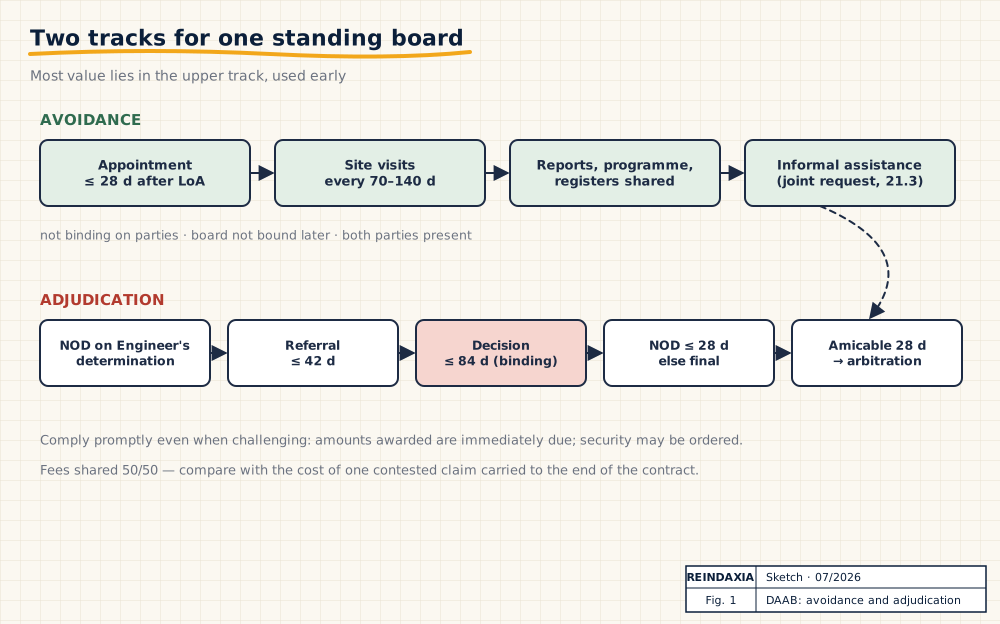
<p>Under Sub-Clause 21.1, the parties jointly appoint the board within the time stated in the Contract Data, <strong>28 days</strong> after the contractor receives the Letter of Acceptance if nothing is stated. The board has one or three members, as the Contract Data provide; three if they say nothing. For a three-member board, each party selects one member for the other’s agreement, and the parties agree the chair after consulting those two. Members are chosen from a list in the Contract Data when one is provided. The board is constituted when the parties and the members have all signed the DAAB Agreement. <strong>Each party pays half</strong> of the members’ fees.</p>

<p>If a party fails to agree an appointment, Sub-Clause 21.2 allows the appointing entity named in the Contract Data to appoint. If no board is in place when a dispute arises, Sub-Clause 21.8 allows the dispute to go directly to the final forum.</p>

<p>A practical point for public employers: the selection of board members should be prepared during tendering. A list of proposed members in the Contract Data, agreed procedures for fee approval and a budget line for the board avoid the months of delay we see when appointment begins only after contract signature.</p>

<h2 id="how-the-board-stays-informed">How the board stays informed</h2>

<p>The Procedural Rules ask the board to become and remain informed about the project and any actual or potential disagreement. Soon after appointment it holds a face-to-face meeting with the parties and sets a schedule of meetings and site visits. Visits take place at intervals of <strong>no more than 140 days and no less than 70 days</strong>, unless the parties and the board agree otherwise, and can be supplemented by video meetings. The parties send the board the documents it needs to follow the project, typically progress reports, programme updates and key correspondence.</p>

<p>These visits are not a formality. They are the board’s only way to understand the project before it is asked to decide something about it. Cancelling them to save money is the most expensive saving we know.</p>

<h2 id="informal-assistance-the-avoidance-tool">Informal assistance: the avoidance tool</h2>

<p>Sub-Clause 21.3 allows the parties, <strong>if they agree</strong>, to jointly ask the board, in writing with a copy to the Engineer, to help them or to discuss informally any issue or disagreement. The board may itself invite them to do so when it becomes aware of an issue. The assistance may take place during a meeting, a site visit or otherwise, with both parties present. It may not be requested while the Engineer is dealing with the same matter under Sub-Clause 3.7, unless the parties agree.</p>

<p>Two features make this tool safe to use. The parties are <strong>not bound</strong> by any advice given. And the board is <strong>not bound</strong> by its informal views in any later decision. The informal discussion therefore costs little in legal terms: neither party gives anything away, and both hear how three experienced people read the contract and the facts.</p>

<p>In our experience, the issues best suited to informal assistance are those where the parties disagree on the reading of the contract rather than on facts: whether a ground condition was foreseeable, how a specification requirement should be interpreted, which delay analysis method applies, whether a performance shortfall justifies rejection or a price reduction. An hour of discussion often brings the parties close enough to settle through the Engineer.</p>

<h2 id="when-a-dispute-arises">When a dispute arises</h2>

<p>If a disagreement becomes a dispute, the procedure of Sub-Clause 21.4 applies:</p>

<table>
  <thead>
    <tr>
      <th>Step</th>
      <th>Time limit</th>
    </tr>
  </thead>
  <tbody>
    <tr>
      <td>Referral to the board after a Notice of Dissatisfaction with the Engineer’s determination</td>
      <td>Within <strong>42 days</strong> of the NOD, otherwise the NOD lapses</td>
    </tr>
    <tr>
      <td>Board’s decision</td>
      <td>Within <strong>84 days</strong> of the referral, or another period proposed by the board and agreed</td>
    </tr>
    <tr>
      <td>Notice of Dissatisfaction with the decision</td>
      <td>Within <strong>28 days</strong> of receiving it; without one, the decision becomes final and binding</td>
    </tr>
    <tr>
      <td>Amicable settlement attempt</td>
      <td>Arbitration may start from the 28th day after the NOD</td>
    </tr>
  </tbody>
</table>

<p>The decision is <strong>binding</strong> from the moment it is given. The parties must comply promptly, even if one of them gives a Notice of Dissatisfaction. An amount the board awards is immediately due, without certification. Where there are reasonable grounds to fear the payee could not repay if the decision were later reversed, the board may require security. A party that fails to comply may be taken directly to arbitration to enforce the decision under Sub-Clause 21.7.</p>

<p>The board’s proceedings are not an arbitration. They are faster, less formal and cheaper, and in many jurisdictions their decisions are respected in practice even when challenged.</p>

<p><img src="/assets/blog/fidic-daab-two-tracks.svg" alt="DAAB two tracks" />
<em>Figure 1. The two tracks of a standing DAAB: avoidance first, adjudication if needed.</em></p>

<h2 id="particular-considerations-for-public-employers">Particular considerations for public employers</h2>

<p>Public employers raise three recurring objections to the board.</p>

<p><strong>“It costs too much.”</strong> The fees of a three-member board are typically a small fraction of the contract value, shared equally with the contractor. They should be compared with the cost of one contested claim taken to the end of the contract and then to court.</p>

<p><strong>“Our law does not allow it.”</strong> Public procurement and arbitration rules vary between countries, and in some, public entities face restrictions on arbitration. The board itself is not an arbitral tribunal. Its decisions are contractual. The Particular Conditions should define the final forum (national courts or arbitration) in accordance with the governing law and any financing agreement, and fit the board and any national amicable settlement body into a clear sequence. Removing the board altogether breaches the Golden Principles and, on bank-financed projects, is usually not accepted by the lender.</p>

<p><strong>“Decisions will be made by outsiders.”</strong> The opposite is true: a standing board that visits regularly knows the project better than any judge or arbitrator ever will, and its decisions can be challenged.</p>

<h2 id="how-to-get-value-from-the-board">How to get value from the board</h2>

<p><strong>Appoint it on time.</strong> Prepare the list of members and the fee approval during tendering.</p>

<p><strong>Keep it informed.</strong> Send monthly reports and programme updates; maintain the visit schedule.</p>

<p><strong>Put avoidance on the agenda.</strong> At each visit, review the claims register and the early warning register together and ask: which of these could use the board’s informal view?</p>

<p><strong>Use the Engineer first.</strong> The board does not replace the Engineer’s determinations. It helps where the Engineer’s process has stalled or where the parties need an independent reading.</p>

<p><strong>Comply with decisions,</strong> even when you intend to challenge them. Non-compliance damages credibility and invites enforcement.</p>

<h2 id="our-view">Our view</h2>

<p>The DAAB is the 2017 edition’s most visible statement that disputes are better prevented than decided. Its value lies less in its decisions than in its presence: a small group of experienced people who know the project, visit it regularly and are available to discuss problems early. On the projects where we have seen boards used this way, few formal referrals were ever needed.</p>

<h2 id="references">References</h2>

<ul>
  <li>FIDIC, <em>Conditions of Contract for Construction</em> (Red Book), Second Edition, 2017, Clause 21 and the appendix <em>General Conditions of Dispute Avoidance/Adjudication Agreement</em> with its <em>Procedural Rules</em>.</li>
  <li>FIDIC, <em>FIDIC Golden Principles</em>, First Edition, 2019 (Principle GP5).</li>
  <li>FIDIC, <em>Conditions of Contract for Construction, MDB Harmonised Edition</em> (Pink Book), 2010, Clause 20 (Dispute Board).</li>
  <li>Dispute Resolution Board Foundation, <em>Practices and Procedures</em>, for practical guidance on board operation.</li>
</ul>

<p><em>This article is a general commentary and not legal advice. The wording of the FIDIC forms is protected by copyright; refer to the official FIDIC publications and to the Particular Conditions of your contract.</em></p>

<hr />

<p>Reindaxia helps employers and contractors prepare dispute board provisions, keep boards informed, and present issues for informal assistance or decision on FIDIC contracts. <a href="/en.html#contact">Talk to us</a>.</p>]]></content><author><name>Reindaxia Engineering &amp; Consulting</name></author><category term="Contracts and FIDIC" /><summary type="html"><![CDATA[How the standing Dispute Avoidance/Adjudication Board of the FIDIC 2017 contracts works, and how employers and contractors can use its informal assistance, site visits and decisions to prevent disputes. Appointment, costs, procedure, time limits, and practical advice for public projects.]]></summary></entry><entry xml:lang="en"><title type="html">Tests on completion, taking over and the defects period: FIDIC Clauses 9 to 11 seen by a quality engineer</title><link href="https://www.reindaxia.tn/blog/fidic-tests-on-completion-taking-over-defects-period-quality-engineer.html" rel="alternate" type="text/html" title="Tests on completion, taking over and the defects period: FIDIC Clauses 9 to 11 seen by a quality engineer" /><published>2026-05-25T00:00:00+01:00</published><updated>2026-05-25T00:00:00+01:00</updated><id>https://www.reindaxia.tn/blog/fidic-tests-on-completion-taking-over-defects-period-quality-engineer</id><content type="html" xml:base="https://www.reindaxia.tn/blog/fidic-tests-on-completion-taking-over-defects-period-quality-engineer.html"><![CDATA[<blockquote>
  <p><strong>In short.</strong> The last phase of a FIDIC contract is governed by three clauses that are often read separately: Clause 9 on Tests on Completion, Clause 10 on taking over, and Clause 11 on defects. For a quality engineer they form a single sequence: prove performance, accept the works with a controlled list of reservations, then follow those reservations and any new defects until the Performance Certificate. The 2017 edition adds firm time limits and documentary preconditions at each step. Projects that prepare this sequence from the start hand over in weeks; those that discover it at the end can take months.</p>
</blockquote>

<h2 id="accepted-but-not-quite">Accepted, but not quite</h2>

<p>The pumping station had passed its tests. The Engineer issued the Taking-Over Certificate, and attached to it a list of outstanding work and defects: 340 items. Some were cosmetic, a few were not, including a vibration level on one pump close to the acceptance limit and a missing set of as-built drawings for the electrical room.</p>

<p>A year later, at the end of the Defects Notification Period, 60 items were still open. Nobody had tracked the list after the certificate was signed. The site team had demobilised, the contractor’s warranty team worked from its own list, the operator from another. The Performance Certificate was delayed by eight months, the final guarantee was retained, and the pump with the borderline vibration had in the meantime damaged its bearings.</p>

<p>The contract had all the tools needed. They were used one at a time, by different people.</p>

<h2 id="clause-9-proving-performance">Clause 9: proving performance</h2>

<h3 id="the-test-programme">The test programme</h3>

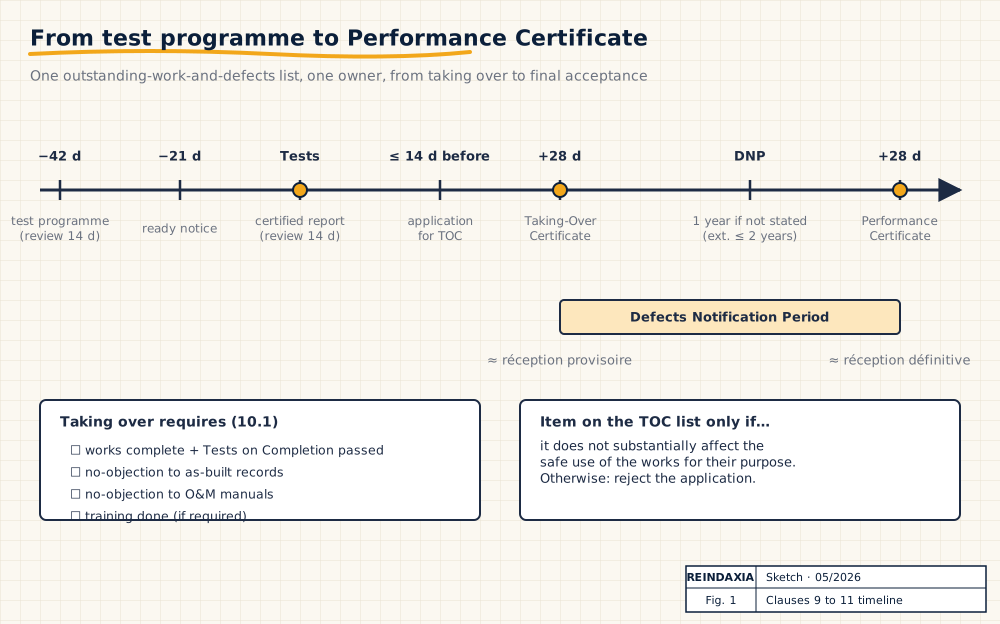
<p>Under Sub-Clause 9.1, Tests on Completion are carried out after the as-built records and the operation and maintenance manuals have been submitted, where the contract requires them. At least <strong>42 days</strong> before the tests are due to start, the contractor submits a detailed test programme with timing and resources. The Engineer may give notice of non-compliance; the contractor then revises it within <strong>14 days</strong>. Silence for 14 days is a deemed no-objection, and the tests cannot start without one.</p>

<p>The contractor then gives at least <strong>21 days’</strong> notice of the date after which it will be ready for each test, and starts within 14 days of that date. Once the tests are passed, it submits a certified report. The Engineer has <strong>14 days</strong> to give notice that the results do not comply, failing which a no-objection is deemed given. When assessing the results, the Engineer must allow for the effect of any use of the works by the employer.</p>

<p>From a quality perspective, the test programme is the moment to verify that each test has a <strong>written procedure, a defined acceptance criterion, calibrated instruments and a record format</strong>, and that the procedures refer to the specification and standards actually in the contract. A test without an agreed criterion is not a test; it is a demonstration.</p>

<h3 id="delays-retests-and-failure">Delays, retests and failure</h3>

<p>If the employer unduly delays tests, Sub-Clause 10.3 applies: where the contractor is prevented from testing for more than 14 days, the works are deemed taken over on the date the tests would otherwise have been completed, and the tests are carried out later, before the end of the Defects Notification Period. If the contractor delays them, the Engineer may require them to be carried out within 21 days of a notice, and the employer may ultimately carry them out at the contractor’s risk and cost.</p>

<p>If the works fail, Sub-Clause 9.3 allows either party to require a retest under the same conditions. If the retest also fails, Sub-Clause 9.4 gives the Engineer four options: order another retest; reject the works if the failure deprives the employer of substantially the whole benefit; reject a Section if it cannot be used for its intended purpose; or issue a Taking-Over Certificate at the employer’s request, with a reduction in the contract price to be agreed or determined.</p>

<p>The last option is the one most often used and least often documented. A price reduction for a performance shortfall should be based on a clear analysis: the shortfall measured, its effect on the employer, and the method of valuation.</p>

<h2 id="clause-10-taking-over">Clause 10: taking over</h2>

<h3 id="the-preconditions">The preconditions</h3>

<p>Sub-Clause 10.1 lists the conditions for taking over, which go beyond physical completion:</p>

<ul>
  <li>the works are completed in accordance with the contract, <strong>including passing the Tests on Completion</strong>, except for minor outstanding work and defects;</li>
  <li>where applicable, the Engineer has given (or is deemed to have given) a no-objection to the <strong>as-built records</strong>;</li>
  <li>where applicable, the same for the <strong>operation and maintenance manuals</strong>;</li>
  <li>where applicable, the contractor has carried out the <strong>training</strong> required;</li>
  <li>a Taking-Over Certificate has been issued or deemed issued.</li>
</ul>

<p>The documentary conditions are new in 2017 and, in our experience, the most frequent cause of late taking over. As-built drawings and manuals require Engineer review time, typically defined in the specification. They need to be submitted, reviewed and corrected before the contractor applies for taking over, not after.</p>

<h3 id="the-application-and-the-certificate">The application and the certificate</h3>

<p>The contractor may apply by notice <strong>no more than 14 days</strong> before it expects the works to be complete. The Engineer then has <strong>28 days</strong> either to issue the certificate, stating the date of completion and listing the minor outstanding work and defects, or to reject the application with reasons, specifying what remains to be done. If the Engineer does neither and the conditions are met, the certificate is deemed issued, and the works deemed complete on the fourteenth day after the application.</p>

<p>The phrase that matters most for quality is the one that limits the list: the outstanding work and defects must not <strong>substantially affect the safe use</strong> of the works for their intended purpose. That is the test to apply to every item proposed for the list, and it is very close to the logic of punch list categories used in industrial mechanical completion: an item that prevents safe use is not a reservation, it is a reason to refuse.</p>

<h3 id="sections-and-parts">Sections and parts</h3>

<p>Where the contract defines Sections, each is taken over separately, with its own Date of Completion and its own Defects Notification Period. Under Sub-Clause 10.2, the employer may also take over parts of the works at its discretion. If it uses a part before taking over, other than as a temporary measure provided for in the specification or agreed, that part is deemed taken over from the date of use. Public employers that open a road or a building to the public “temporarily” should be aware of this effect.</p>

<h2 id="clause-11-outstanding-work-defects-and-the-performance-certificate">Clause 11: outstanding work, defects and the Performance Certificate</h2>

<h3 id="two-obligations-one-list">Two obligations, one list</h3>

<p>Sub-Clause 11.1 requires the contractor to complete the outstanding work listed in the Taking-Over Certificate within the time stated or instructed, and to remedy defects or damage notified before the end of the Defects Notification Period. When a defect appears, the parties <strong>inspect it jointly</strong>, the contractor proposes remedial work, and the procedure of Sub-Clause 7.5 applies.</p>

<p>The Defects Notification Period is stated in the Contract Data, and is <strong>one year</strong> if nothing is stated. It runs from the Date of Completion of the works, Section or part.</p>

<h3 id="who-pays">Who pays</h3>

<p>Under Sub-Clause 11.2, remedial work is at the contractor’s cost to the extent it results from contractor design, non-conforming plant, materials or workmanship, improper operation or maintenance attributable to the contractor (including deficient as-built records, manuals or training), or any other breach. If the contractor considers the cause lies elsewhere, it gives notice and the Engineer agrees or determines the cause; work found not attributable to the contractor is treated as a variation.</p>

<h3 id="extension-failure-and-access">Extension, failure and access</h3>

<p>Sub-Clause 11.3 allows the employer, subject to the claims procedure, to extend the period for any part of the works that cannot be used because of a defect for which the contractor is responsible, by <strong>no more than two years</strong> beyond the period stated in the Contract Data. Sub-Clause 11.4 lets the employer fix a date for unduly delayed remedial work and, if it is missed, carry out the work at the contractor’s cost, obtain a price reduction, or, in serious cases, terminate for the affected part.</p>

<h3 id="the-performance-certificate">The Performance Certificate</h3>

<p>Under Sub-Clause 11.9, the Engineer issues the Performance Certificate within <strong>28 days</strong> after the latest expiry of the Defects Notification Periods, or as soon as the contractor has supplied all Contractor’s Documents and completed and tested all the works, including remedying defects. If the Engineer fails to do so, it is deemed issued 28 days after the date it should have been. Only the Performance Certificate constitutes <strong>acceptance of the works</strong>. Each party remains liable for obligations still unperformed, with a limit, for plant, of two years after the end of the defects period except in cases of fraud, gross negligence, deliberate default or reckless misconduct, or where the law provides otherwise.</p>

<p><img src="/assets/blog/fidic-9-11-timeline.svg" alt="Clauses 9 to 11 timeline" />
<em>Figure 1. From the test programme to the Performance Certificate, with the conditions for taking over.</em></p>

<h2 id="a-note-on-tunisian-public-contracts">A note on Tunisian public contracts</h2>

<p>Public works contracts in Tunisia traditionally speak of <em>réception provisoire</em> and <em>réception définitive</em>, with a guarantee period between them and the release of the definitive guarantee within the time fixed by the procurement regulations. In a FIDIC-based public contract, the Taking-Over Certificate plays the role of provisional acceptance and the Performance Certificate that of final acceptance. The Particular Conditions should say so explicitly, align the Defects Notification Period with the guarantee period required by the applicable administrative conditions, and link the release of the performance security and retention money to the Performance Certificate. Two vocabularies without a correspondence table produce two sets of dates.</p>

<h2 id="the-quality-engineers-toolkit-for-the-last-phase">The quality engineer’s toolkit for the last phase</h2>

<table>
  <thead>
    <tr>
      <th>Moment</th>
      <th>Tool</th>
      <th>Purpose</th>
    </tr>
  </thead>
  <tbody>
    <tr>
      <td>Six months before tests</td>
      <td>Test matrix</td>
      <td>Every test in the specification, with procedure, criterion, instruments, responsibility</td>
    </tr>
    <tr>
      <td>42 days before tests</td>
      <td>Test programme and procedures</td>
      <td>Contractual submission under 9.1</td>
    </tr>
    <tr>
      <td>Before applying for taking over</td>
      <td>Documentation tracker</td>
      <td>As-built records, manuals, training records, compliance verification dossier</td>
    </tr>
    <tr>
      <td>At taking over</td>
      <td>Single outstanding work and defects list</td>
      <td>One list, categorised by safe-use test, with target dates</td>
    </tr>
    <tr>
      <td>During the defects period</td>
      <td>Defects register</td>
      <td>Notification, joint inspection, proposal, remedy, retest, closure</td>
    </tr>
    <tr>
      <td>Before the end of the period</td>
      <td>Close-out review</td>
      <td>Open items, extension of period if justified, Contractor’s Documents complete</td>
    </tr>
  </tbody>
</table>

<p>The single list is the most important. It starts as the attachment to the Taking-Over Certificate, is shared by the Engineer, the contractor and the operator, and is closed line by line with evidence. Defects notified during the period are added to it. When it is empty and the documents are complete, the Performance Certificate follows.</p>

<h2 id="our-view">Our view</h2>

<p>Clauses 9 to 11 are where a contract becomes an asset in operation. They reward the parties that treat testing as a planned quality activity, taking over as a documented decision, and the defects period as a managed process rather than a waiting period. The pumping station in our example did not lack a good contract; it lacked one list and one owner.</p>

<h2 id="references">References</h2>

<ul>
  <li>FIDIC, <em>Conditions of Contract for Construction</em> (Red Book), Second Edition, 2017, Sub-Clauses 1.1.27, 4.4, 4.5, 7.4, 7.5, 9.1 to 9.4, 10.1 to 10.3 and 11.1 to 11.11.</li>
  <li>ISO 9001:2015, clauses 8.6 (release of products and services) and 8.7 (control of nonconforming outputs).</li>
  <li>ISO 10005:2018, <em>Quality management — Guidelines for quality plans</em>.</li>
  <li>Décret n° 2014-1039 du 13 mars 2014 portant réglementation des marchés publics (Tunisia), provisions on guarantees, acceptance and final settlement.</li>
</ul>

<p><em>This article is a general commentary and not legal advice. The wording of the FIDIC forms is protected by copyright; refer to the official FIDIC publications and to the Particular Conditions of your contract.</em></p>

<hr />

<p>Reindaxia prepares test programmes, manages taking-over documentation and runs defects registers for employers and contractors on FIDIC projects. <a href="/en.html#contact">Talk to us</a>.</p>]]></content><author><name>Reindaxia Engineering &amp; Consulting</name></author><category term="Contracts and FIDIC" /><summary type="html"><![CDATA[The end of a FIDIC Red Book 2017 contract from a quality perspective: test programme and notices under Clause 9, retesting and failure, the conditions for taking over under Clause 10, outstanding work and defects under Clause 11, the Defects Notification Period, the Performance Certificate, and how they connect with Tunisian provisional and final acceptance.]]></summary></entry><entry><title type="html">Variations FIDIC et avenants publics : faire concorder la Clause 13 avec les commissions de contrôle</title><link href="https://www.reindaxia.tn/blog/variations-fidic-avenants-marches-publics-commissions-de-controle.html" rel="alternate" type="text/html" title="Variations FIDIC et avenants publics : faire concorder la Clause 13 avec les commissions de contrôle" /><published>2026-04-20T00:00:00+01:00</published><updated>2026-04-20T00:00:00+01:00</updated><id>https://www.reindaxia.tn/blog/variations-fidic-avenants-marches-publics-commissions-de-controle</id><content type="html" xml:base="https://www.reindaxia.tn/blog/variations-fidic-avenants-marches-publics-commissions-de-controle.html"><![CDATA[<blockquote>
  <p><strong>En bref.</strong> Le FIDIC permet à l’Engineer d’ordonner une variation à tout moment avant la réception, et à l’entrepreneur d’être payé sans passer par la procédure de réclamation. Le droit tunisien des marchés publics exige qu’une modification des conditions du marché fasse l’objet d’un avenant, après avis de la commission de contrôle compétente. Les deux logiques se rencontrent sur chaque chantier public financé en FIDIC. Mal articulées, elles produisent des travaux exécutés que l’acheteur ne peut pas payer. Bien articulées, elles se complètent.</p>
</blockquote>

<h2 id="le-mur-de-soutènement">Le mur de soutènement</h2>

<p>Sur un projet routier, l’étude géotechnique d’exécution a révélé qu’un talus prévu en déblai simple ne tiendrait pas. L’Engineer a instruit un mur de soutènement, ce que la Clause 13 lui permettait. L’entrepreneur a construit le mur en dix semaines, transmis ses éléments de valorisation, et l’Engineer a déterminé un prix.</p>

<p>Restait à le payer. Le montant cumulé des modifications dépassait déjà le seuil prévu au marché ; il fallait un avenant. Le dossier d’avenant a été préparé quatre mois après l’achèvement du mur, transmis à la commission de contrôle, renvoyé pour compléments, puis approuvé. L’entrepreneur a attendu près d’un an pour être payé d’un ouvrage que tout le monde jugeait nécessaire, et une réclamation pour frais financiers s’est ajoutée au dossier.</p>

<p>Personne n’avait enfreint les règles. Chacun avait appliqué les siennes, sans calendrier commun.</p>

<h2 id="ce-que-dit-le-fidic">Ce que dit le FIDIC</h2>

<p>Selon la sous-clause 13.1 du Red Book 2017, l’Engineer peut initier une variation à tout moment avant l’émission du certificat de réception des ouvrages. L’entrepreneur est tenu de l’exécuter, sauf s’il notifie promptement, avec justifications, que les travaux modifiés étaient imprévisibles au regard de la nature des ouvrages décrits, qu’il ne peut pas se procurer aisément les fournitures nécessaires, ou que la variation compromet le respect de ses obligations en matière de santé, de sécurité ou de protection de l’environnement ; l’Engineer annule, confirme ou modifie alors l’instruction. Une variation peut porter sur les quantités, les caractéristiques, les cotes et implantations, des travaux supplémentaires ou l’ordre d’exécution, mais ne peut pas consister à retirer des travaux pour les confier au maître d’ouvrage ou à un autre entrepreneur, sauf accord des parties. Symétriquement, l’entrepreneur ne doit apporter aucune modification aux ouvrages permanents tant qu’une variation n’a pas été instruite.</p>

<p>La sous-clause 13.3 propose deux voies :</p>

<ul>
  <li><strong>la variation par instruction</strong> (13.3.1) : l’Engineer décrit la modification par avis ; l’entrepreneur l’exécute et remet, dans les <strong>28 jours</strong>, une description des travaux, un programme et une proposition d’ajustement du prix évaluée selon la Clause 12. L’Engineer procède ensuite selon la sous-clause 3.7, et l’entrepreneur a droit à l’ajustement et à la prolongation de délai <strong>sans devoir passer par la procédure de réclamation</strong> de la Clause 20 ;</li>
  <li><strong>la variation par demande de proposition</strong> (13.3.2) : l’Engineer demande d’abord une proposition ; l’entrepreneur la remet ou explique pourquoi il ne peut pas s’y conformer ; l’Engineer donne ou refuse son accord, et, s’il l’accepte, instruit la variation. Si la proposition est refusée, le coût de sa préparation peut être réclamé selon la procédure de réclamation.</li>
</ul>

<p>La Clause 12 gouverne l’évaluation : prix du bordereau quand ils s’appliquent ; nouveaux prix lorsque les quantités varient au-delà des seuils qu’elle fixe ou que le bordereau ne contient pas de prix adapté, dérivés des prix existants ajustés ou, à défaut, du coût raisonnable augmenté de la marge prévue aux Contract Data.</p>

<p>Enfin, la sous-clause 3.5 traite le cas des instructions qui ne disent pas leur nom : si l’entrepreneur estime qu’une instruction constitue une variation, il doit le notifier immédiatement, avant d’exécuter, et l’Engineer dispose de <strong>7 jours</strong> pour confirmer, annuler ou modifier l’instruction, faute de quoi elle est réputée retirée.</p>

<h2 id="ce-que-dit-le-droit-tunisien">Ce que dit le droit tunisien</h2>

<p>Le décret n° 2014-1039 du 13 mars 2014 pose des règles qui s’appliquent quelle que soit la forme du contrat :</p>

<ul>
  <li>toute modification des clauses administratives, financières ou techniques du marché (prix, délais, quantités, nature des prestations) fait l’objet d’un <strong>avenant écrit</strong>, signé par l’acheteur public et le titulaire après <strong>avis de la commission de contrôle compétente</strong> ;</li>
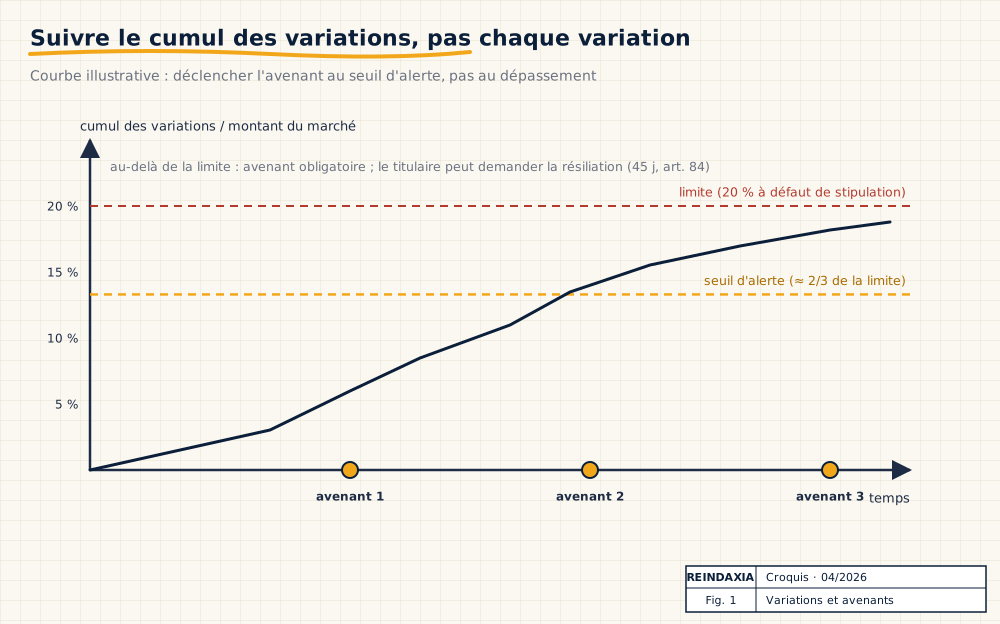
  <li>l’article 88 fixe la règle des variations de la masse : tant que la variation reste dans la limite prévue par le cahier des charges, le titulaire ne peut élever aucune réclamation ; à défaut de stipulation, cette limite est de <strong>20 %</strong> du montant du marché, et un dépassement exige un avenant ;</li>
  <li>l’article 84 ouvre au titulaire, au-delà de cette limite, un droit de résiliation sans indemnité en cas d’augmentation, à demander dans les <strong>45 jours</strong> suivant la réception de l’acte qui la provoque, et un droit à indemnité en cas de diminution ;</li>
  <li>l’article 155 interdit de soumettre aux commissions de contrôle des dossiers à titre de régularisation.</li>
</ul>

<p>Ce dernier point est souvent sous-estimé. Une commission qui reçoit un avenant pour des travaux déjà exécutés depuis des mois peut y voir une régularisation déguisée. Le calendrier compte donc autant que le contenu.</p>

<h2 id="où-les-deux-logiques-se-heurtent">Où les deux logiques se heurtent</h2>

<table>
  <thead>
    <tr>
      <th>Situation</th>
      <th>Logique FIDIC</th>
      <th>Logique marchés publics</th>
      <th>Risque</th>
    </tr>
  </thead>
  <tbody>
    <tr>
      <td>Travaux imprévus urgents</td>
      <td>Instruction immédiate par l’Engineer</td>
      <td>Avenant préalable si la limite est dépassée</td>
      <td>Travaux faits, paiement bloqué</td>
    </tr>
    <tr>
      <td>Accumulation de petites variations</td>
      <td>Chacune évaluée séparément</td>
      <td>Seul le cumul compte pour le seuil</td>
      <td>Dépassement découvert tard</td>
    </tr>
    <tr>
      <td>Nouveaux prix</td>
      <td>Déterminés par l’Engineer (3.7)</td>
      <td>Soumis à la commission avec l’avenant</td>
      <td>Désaccord entre détermination et avis</td>
    </tr>
    <tr>
      <td>Prolongation de délai liée</td>
      <td>Accordée sans réclamation</td>
      <td>Avenant sur le délai</td>
      <td>Pénalités appliquées à tort</td>
    </tr>
    <tr>
      <td>Retrait de travaux</td>
      <td>Limité par 13.1</td>
      <td>Diminution de la masse, indemnité possible</td>
      <td>Litige sur l’indemnisation</td>
    </tr>
  </tbody>
</table>

<h2 id="une-méthode-pour-les-faire-concorder">Une méthode pour les faire concorder</h2>

<h3 id="1-écrire-le-seuil-dans-les-conditions-particulières">1. Écrire le seuil dans les conditions particulières</h3>

<p>Le cahier des charges fixe sa propre limite de variation. Les conditions particulières doivent la reprendre explicitement et définir un <strong>seuil d’alerte</strong>, par exemple aux deux tiers de la limite, à partir duquel l’Engineer et le maître d’ouvrage préparent un avenant.</p>

<h3 id="2-tenir-un-registre-unique-des-variations">2. Tenir un registre unique des variations</h3>

<p>Un seul registre, tenu par l’Engineer et partagé avec le maître d’ouvrage, porte chaque variation : référence de l’instruction ou de la demande de proposition, date, description, montant estimé puis déterminé, effet sur le délai, et <strong>cumul en pourcentage du montant du marché</strong>. Le cumul est mis à jour à chaque nouvelle ligne et présenté dans chaque rapport mensuel.</p>

<h3 id="3-privilégier-la-demande-de-proposition-pour-les-variations-importantes">3. Privilégier la demande de proposition pour les variations importantes</h3>

<p>La voie 13.3.2 laisse le temps d’obtenir un prix avant d’engager les travaux. Pour une variation qui fera franchir le seuil, elle permet de préparer l’avenant en parallèle : proposition de l’entrepreneur, analyse de l’Engineer, dossier à la commission, puis instruction une fois l’avis rendu. La sous-clause 3.2 permet de soumettre à l’accord préalable du maître d’ouvrage, à condition de le prévoir dans les conditions particulières, l’instruction de variations au-delà d’un montant défini. C’est l’outil adapté ; il ne doit jamais toucher aux déterminations de la sous-clause 3.7.</p>

<h3 id="4-prévoir-le-cas-de-lurgence">4. Prévoir le cas de l’urgence</h3>

<p>Certaines variations ne peuvent pas attendre : sécurité, stabilité, protection des ouvrages exécutés. Les conditions particulières peuvent prévoir que l’Engineer instruit la variation, que le maître d’ouvrage saisit la commission de contrôle dans un délai court, et que le dossier expose dès le départ la justification de l’urgence. La commission voit ainsi une procédure engagée au moment des faits, pas une régularisation tardive.</p>

<h3 id="5-grouper-les-avenants-sans-les-retarder">5. Grouper les avenants sans les retarder</h3>

<p>Un avenant par variation encombre les commissions ; un avenant unique en fin de chantier ressemble à une régularisation. Le bon rythme est intermédiaire : un avenant groupé à intervalles réguliers, ou dès que le seuil d’alerte est atteint, accompagné du registre et des déterminations de l’Engineer.</p>

<h3 id="6-constituer-un-dossier-davenant-que-la-commission-peut-lire">6. Constituer un dossier d’avenant que la commission peut lire</h3>

<p>D’expérience, les commissions posent toujours les mêmes questions : pourquoi la modification était-elle nécessaire, pourquoi n’avait-elle pas été prévue, comment le prix a-t-il été établi, quel est l’effet sur le délai et sur le coût total, les crédits sont-ils disponibles ? Un dossier qui y répond d’emblée revient rarement.</p>

<table>
  <thead>
    <tr>
      <th>Pièce</th>
      <th>Contenu</th>
    </tr>
  </thead>
  <tbody>
    <tr>
      <td>Note de présentation</td>
      <td>Origine, nécessité, caractère imprévu, urgence le cas échéant</td>
    </tr>
    <tr>
      <td>Instruction ou demande de proposition</td>
      <td>Avis de l’Engineer, date</td>
    </tr>
    <tr>
      <td>Proposition de l’entrepreneur</td>
      <td>Description, programme, prix</td>
    </tr>
    <tr>
      <td>Analyse de l’Engineer</td>
      <td>Évaluation selon la Clause 12, détermination selon 3.7</td>
    </tr>
    <tr>
      <td>Registre des variations</td>
      <td>Cumul avant et après l’avenant</td>
    </tr>
    <tr>
      <td>Effet sur le délai</td>
      <td>Analyse sur le programme accepté</td>
    </tr>
    <tr>
      <td>Situation budgétaire</td>
      <td>Crédits disponibles ou engagés</td>
    </tr>
  </tbody>
</table>

<p><img src="/assets/blog/variations-cumul-seuil-avenants.svg" alt="Cumul des variations et seuil d'alerte" />
<em>Figure 1. Courbe illustrative du cumul des variations, avec un seuil d’alerte qui déclenche les avenants avant la limite réglementaire.</em></p>

<h2 id="du-côté-de-lentrepreneur">Du côté de l’entrepreneur</h2>

<p>L’entrepreneur a intérêt à cette discipline. Il doit remettre ses éléments dans les 28 jours, notifier immédiatement toute instruction qu’il considère comme une variation non déclarée, et suivre lui-même le cumul. Au-delà de la limite réglementaire, il dispose d’un droit de résiliation qu’il exerce rarement, mais qu’il doit connaître, avec son délai de 45 jours.</p>

<h2 id="ce-que-nous-retenons">Ce que nous retenons</h2>

<p>La Clause 13 et les règles d’avenant ne sont pas incompatibles. Elles décrivent deux moments d’une même décision : la décision technique de modifier, et la décision administrative d’engager la dépense. Le travail consiste à les mettre dans le même calendrier, avec un registre commun, un seuil d’alerte et des dossiers complets. Le mur de notre exemple aurait été payé dans le trimestre.</p>

<h2 id="références">Références</h2>

<ul>
  <li>FIDIC, <em>Conditions of Contract for Construction</em> (Red Book), deuxième édition, 2017, sous-clauses 3.2, 3.5, 3.7, 12, 13.1, 13.2, 13.3 et 20.2.</li>
  <li>FIDIC, <em>FIDIC Golden Principles</em>, première édition, 2019.</li>
  <li>Décret n° 2014-1039 du 13 mars 2014 portant réglementation des marchés publics, notamment les articles 84, 88 et 155 et les dispositions relatives aux avenants.</li>
  <li>Haute instance de la commande publique, <em>Guide général des marchés publics</em>, 2015.</li>
</ul>

<p><em>Cet article est un commentaire général et ne constitue pas un avis juridique. Le texte des contrats FIDIC est protégé par le droit d’auteur ; se reporter aux publications officielles et aux conditions particulières de chaque marché.</em></p>

<hr />

<p>Reindaxia accompagne les maîtres d’ouvrage publics et les entreprises dans la gestion des variations et la préparation des avenants sur les marchés FIDIC. <a href="/contact.html?besoin=projet">Parlons de votre projet</a>.</p>]]></content><author><name>Reindaxia Engineering &amp; Consulting</name></author><category term="Contrats et FIDIC" /><summary type="html"><![CDATA[Comment articuler la procédure de variation du FIDIC Red Book 2017 (Clause 13, sous-clauses 13.1 à 13.3) avec les règles tunisiennes sur les avenants et l'avis préalable des commissions de contrôle des marchés : seuils, calendrier, avenants groupés, registre et conditions particulières.]]></summary></entry><entry xml:lang="en"><title type="html">Notices and claims under FIDIC Clause 20: keeping a register and meeting the 28 and 84 day limits</title><link href="https://www.reindaxia.tn/blog/fidic-clause-20-notices-claims-register-28-84-days.html" rel="alternate" type="text/html" title="Notices and claims under FIDIC Clause 20: keeping a register and meeting the 28 and 84 day limits" /><published>2026-03-16T00:00:00+01:00</published><updated>2026-03-16T00:00:00+01:00</updated><id>https://www.reindaxia.tn/blog/fidic-clause-20-notices-claims-register-28-84-days</id><content type="html" xml:base="https://www.reindaxia.tn/blog/fidic-clause-20-notices-claims-register-28-84-days.html"><![CDATA[<blockquote>
  <p><strong>In short.</strong> The 2017 FIDIC conditions treat claims as a routine contract procedure, applied equally to both parties, with strict time limits at each step. A Notice of Claim must be given within 28 days of awareness of the event, and a fully detailed claim within 84 days. Miss the first and the claim is, in principle, lost; omit the legal basis from the second and the notice lapses. None of this is difficult to manage with a disciplined register and a weekly review. Almost all of it goes wrong without one.</p>
</blockquote>

<h2 id="the-notice-that-was-31-days-late">The notice that was 31 days late</h2>

<p>The event was clear enough: an access road promised by the employer was closed by a local authority for six weeks, cutting off a work front. The site manager mentioned it in the weekly meeting, the minutes recorded it, the monthly report described it in detail. The contractor’s commercial team, busy with a variation, wrote the formal Notice of Claim fifty-nine days after the closure.</p>

<p>The Engineer replied within a fortnight that the notice was late. The contractor argued that the employer had known all along, through the minutes and the report. The argument had some merit, and under the 2017 edition the question of whether late submission could be justified would eventually go to the Engineer and, beyond that, to the dispute board. But the contractor had turned a straightforward entitlement into a contested one, and spent more on arguing about the notice than on preparing the claim.</p>

<p>The contract had said, in plain terms, that nothing in a progress report or a programme counts as a Notice.</p>

<h2 id="what-a-claim-is-in-the-2017-edition">What a “claim” is in the 2017 edition</h2>

<p>Sub-Clause 20.1 distinguishes three situations:</p>

<ol>
  <li>the <strong>employer</strong> considers itself entitled to additional payment, a reduction in the price, or an extension of the Defects Notification Period;</li>
  <li>the <strong>contractor</strong> considers itself entitled to additional payment or an extension of time;</li>
  <li>either party considers itself entitled to <strong>another kind of entitlement or relief</strong> (for example, an interpretation of a provision), in which case the Engineer goes directly to the agreement or determination procedure once the other party disagrees.</li>
</ol>

<p>The first two follow the full procedure of Sub-Clause 20.2. A claim is distinct from a <em>Dispute</em>: a claim becomes a dispute only after the Engineer’s determination is challenged, or the procedure fails. And a variation instructed under Clause 13 does not require a claim at all, since the contract itself provides the adjustment.</p>

<h2 id="the-procedure-step-by-step">The procedure, step by step</h2>

<table>
  <thead>
    <tr>
      <th>Step</th>
      <th>Who</th>
      <th>Time limit</th>
      <th>Consequence of missing it</th>
    </tr>
  </thead>
  <tbody>
    <tr>
      <td>Notice of Claim, describing the event</td>
      <td>Claiming party</td>
      <td>As soon as practicable, and <strong>no later than 28 days</strong> after becoming aware, or when it should have become aware, of the event</td>
      <td>No entitlement; the other party is discharged from liability for the event</td>
    </tr>
    <tr>
      <td>Response on late notice</td>
      <td>Engineer</td>
      <td><strong>14 days</strong> after receiving the Notice</td>
      <td>If the Engineer says nothing, the Notice is deemed valid (the other party may still contest it)</td>
    </tr>
    <tr>
      <td>Contemporary records</td>
      <td>Claiming party</td>
      <td>Throughout</td>
      <td>Weaker claim; the Engineer may instruct additional records</td>
    </tr>
    <tr>
      <td>Fully detailed claim</td>
      <td>Claiming party</td>
      <td><strong>84 days</strong> after awareness, or another period agreed</td>
      <td>If the statement of contractual or legal basis is missing, the Notice of Claim is deemed to have lapsed</td>
    </tr>
    <tr>
      <td>Agreement or determination</td>
      <td>Engineer</td>
      <td>42 + 42 days from receipt of the fully detailed claim</td>
      <td>Claim deemed rejected if no determination; either party may then go to the DAAB</td>
    </tr>
    <tr>
      <td>Claims of continuing effect</td>
      <td>Claiming party</td>
      <td>Interim claims monthly; final claim within 28 days after the effects end</td>
      <td>Same rules apply to each submission</td>
    </tr>
  </tbody>
</table>

<h3 id="the-28-day-notice-of-claim">The 28-day Notice of Claim</h3>

<p>The notice must describe the event or circumstance and state that it is a Notice of Claim. It does not need figures. Its purpose is to warn the other party and the Engineer early enough to investigate, record and mitigate. The test is not when the claimant decided to claim, but when it became aware, or should have become aware, of the event.</p>

<h3 id="the-engineers-14-days">The Engineer’s 14 days</h3>

<p>New in 2017, this gives some protection to a claimant who notified late. If the Engineer considers the notice late, it must say so within 14 days; otherwise the notice is deemed valid. The other party may still disagree, and the issue is then dealt with in the determination. The safest course remains to notify on time.</p>

<h3 id="contemporary-records">Contemporary records</h3>

<p>The claimant must keep the records needed to substantiate the claim, from the time of the event. The Engineer may inspect them and instruct additional ones, without admitting liability. “Contemporary” means created at or shortly after the event: daily site diaries, labour and equipment returns, photographs with dates, weather records, correspondence. Records reconstructed months later carry little weight.</p>

<h3 id="the-84-day-fully-detailed-claim">The 84-day fully detailed claim</h3>

<p>It contains four elements: a detailed description of the event; a <strong>statement of the contractual and/or legal basis</strong>; all contemporary records relied on; and detailed supporting particulars of the amount and the extension of time claimed. The second element is critical: without it, within 84 days, the Notice of Claim lapses and the Engineer must say so within 14 days.</p>

<h3 id="determination">Determination</h3>

<p>From receipt of the fully detailed claim, the Engineer has 42 days to reach agreement and a further 42 days to determine. The Engineer may ask for additional particulars, but must still give its response on the contractual or legal basis within the time limit. Where the claimant asks for the late submission of a notice or claim to be excused, the Engineer considers circumstances such as the prejudice to the other party and whether it already knew of the event, without these factors being binding.</p>

<p><img src="/assets/blog/fidic-clause-20-claim-clocks.svg" alt="Clause 20 claim clocks" />
<em>Figure 1. A claim from awareness to decision: the 28, 14, 84 and 42 + 42 day clocks.</em></p>

<h2 id="employers-claim-too">Employers claim too</h2>

<p>The 2017 edition puts employer claims under the same rules. Delay damages, costs of remedying defects the contractor failed to correct, back-charges for utilities or services, extensions of the Defects Notification Period: all require a timely Notice of Claim and a fully detailed claim. Public employers often apply deductions directly in payment certificates without following this route. Under the 2017 conditions, the employer’s entitlement to be paid, or to reduce the price, has to be established through the same procedure, agreed or determined by the Engineer, before it is reflected in a payment certificate; an unnotified employer claim is exposed to the same time bar as a contractor’s.</p>

<h2 id="the-claims-register">The claims register</h2>

<p>A register is not a legal document; it is a management tool that makes time limits visible. We recommend that both parties keep one, and that the Engineer keep its own. A workable set of fields:</p>

<table>
  <thead>
    <tr>
      <th>Field</th>
      <th>Purpose</th>
    </tr>
  </thead>
  <tbody>
    <tr>
      <td>Event reference and short title</td>
      <td>One line per event, never merged</td>
    </tr>
    <tr>
      <td>Date of event and date of awareness</td>
      <td>The 28-day clock runs from awareness</td>
    </tr>
    <tr>
      <td>Source</td>
      <td>Site diary, letter, meeting, inspection, report</td>
    </tr>
    <tr>
      <td>Clause(s) potentially relied on</td>
      <td>Early view of entitlement</td>
    </tr>
    <tr>
      <td>Notice of Claim: due date, date sent, reference</td>
      <td>The time bar check</td>
    </tr>
    <tr>
      <td>Engineer’s response on timeliness: due date, received</td>
      <td>14-day window</td>
    </tr>
    <tr>
      <td>Records instructed or kept</td>
      <td>Location of evidence</td>
    </tr>
    <tr>
      <td>Fully detailed claim: due date, date sent</td>
      <td>84-day check</td>
    </tr>
    <tr>
      <td>Continuing effect? Interim claims sent</td>
      <td>Monthly rhythm</td>
    </tr>
    <tr>
      <td>3.7 dates: agreement deadline, determination deadline</td>
      <td>The Engineer’s clock</td>
    </tr>
    <tr>
      <td>Outcome: agreed / determined / NOD / DAAB</td>
      <td>Status at a glance</td>
    </tr>
    <tr>
      <td>Amount and days claimed / agreed</td>
      <td>Exposure and settlement</td>
    </tr>
  </tbody>
</table>

<p>The register is reviewed <strong>weekly</strong>, in a short meeting between the site manager and the contract manager. The question is simple: what happened this week that may be a claim event? Anything uncertain is notified. A notice costs a letter; a missed notice may cost the entitlement.</p>

<h2 id="quality-of-notices-not-quantity">Quality of notices, not quantity</h2>

<p>The opposite failure exists. Some contractors notify every event, in vague terms, as a precaution. The Engineer’s office fills with hundreds of notices, none substantiated, and the useful ones are lost among them. A good notice is short, specific and timely: which event, when it occurred, which work it affects, and why it may give rise to an entitlement. Its credibility depends on the claims that follow it.</p>

<h2 id="what-we-recommend">What we recommend</h2>

<p><strong>Separate operational and contractual communication.</strong> Minutes and reports inform; notices notify. Use the form and the wording the contract requires.</p>

<p><strong>Train site managers to recognise claim events,</strong> not to draft claims. The contract manager does the drafting.</p>

<p><strong>Set the calendar on day one:</strong> every notice creates two future dates, 84 days for the claim and 14 days for the Engineer’s response.</p>

<p><strong>Keep records as if the claim will be read by a stranger.</strong> Eventually it may be, at the DAAB.</p>

<p><strong>For employers: notify your own claims,</strong> and resist applying unnotified deductions.</p>

<h2 id="our-view">Our view</h2>

<p>The FIDIC claims procedure is demanding, but fair: it treats both parties alike and resolves matters while the works continue. The parties that suffer from it are those that treat it as a legal exercise for the end of the project. The parties that benefit are those that run it as a weekly management routine.</p>

<h2 id="references">References</h2>

<ul>
  <li>FIDIC, <em>Conditions of Contract for Construction</em> (Red Book), Second Edition, 2017, Sub-Clauses 1.3, 3.7, 4.20, 8.3, 13.3, 14.6, 20.1, 20.2 and 21.4.</li>
  <li>FIDIC, <em>FIDIC Golden Principles</em>, First Edition, 2019 (Principle GP4 on reasonable time limits).</li>
  <li>Society of Construction Law, <em>Delay and Disruption Protocol</em>, Second Edition, 2017 (records and notices).</li>
</ul>

<p><em>This article is a general commentary and not legal advice. The wording of the FIDIC forms is protected by copyright; refer to the official FIDIC publications and to the Particular Conditions of your contract.</em></p>

<hr />

<p>Reindaxia sets up claims registers and notice procedures, prepares and reviews claims, and trains site and contract teams on FIDIC contracts. <a href="/en.html#contact">Talk to us</a>.</p>]]></content><author><name>Reindaxia Engineering &amp; Consulting</name></author><category term="Contracts and FIDIC" /><summary type="html"><![CDATA[A practical guide to the 2017 FIDIC claims procedure: what counts as a claim, the 28-day Notice of Claim and time bar, the Engineer's 14-day response, contemporary records, the 84-day fully detailed claim, continuing claims, and how to design a claims register that both contractors and employers can rely on.]]></summary></entry><entry><title type="html">Câbles électriques : de l’usine au poteau, tout ce qu’un essai en usine ne garantit pas</title><link href="https://www.reindaxia.tn/blog/cables-de-l-usine-au-poteau-reception-expedition-risques.html" rel="alternate" type="text/html" title="Câbles électriques : de l’usine au poteau, tout ce qu’un essai en usine ne garantit pas" /><published>2026-02-09T00:00:00+01:00</published><updated>2026-02-09T00:00:00+01:00</updated><id>https://www.reindaxia.tn/blog/cables-de-l-usine-au-poteau-reception-expedition-risques</id><content type="html" xml:base="https://www.reindaxia.tn/blog/cables-de-l-usine-au-poteau-reception-expedition-risques.html"><![CDATA[<blockquote>
  <p><strong>En bref.</strong> Deux lots de câbles, deux fabricants, deux réceptions en usine conformes, et pourtant des incidents quelques mois après la pose : des claquages sur un câble moyenne tension, des départs de feu sur un câble aérien basse tension. Dans le premier cas, la cause était un clou ; dans le second, un réseau exploité au-delà de ce que le câble pouvait supporter par 45 °C à l’ombre. Aucun essai en usine n’aurait pu détecter l’un ou l’autre. Cet article suit un câble depuis la salle d’essais jusqu’au poteau, et montre à chaque étape ce qu’il faut vérifier.</p>
</blockquote>

<h2 id="quatre-jours-en-usine">Quatre jours en usine</h2>

<p>La campagne d’essais avait duré quatre jours, dans une usine de câbles en Asie. Le maître d’ouvrage, son ingénieur-conseil et l’entrepreneur y avaient délégué leurs représentants. Dix références étaient concernées : câbles aériens préassemblés basse tension de plusieurs sections, câbles d’éclairage public, conducteurs nus en alliage d’aluminium, câbles cuivre de faible section, câble souterrain de forte section. Pour les références principales, cinq tourets avaient été tirés au sort ; pour les autres, un seul.</p>

<p>Tout s’était déroulé comme prévu. Examen visuel, contrôle des dimensions, épaisseur moyenne et minimale de l’isolant, nombre et diamètre des brins, résistance linéique des conducteurs à 20 °C, charge de rupture du neutre porteur, essai d’allongement à chaud de l’isolant réticulé, traction et allongement à la rupture, tenue diélectrique. Les valeurs relevées étaient dans les tolérances, souvent avec une marge confortable : une résistance mesurée autour de 0,43 Ω/km pour un maximum de 0,443 Ω/km, une épaisseur d’isolant entre 1,83 et 1,89 mm pour 1,80 mm spécifiés. Le procès-verbal concluait : <em>matériel accepté pour expédition</em>.</p>

<p>Moins d’un an plus tard, trois tronçons de ce câble avaient brûlé.</p>

<p>Sur un autre projet, un câble moyenne tension réticulé, lui aussi testé à 100 % en usine, a présenté des claquages après la pose. Même stupeur, même premier réflexe : le fabricant a mal travaillé. Dans les deux cas, ce n’était pas la bonne explication.</p>

<h2 id="ce-quun-essai-en-usine-vérifie-et-ce-quil-ne-vérifie-pas">Ce qu’un essai en usine vérifie, et ce qu’il ne vérifie pas</h2>

<p>Il faut d’abord rappeler ce que recouvre une réception en usine de câbles. Les normes de produit distinguent trois familles d’essais.</p>

<p>Les <strong>essais individuels</strong> (<em>routine tests</em>) sont réalisés sur chaque longueur fabriquée : résistance des conducteurs, essai de tension, et pour les câbles moyenne tension, mesure des décharges partielles. Sur le câble HTA de notre second cas, le fabricant avait appliqué à chaque touret une tension alternative de 3,5 U₀ pendant cinq minutes, puis vérifié l’absence de décharges partielles détectables à 1,73 U₀, conformément aux pratiques de la norme IEC 60502-2.</p>

<p>Les <strong>essais sur prélèvement</strong> (<em>sample tests</em>) sont réalisés sur une fraction de la production : dimensions, épaisseurs, essais mécaniques et thermiques des matériaux. C’est l’essentiel de ce que l’on contrôle en présence de l’acheteur.</p>

<p>Les <strong>essais de type</strong> sont réalisés une fois pour qualifier une conception. On n’en refait pas à chaque commande ; on vérifie que les certificats existent, qu’ils sont récents et qu’ils couvrent bien la construction livrée.</p>

<p>La réception en usine apporte donc une assurance solide sur <strong>la conformité de la fabrication</strong>. Elle ne dit rien de ce qui arrivera au câble ensuite : le chargement, la traversée, le port, la route, le stockage, le déroulage, la pose, la mise en charge. Et c’est précisément là que nos deux câbles ont été abîmés.</p>

<h2 id="premier-cas--un-clou-dans-la-gaine">Premier cas : un clou dans la gaine</h2>

<p>Les premiers signalements concernaient l’aspect du câble HTA : de petites boursouflures en surface de la gaine. L’enquête du fabricant les a expliquées sans difficulté. Lors de l’extrusion de la gaine extérieure, le ruban composite aluminium-polyéthylène qui assure l’étanchéité longitudinale est préchauffé pour adhérer ; une partie du film plastique avait fondu, s’était agglomérée et avait été entraînée dans la filière. Défaut d’aspect réel, mais situé entre le ruban et la gaine, sans atteinte aux écrans ni à l’isolant. Il n’expliquait pas les claquages.</p>

<p>Les claquages, eux, présentaient une forme rayonnante, ouverte vers l’extérieur. Or un défaut de fabrication interne, une aspérité sur le conducteur ou un défaut de l’écran semi-conducteur, produit typiquement une perforation en tête d’épingle qui progresse de l’intérieur vers l’extérieur. L’hypothèse d’une surcharge était également écartée au vu des courants mesurés.</p>

<p>L’explication est venue de l’entrepôt du chantier. Plusieurs tourets y étaient vrillés, leurs flasques déformés, les planches de l’habillage de protection désalignées. Sur l’un d’eux, un clou servant à fixer ces planches avait traversé la gaine et le ruban d’étanchéité au droit du flasque. Le câble, découpé, montrait l’isolant percé à cet endroit précis. Le défaut était mécanique, et il datait de la manutention.</p>

<p><img src="/assets/blog/cables-tourets-stockage.jpg" alt="Tourets stockés sur le site" />
<em>Figure 1. Tourets stockés sur le site : flasques et habillages déformés après les manutentions.</em></p>

<p><img src="/assets/blog/cables-touret-flasque-endommage.jpg" alt="Touret dont l’habillage de bois est endommagé" />
<em>Figure 2. Touret à l’arrivée sur le site : planches de l’habillage déplacées, flasque déformé.</em></p>

<p><img src="/assets/blog/cables-gaine-perforee.jpg" alt="Gaine de câble perforée" />
<em>Figure 3. Gaine extérieure endommagée au contact de l’habillage.</em></p>

<p>Le fabricant a produit les photos de chargement en usine et au port, tourets intacts, calés et sanglés dans les conteneurs. La question de la responsabilité s’est alors déplacée vers le transport et la manutention, ce qui, sans constat contradictoire à l’arrivée, est extrêmement difficile à établir.</p>

<p><img src="/assets/blog/cables-touret-conteneur.jpg" alt="Touret calé dans un conteneur" />
<em>Figure 4. Touret chargé debout, calé et arrimé dans le conteneur au départ de l’usine.</em></p>

<h2 id="second-cas--un-câble-poussé-au-delà-de-ses-limites">Second cas : un câble poussé au-delà de ses limites</h2>

<p>Le câble aérien basse tension a connu trois départs de feu sur des tronçons différents, quelques mois après la mise sous tension. L’analyse technique a passé en revue les causes habituelles d’échauffement d’un câble isolé : surcharge, déséquilibre entre phases, température ambiante, conditions de pose, mise à la terre et qualité intrinsèque du câble.</p>

<p>Le calcul était sans appel. Le courant admissible d’un câble préassemblé de 3 × 70 mm² est d’un peu plus de 200 A à 30 °C. À 45 ou 50 °C, valeurs courantes en été dans la région, il faut appliquer un facteur de correction d’environ 0,82 pour une isolation en polyéthylène réticulé, ce qui ramène la capacité vers 175 à 185 A. Le courant mesuré sur les départs concernés approchait 250 A. Le câble fonctionnait donc durablement au-delà de son courant admissible, avec une température d’âme susceptible de dépasser les 90 °C que supporte l’isolant en régime permanent. Le déséquilibre des charges entre phases, qui surcharge une phase et le neutre, et une coordination imparfaite des protections en amont complétaient le tableau.</p>

<p>Le câble était conforme. Le réseau, lui, était exploité hors du domaine pour lequel il avait été dimensionné. L’entrepreneur a malgré tout décidé de remplacer l’ensemble du câble concerné, à ses frais, par celui d’un autre fournisseur agréé. C’était un choix de prudence et de relation avec le client, pas une reconnaissance de défaut. Il n’aurait pas suffi à lui seul : sans correction de la charge et de l’équilibrage, le nouveau câble aurait connu le même sort.</p>

<h2 id="construire-un-protocole-dessais-qui-tient-la-route">Construire un protocole d’essais qui tient la route</h2>

<p>Sur l’un de ces projets, le protocole d’essais avait été rédigé un mois avant la campagne et approuvé par toutes les parties. C’est un document court, une douzaine de pages, mais il fait gagner des journées entières en usine. Pour chaque famille de produits, il fixe la norme de référence, l’article précis de cette norme, la nature de l’essai, sa fréquence et le formulaire où le résultat sera consigné. On y lit, par exemple :</p>

<table>
  <thead>
    <tr>
      <th>Produit</th>
      <th>Essais individuels (chaque longueur)</th>
      <th>Essais sur prélèvement</th>
      <th>Fréquence de prélèvement</th>
    </tr>
  </thead>
  <tbody>
    <tr>
      <td>Câble souterrain HTA à isolant réticulé</td>
      <td>Résistance des âmes, décharges partielles, essai de tension (IEC 60502-2, art. 16)</td>
      <td>Examen de l’âme, vérifications dimensionnelles, essai de tension, allongement à chaud (IEC 60502-2, art. 17)</td>
      <td>10 % des tourets</td>
    </tr>
    <tr>
      <td>Câble souterrain BT</td>
      <td>Résistance des âmes, essai de tension (IEC 60502-1, art. 15)</td>
      <td>Examen de l’âme, dimensions, allongement à chaud des enveloppes réticulées (IEC 60502-1, art. 16)</td>
      <td>10 % des tourets</td>
    </tr>
    <tr>
      <td>Câble aérien préassemblé BT</td>
      <td>Selon NF C 33-209</td>
      <td>Âmes (constitution, dimensions, résistance linéique, pas de câblage), enveloppes (dimensions, caractéristiques mécaniques, allongement et rétraction à chaud), câble terminé (constitution, repérage, marquage, pas d’assemblage, étanchéité longitudinale, adhérence de la gaine du neutre, rigidité diélectrique)</td>
      <td>Cinq échantillons par section</td>
    </tr>
    <tr>
      <td>Conducteur nu en alliage d’aluminium</td>
      <td>Selon EN 50182</td>
      <td>Conducteur (état de surface, diamètre, tenue des couches, rapport et sens de câblage, nombre de fils, masse linéique), fils (diamètre, traction, allongement, résistivité, enroulement), graisse de protection (masse, point de goutte)</td>
      <td>10 % des tourets</td>
    </tr>
  </tbody>
</table>

<p>Trois détails distinguent un bon protocole d’un document de forme. Il cite l’<strong>article</strong> de la norme et pas seulement la norme, ce qui coupe court aux discussions sur la méthode d’essai. Il fixe le <strong>taux de prélèvement</strong> et la règle de tirage des échantillons, choisis par l’acheteur. Et il joint les <strong>formulaires vierges</strong> de procès-verbal, avec la case du numéro de touret, celle de l’inspecteur et celle de la date. Le jour de la réception, chacun sait ce qu’il doit voir, mesurer et signer.</p>

<p>Ce même projet montre aussi la limite de l’exercice : le protocole ne contenait pas une ligne sur l’emballage, le chargement ou l’état des tourets. Il décrivait parfaitement le câble, et ignorait tout de son voyage. C’est ce que nous ajoutons désormais systématiquement, sous la forme d’une inspection avant expédition distincte.</p>

<h2 id="le-parcours-dun-câble-étape-par-étape">Le parcours d’un câble, étape par étape</h2>

<p>Ces deux histoires se retrouvent, sous des formes diverses, sur la plupart des projets de réseaux. Elles rappellent qu’un câble traverse au moins six étapes entre la sortie de l’extrudeuse et sa mise en charge, et que chacune a ses propres risques.</p>

<table>
  <thead>
    <tr>
      <th>Étape</th>
      <th>Risques typiques</th>
      <th>Ce qu’il faut vérifier</th>
    </tr>
  </thead>
  <tbody>
    <tr>
      <td><strong>Fabrication et essais</strong></td>
      <td>Défaut de matériau, d’extrusion, d’épaisseur ; essais incomplets</td>
      <td>Plan qualité et plan d’inspection du fabricant, essais individuels à 100 %, prélèvements tirés au sort, étalonnage des instruments, certificats d’essais de type</td>
    </tr>
    <tr>
      <td><strong>Conditionnement</strong></td>
      <td>Touret sous-dimensionné, habillage mal fixé, extrémités non obturées</td>
      <td>Diamètre du fût compatible avec le rayon de courbure, flasques en bon état, habillage complet, clous et vis ne dépassant pas vers le câble, capuchons d’étanchéité, marquage du touret et sens de déroulage</td>
    </tr>
    <tr>
      <td><strong>Chargement et transport</strong></td>
      <td>Tourets couchés, mal calés, chocs, écrasement</td>
      <td>Tourets chargés debout, calés et arrimés, photos datées au chargement, rapport d’inspection avant expédition</td>
    </tr>
    <tr>
      <td><strong>Arrivée et réception</strong></td>
      <td>Avaries de transport non constatées</td>
      <td>Inspection contradictoire à la livraison, réserves écrites sur le bon de livraison, photos, déclaration à l’assureur dans les délais</td>
    </tr>
    <tr>
      <td><strong>Stockage</strong></td>
      <td>Tourets roulés dans le mauvais sens, posés à plat, au soleil, sur sol meuble</td>
      <td>Stockage debout sur sol stable, cales, rotation dans le sens indiqué, extrémités obturées, inventaire par numéro de touret</td>
    </tr>
    <tr>
      <td><strong>Pose et mise en service</strong></td>
      <td>Rayon de courbure, traction excessive, frottements ; surcharge, déséquilibre</td>
      <td>Contrôle visuel des premières spires, mesure d’isolement avant et après pose, respect des efforts de tirage, équilibrage des charges, réglage des protections</td>
    </tr>
  </tbody>
</table>

<p><img src="/assets/blog/cables-parcours-six-etapes.svg" alt="Parcours d'un câble en six étapes" />
<em>Figure 5. Les six étapes du parcours d’un câble, de l’extrudeuse à la mise en service, et ce qu’il faut vérifier à chacune.</em></p>

<h2 id="quelques-règles-que-lexpérience-impose">Quelques règles que l’expérience impose</h2>

<p><strong>Une réception en usine se prépare.</strong> Le plan d’inspection du fabricant doit être approuvé avant les essais ; il précise pour chaque caractéristique la nature du contrôle, sa fréquence, le critère d’acceptation et l’enregistrement. Les échantillons sont choisis par l’acheteur, pas présentés par le fabricant. Les numéros des tourets prélevés figurent au procès-verbal.</p>

<p><strong>L’emballage est un livrable.</strong> Un touret n’est pas un simple support : c’est la protection du câble pendant des semaines de transport et de stockage. Ses caractéristiques méritent une spécification, et son état une vérification lors de l’inspection avant expédition, au même titre que le câble lui-même.</p>

<p><strong>La réception à l’arrivée n’est pas une formalité.</strong> C’est le seul moment où l’on peut établir contradictoirement dans quel état la marchandise a été livrée. Toute avarie doit être portée en réserve écrite, photographiée et déclarée sans délai au transporteur et à l’assureur. Selon l’Incoterm retenu, le transfert des risques a lieu au chargement à bord dans le port de départ (FOB, CFR, CIF) ou à destination (DAP, DDP) : savoir lequel s’applique, c’est savoir qui supporte une avarie de transport et qui doit l’assurer.</p>

<p><strong>Un touret abîmé appelle une vérification avant la pose.</strong> Contrôle visuel complet des spires extérieures et de celles en contact avec les flasques, mesure de résistance d’isolement et, en cas de doute, coupe de la longueur exposée. Le fabricant de notre premier cas recommandait par précaution d’éliminer environ 150 mètres de spires extérieures sur les tourets endommagés : la mesure paraît coûteuse, elle l’est beaucoup moins qu’un claquage en service.</p>

<p><strong>Un câble se choisit pour un réseau, pas pour un catalogue.</strong> Le courant admissible publié correspond à des conditions de référence. Température ambiante réelle, ensoleillement, regroupement, équilibrage des phases et réglage des protections doivent être intégrés dès les études, puis vérifiés lors de la mise en service et du suivi d’exploitation.</p>

<p><strong>La traçabilité fait gagner les litiges.</strong> Numéro de touret, longueur, date de fabrication, procès-verbaux d’essai, photos de chargement, réserves à l’arrivée, emplacement de pose : quand un incident survient, ces informations permettent de reconstituer l’histoire d’un câble en quelques heures. Sans elles, chacun défend sa version.</p>

<h2 id="pour-conclure">Pour conclure</h2>

<p>Dans aucun de ces deux cas la réception en usine n’a failli. Elle a vérifié ce qu’elle pouvait vérifier. Ce qui a manqué, c’est la continuité du contrôle entre la salle d’essais et la mise en charge : un habillage de touret, une inspection à l’arrivée, une vérification avant pose, une étude de charge. L’assurance qualité d’un approvisionnement ne s’arrête pas à la signature du procès-verbal d’usine. Elle s’arrête quand le câble est posé, raccordé et exploité dans les conditions pour lesquelles il a été conçu.</p>

<h2 id="références">Références</h2>

<ul>
  <li>IEC 60502-2, <em>Câbles d’énergie à isolant extrudé et leurs accessoires pour des tensions assignées de 1 kV à 30 kV — Partie 2 : câbles de tensions assignées de 6 kV à 30 kV</em>.</li>
  <li>NF C 33-209, <em>Câbles isolés assemblés en faisceau pour réseaux aériens de distribution basse tension</em>.</li>
  <li>IEC 60228, <em>Âmes des câbles isolés</em>.</li>
  <li>IEC 60502-1, <em>Câbles d’énergie à isolant extrudé et leurs accessoires pour des tensions assignées de 1 kV à 30 kV — Partie 1 : câbles de tensions assignées de 1 kV et 3 kV</em>.</li>
  <li>EN 50182, <em>Conducteurs pour lignes aériennes — Conducteurs à fils ronds câblés en couches concentriques</em>.</li>
  <li>Série IEC 60811, <em>Câbles électriques et à fibres optiques — Méthodes d’essai pour les matériaux non métalliques</em> (allongement à chaud, propriétés mécaniques).</li>
  <li>IEC 60287, <em>Câbles électriques — Calcul du courant admissible</em>.</li>
  <li>IEC 60364-5-52 et NF C 15-100, choix et mise en œuvre des canalisations, facteurs de correction de température.</li>
  <li>ICC, <em>Incoterms 2020</em>.</li>
</ul>

<hr />

<p>Reindaxia témoigne les essais de réception en usine pour le compte des acheteurs, rédige les plans d’inspection avant expédition et organise la réception des matériels à l’arrivée sur chantier. <a href="/contact.html?besoin=inspection">Parlons de vos approvisionnements</a>.</p>]]></content><author><name>Reindaxia Engineering &amp; Consulting</name></author><category term="Inspection et FAT" /><summary type="html"><![CDATA[Réception en usine, préparation à l'expédition, transport, stockage et pose des câbles BT et HTA : retour d'expérience sur deux incidents après des essais en usine conformes, normes applicables, Incoterms et points de contrôle à chaque étape.]]></summary><media:thumbnail xmlns:media="http://search.yahoo.com/mrss/" url="https://www.reindaxia.tn/assets/blog/cables-touret-flasque-endommage.jpg" /><media:content medium="image" url="https://www.reindaxia.tn/assets/blog/cables-touret-flasque-endommage.jpg" xmlns:media="http://search.yahoo.com/mrss/" /></entry><entry xml:lang="en"><title type="html">Quality under FIDIC Sub-Clause 4.9: quality plan, inspection and test plans, and proof of compliance</title><link href="https://www.reindaxia.tn/blog/fidic-quality-management-sub-clause-4-9-quality-plan-itp.html" rel="alternate" type="text/html" title="Quality under FIDIC Sub-Clause 4.9: quality plan, inspection and test plans, and proof of compliance" /><published>2026-01-19T00:00:00+01:00</published><updated>2026-01-19T00:00:00+01:00</updated><id>https://www.reindaxia.tn/blog/fidic-quality-management-sub-clause-4-9-quality-plan-itp</id><content type="html" xml:base="https://www.reindaxia.tn/blog/fidic-quality-management-sub-clause-4-9-quality-plan-itp.html"><![CDATA[<blockquote>
  <p><strong>In short.</strong> The 2017 Red Book made quality a contractual system rather than a set of inspections. Sub-Clause 4.9 requires the contractor to prepare a quality management system specific to the works, submit it within 28 days, audit it at least every six months, and run a compliance verification system that ends with a complete set of documents proving conformity. This article translates those obligations into the tools a quality engineer actually uses: a project quality plan, inspection and test plans, notices and records, and a dossier that is built from day one rather than reconstructed at the end.</p>
</blockquote>

<h2 id="the-binder-that-arrived-last">The binder that arrived last</h2>

<p>The works were finished. The taking-over inspection went well. Then the Engineer asked for the compliance verification documentation for the first Section, and the contractor’s quality manager asked for three weeks.</p>

<p>It took four months. Material certificates were in the procurement department, scattered by purchase order. Concrete test results were with the laboratory subcontractor. Inspection records existed, but many carried no reference to the drawing revision they had been checked against. Some hold points had been released by telephone. Nothing was missing in the sense that the work had not been done; a great deal was missing in the sense that it could not be proved.</p>

<p>The quality system on that project had been certified, audited and approved. It had not been designed for the contract.</p>

<h2 id="what-sub-clause-49-requires">What Sub-Clause 4.9 requires</h2>

<p>The sub-clause has three parts.</p>

<p><strong>The QM System (4.9.1).</strong> The contractor prepares and implements a quality management system <strong>specifically for the works</strong>, to demonstrate compliance with the contract, and submits it to the Engineer <strong>within 28 days of the Commencement Date</strong>, then every update. It must follow any details in the specification and include procedures for three things: tracing every notice, Contractor’s Document, as-built record, manual and contemporary record to the work it relates to, “with full certainty”; managing interfaces between stages of the work and between subcontractors; and submitting Contractor’s Documents for review.</p>

<p>The Engineer may review it and give notice of non-compliance; the contractor then has <strong>14 days</strong> to revise it. Without a notice within <strong>21 days</strong>, no-objection is deemed given. At any time, the Engineer may notify a failure to implement the system, which the contractor must remedy immediately. The contractor carries out <strong>internal audits at least every 6 months</strong> and sends a report within <strong>7 days</strong> of each one, with corrective measures. If the contractor’s certification involves external audits, any failings identified must be notified to the Engineer.</p>

<p><strong>The Compliance Verification System (4.9.2).</strong> The contractor runs a system to demonstrate that design (where applicable), materials, plant, work and workmanship comply in all respects. It includes a method for reporting the results of all its inspections and tests. Any non-compliance triggers the defects and rejection procedure of Sub-Clause 7.5. At the end, the contractor submits a <strong>complete set of compliance verification documentation</strong> for the works or each Section, compiled as the specification describes.</p>

<p><strong>No relief (4.9.3).</strong> Complying with these systems does not relieve the contractor of any obligation. A signed inspection record does not make a defective weld acceptable.</p>

<h2 id="from-obligation-to-tools">From obligation to tools</h2>

<h3 id="the-project-quality-plan">The project quality plan</h3>

<p>The QM System required by the contract is, in practice, a <strong>project quality plan</strong> in the sense of ISO 10005: a document that says how the organisation’s general system applies to this contract. ISO 9001 certification is a good starting point; it is not a substitute, because the contract asks for something specific to the works.</p>

<p>A plan that satisfies 4.9.1 typically covers:</p>

<table>
  <thead>
    <tr>
      <th>Section</th>
      <th>What it must say for this contract</th>
    </tr>
  </thead>
  <tbody>
    <tr>
      <td>Scope and organisation</td>
      <td>Works, Sections, key personnel, quality authority independent of production</td>
    </tr>
    <tr>
      <td>Document control</td>
      <td>Numbering, revision status, transmittals, review periods stated in the specification</td>
    </tr>
    <tr>
      <td>Traceability</td>
      <td>How each record is tied to an item, location, drawing revision and test</td>
    </tr>
    <tr>
      <td>Interfaces</td>
      <td>Between design, procurement, construction and testing; between subcontractors; with other contractors on site</td>
    </tr>
    <tr>
      <td>Procurement and suppliers</td>
      <td>Supplier qualification, shop inspection, release for shipment, receipt inspection</td>
    </tr>
    <tr>
      <td>Inspection and testing</td>
      <td>ITP list, hold and witness points, notification rules, calibration</td>
    </tr>
    <tr>
      <td>Non-conformities</td>
      <td>Recording, disposition, remedial proposal under 7.5, closure</td>
    </tr>
    <tr>
      <td>Audits</td>
      <td>Internal audit programme (at least every 6 months), reporting within 7 days</td>
    </tr>
    <tr>
      <td>Compliance verification documentation</td>
      <td>Structure of the final dossier, built progressively</td>
    </tr>
  </tbody>
</table>

<h3 id="inspection-and-test-plans">Inspection and test plans</h3>

<p>The ITP is where the contract becomes a sequence of checks. For each work type (earthworks, concrete, steel, piping, electrical, instrumentation, equipment installation), it lists the activities, the acceptance criteria with their reference (specification clause, standard, drawing), the verifying document, and who intervenes at each step.</p>

<p>The three intervention codes most projects use deserve precise definitions in the plan itself:</p>

<ul>
  <li><strong>Hold point</strong>: work does not proceed beyond this step without the Engineer’s attendance or written release.</li>
  <li><strong>Witness point</strong>: the Engineer is notified and may attend; work proceeds if the Engineer does not.</li>
  <li><strong>Review point</strong>: the Engineer reviews records after the fact.</li>
</ul>

<p>These codes must be read with the contract. Under Sub-Clause 7.3, the contractor gives notice whenever work is ready for inspection and before it is covered up; if the Engineer does not attend at the stated time, the contractor may proceed, and if the contractor fails to notify, it must uncover the work at its own cost when required. Under Sub-Clause 7.4, the Engineer gives at least <strong>72 hours’</strong> notice of intention to attend tests; if the Engineer does not attend, the tests are deemed to have been made in the Engineer’s presence and the readings accepted. A hold point that the contract does not support is unenforceable; a contract right that the ITP ignores is lost in practice. The ITP should reconcile the two, and the Particular Conditions or specification should give contractual force to any genuine hold points.</p>

<h3 id="notices-and-records">Notices and records</h3>

<p>Every inspection request is a notice under the contract. It should identify the item, location, drawing and revision, ITP step and proposed time. The record that follows carries the same references and the result. This is what “traced with full certainty” means on site: a reviewer, years later, can go from a pipe spool to its weld map, welder qualification, NDT report, material certificate and test pack, and back.</p>

<h3 id="non-conformities">Non-conformities</h3>

<p>Sub-Clause 7.5 sets the sequence: the Engineer notifies the defect, the contractor promptly proposes remedial work, the Engineer may object (deemed no-objection after <strong>14 days</strong>), and the remedied work may be retested at the contractor’s risk and cost. A non-conformity register that mirrors these steps, with dates, makes the contractual position visible at any time and feeds the monthly progress report, which under Sub-Clause 4.20 must include quality documents, inspection reports and test results.</p>

<h3 id="internal-audits">Internal audits</h3>

<p>The six-month minimum is a floor. On a project with several subcontractors and an intense construction phase, we plan audits by process and by subcontractor, at a rhythm that lets corrective actions take effect before the next phase. Each audit report reaches the Engineer within seven days. Treated honestly, these reports are the contractor’s best defence: they show a system that finds and fixes its own problems.</p>

<p><img src="/assets/blog/fidic-4-9-qm-itp.svg" alt="QM System and ITP extract" />
<em>Figure 1. Sub-Clause 4.9 dates and an illustrative ITP extract with hold, witness and review points.</em></p>

<h2 id="the-compliance-verification-documentation">The compliance verification documentation</h2>

<p>The final dossier is the reason for everything above. It should be <strong>built progressively</strong>, subsystem by subsystem or Section by Section, and reviewed as it grows. A practical structure follows the physical works rather than the organisation: for each area or system, the drawings at as-built status, the ITP with each step signed, the records and certificates in the order of the ITP, non-conformities and their closure, and test results.</p>

<p>The dossier also matters for taking over. Under Sub-Clause 10.1, taking over requires the works to be completed in accordance with the contract, including passing the Tests on Completion, and, where applicable, no-objection to the as-built records and to the operation and maintenance manuals. A compliance dossier that is 90 % complete at the end of construction makes those steps routine; one that starts at the end makes them the critical path.</p>

<h2 id="what-we-recommend">What we recommend</h2>

<p><strong>Write the plan for the contract, not for the certificate.</strong> Start from the specification and the conditions, then map the corporate procedures onto them.</p>

<p><strong>Reconcile ITPs with Clauses 7 and 4.9 before the first inspection.</strong> Agree the codes, the notice periods and the record formats with the Engineer.</p>

<p><strong>Make traceability a field discipline.</strong> Drawing revision and ITP step on every record; no release by telephone.</p>

<p><strong>Build the dossier as the works progress,</strong> and include its completeness in the monthly report.</p>

<p><strong>Use audits to find problems early,</strong> and report them as the contract requires.</p>

<h2 id="our-view">Our view</h2>

<p>Sub-Clause 4.9 did not invent quality management; it gave it a place in the contract and a deadline. For a contractor, that is an opportunity: a well-run system shortens taking over, reduces disputes about defects and protects against claims. For an employer and its Engineer, it is a tool to require proof rather than promises. In both cases, the work is the same: plan the checks, record them so they can be traced, and assemble the proof as you go.</p>

<h2 id="references">References</h2>

<ul>
  <li>FIDIC, <em>Conditions of Contract for Construction</em> (Red Book), Second Edition, 2017, Sub-Clauses 4.9, 4.20, 7.3, 7.4, 7.5, 7.6 and 10.1.</li>
  <li>ISO 9001:2015, <em>Quality management systems — Requirements</em>.</li>
  <li>ISO 10005:2018, <em>Quality management — Guidelines for quality plans</em>.</li>
  <li>ISO 19011:2018, <em>Guidelines for auditing management systems</em>.</li>
  <li>ISO 10006:2017, <em>Quality management — Guidelines for quality management in projects</em>.</li>
</ul>

<p><em>This article is a general commentary and not legal advice. The wording of the FIDIC forms is protected by copyright; refer to the official FIDIC publications and to the Particular Conditions of your contract.</em></p>

<hr />

<p>Reindaxia prepares project quality plans and ITPs, sets up compliance verification systems, audits contractors and assembles handover dossiers on FIDIC projects. <a href="/en.html#contact">Talk to us</a>.</p>]]></content><author><name>Reindaxia Engineering &amp; Consulting</name></author><category term="Contracts and FIDIC" /><summary type="html"><![CDATA[How to build a contract-specific quality management system and compliance verification system under the FIDIC Red Book 2017: quality plan, ITPs, hold and witness points, inspection notices, records, internal audits and the final compliance verification documentation, linked to ISO 9001 and ISO 10005.]]></summary></entry><entry xml:lang="en"><title type="html">Programme, progress reports and advance warning: managing time under the FIDIC Red Book</title><link href="https://www.reindaxia.tn/blog/fidic-programme-progress-reports-advance-warning.html" rel="alternate" type="text/html" title="Programme, progress reports and advance warning: managing time under the FIDIC Red Book" /><published>2025-12-15T00:00:00+01:00</published><updated>2025-12-15T00:00:00+01:00</updated><id>https://www.reindaxia.tn/blog/fidic-programme-progress-reports-advance-warning</id><content type="html" xml:base="https://www.reindaxia.tn/blog/fidic-programme-progress-reports-advance-warning.html"><![CDATA[<blockquote>
  <p><strong>In short.</strong> Under the 2017 Red Book, time is managed through three documents that are easy to treat as formalities: the programme, the monthly progress report and the advance warning. Used properly, they give both parties a shared baseline, an honest picture of where the works stand, and an early signal when something threatens the completion date. Used as paperwork, they produce exactly the opposite: a disputed baseline, reports nobody reads, and delay claims argued from memory at the end of the project.</p>
</blockquote>

<h2 id="two-programmes-on-the-same-wall">Two programmes on the same wall</h2>

<p>At a monthly meeting on a water infrastructure project, the contractor’s planner and the Engineer’s planner each brought a bar chart. Both claimed to show the “current programme”. They differed by five months on the completion date.</p>

<p>The contractor’s version was the initial programme, submitted in the first weeks, updated with actual dates but never formally resubmitted. The Engineer’s version was the same programme, which the Engineer had rejected by letter eight months earlier, with comments the contractor considered unfounded. Since then each side had maintained its own.</p>

<p>When the first extension of time claim arrived, there was no agreed baseline to measure the delay against. The claim took a year to settle.</p>

<h2 id="what-the-contract-requires-of-the-programme">What the contract requires of the programme</h2>

<p>Sub-Clause 8.3 asks the contractor to submit an initial programme <strong>within 28 days</strong> of receiving the notice of commencement, using the software stated in the specification. The list of required content is long and deliberate. In substance, the programme must show:</p>

<ul>
  <li>the Commencement Date and the Time for Completion, for the works and each Section;</li>
  <li>the dates of access to and possession of each part of the site;</li>
  <li>the intended sequence of the works, including Contractor’s Documents, procurement, manufacture, inspection, delivery, construction and testing;</li>
  <li>the <strong>review periods</strong> for submissions stated in the specification or the conditions;</li>
  <li>the sequence and timing of <strong>inspections and tests</strong>;</li>
  <li>all activities, <strong>logically linked</strong>, with early and late dates, <strong>float</strong> and the <strong>critical path</strong>;</li>
  <li>local rest days and holidays, and key delivery dates of plant and materials;</li>
  <li>for revised programmes, actual progress, delays and their effects, and any remedial work;</li>
  <li>a <strong>supporting report</strong>: main stages, methods, estimated resources per stage, significant changes and proposals to overcome delays.</li>
</ul>

<p>The Engineer reviews it. If the Engineer gives no notice of non-compliance within <strong>21 days</strong> for the initial programme, or <strong>14 days</strong> for a revision, a Notice of No-objection is deemed given and the submission becomes <em>the Programme</em>, with a capital P. When the Engineer does give notice, the contractor has 14 days to resubmit. The contractor must also submit a revised programme whenever the current one no longer reflects actual progress.</p>

<p>Two sentences in the sub-clause are often overlooked. The employer’s personnel may rely on the Programme to plan their own activities, which makes it the reference for access dates, design approvals and interfaces with other contractors. And nothing in a programme or its supporting report counts as a Notice under the contract: a delay shown on a chart is not a claim.</p>

<h2 id="what-makes-a-programme-reviewable">What makes a programme reviewable</h2>

<p>Our review checklist for an initial programme, built from many such reviews, is short:</p>

<ol>
  <li><strong>Logic, not dates.</strong> Every activity has a predecessor and a successor, except the start and finish. Hard constraints are few and justified.</li>
  <li><strong>A credible critical path</strong> that runs from start to finish through work that really drives completion, not through an artificial constraint.</li>
  <li><strong>Float that is visible and not hidden</strong> in inflated durations or preferential logic.</li>
  <li><strong>Contract dates embedded</strong>: access dates, review periods, inspection and test hold points, milestones and Sections.</li>
  <li><strong>Resources consistent with durations</strong>: quantities, productivity assumptions and crew numbers in the supporting report.</li>
  <li><strong>A level of detail that matches the specification</strong>, typically fine enough to measure progress monthly, coarse enough to be maintained.</li>
</ol>

<p>The Engineer’s review should state precisely what does not comply and why. A general rejection gives the contractor nothing to correct and leaves the project without a Programme, which is what happened in our example.</p>

<h2 id="the-monthly-progress-report">The monthly progress report</h2>

<p>Sub-Clause 4.20 requires a progress report each month, <strong>within 7 days</strong> after the end of the month, until completion (or until outstanding work listed in the Taking-Over Certificate is finished). Its content, unless the specification says otherwise, covers progress at each stage from Contractor’s Documents to testing, photographs, manufacturing status of main plant items, personnel and equipment records, quality documents and test results, a list of variations and notices of claim, health, safety and environmental statistics, and a <strong>comparison of actual and planned progress</strong> with the events that may affect completion and the measures taken.</p>

<p>That last item is the heart of the report. Here too, the contract is explicit: nothing in a progress report constitutes a Notice.</p>

<p>In practice, we recommend that the report be built around a small set of stable indicators so that one month can be compared with the next:</p>

<table>
  <thead>
    <tr>
      <th>Indicator</th>
      <th>What it shows</th>
    </tr>
  </thead>
  <tbody>
    <tr>
      <td>Planned versus actual physical progress, by area and discipline</td>
      <td>Whether the gap is growing or closing</td>
    </tr>
    <tr>
      <td>Critical path and float consumed since the last update</td>
      <td>Whether the completion date is under threat</td>
    </tr>
    <tr>
      <td>Contractor’s Documents submitted, under review, with no-objection</td>
      <td>Upstream bottleneck for procurement and construction</td>
    </tr>
    <tr>
      <td>Main plant items: manufacturing and delivery forecast</td>
      <td>Supply-chain risk</td>
    </tr>
    <tr>
      <td>Open non-conformities and inspection results</td>
      <td>Quality debt that will surface at testing</td>
    </tr>
    <tr>
      <td>Variations and notices of claim, with status</td>
      <td>Commercial exposure</td>
    </tr>
  </tbody>
</table>

<p>The Engineer’s response to the report matters as much as the report itself. A short written commentary each month, agreeing or questioning the stated progress and the forecast, prevents the slow divergence that ends with two programmes on the same wall.</p>

<h2 id="advance-warning-the-sub-clause-that-changes-behaviour">Advance warning: the sub-clause that changes behaviour</h2>

<p>Sub-Clause 8.4 is short and new in the 2017 edition. Each party must advise the other, and the Engineer, and the Engineer must advise the parties, <strong>in advance</strong>, of known or probable future events that may adversely affect the contractor’s work, the performance of the completed works, the contract price, or the completion date. The Engineer may then request a proposal under the variation procedure to avoid or reduce the effect.</p>

<p>The duty applies to both parties and to the Engineer. An employer that knows a land expropriation will be late, or that a utility diversion has not been budgeted, is bound to say so. A contractor that sees a supplier failing must say so before the delivery date passes.</p>

<p>Advance warning is not a Notice of Claim. It does not start the 28-day clock under Clause 20 and does not replace it. Its purpose is to bring problems to the table while there is still time to act. The best projects we have seen handle it as a standing item: a short <strong>early warning register</strong>, reviewed at each progress meeting, with an owner and a decision for each line.</p>

<table>
  <thead>
    <tr>
      <th>Field</th>
      <th>Content</th>
    </tr>
  </thead>
  <tbody>
    <tr>
      <td>Reference and date raised</td>
      <td>Who raised it, and to whom</td>
    </tr>
    <tr>
      <td>Description</td>
      <td>The event or circumstance, and why it is expected</td>
    </tr>
    <tr>
      <td>Potential effect</td>
      <td>Work, performance, price, time: a first estimate</td>
    </tr>
    <tr>
      <td>Proposed action</td>
      <td>Mitigation, request for proposal, decision required</td>
    </tr>
    <tr>
      <td>Owner and due date</td>
      <td>One name</td>
    </tr>
    <tr>
      <td>Link to Notice of Claim</td>
      <td>If the event materialises and a claim is notified, its reference</td>
    </tr>
  </tbody>
</table>

<p><img src="/assets/blog/fidic-programme-cycle.svg" alt="Programme, reports and early warning" />
<em>Figure 1. The time management cycle: programme dates, a reviewability checklist and an early warning register.</em></p>

<h2 id="delay-extensions-and-acceleration">Delay, extensions and acceleration</h2>

<p>The programme is what gives meaning to the other time provisions. Sub-Clause 8.5 lists the causes that entitle the contractor to an extension of time, subject to the claims procedure, except for variations, where no claim notice is needed. It also allows the Engineer, when measured quantities fall well below the estimates, to take account of the favourable effect on the critical path, without ever reducing the Time for Completion overall. On <strong>concurrent delay</strong>, the conditions defer to rules stated in the Special Provisions and otherwise to an assessment taking due regard of all relevant circumstances. A public employer should decide which delay analysis method it expects and write it into the Particular Conditions; leaving the point open guarantees a dispute about method before any dispute about facts.</p>

<p>Where progress is too slow for reasons that do not give rise to an extension, Sub-Clause 8.7 lets the Engineer instruct a revised programme showing how the contractor will recover, at its own cost. Without an accepted Programme, that instruction has no reference to work from.</p>

<h2 id="what-we-recommend">What we recommend</h2>

<p><strong>For employers:</strong> state the programming software, the level of detail and the delay analysis method in the specification; staff the Engineer with a planner; and answer access and design obligations on the dates the Programme shows.</p>

<p><strong>For Engineers:</strong> review programmes on time and in specific terms; respond to each monthly report in writing; run the early warning register.</p>

<p><strong>For contractors:</strong> submit a programme that you would be prepared to defend in front of a dispute board; update it every time reality departs from it; never rely on a chart or a report in place of a Notice.</p>

<h2 id="our-view">Our view</h2>

<p>A Programme with a no-objection, kept current, is worth more than any delay analysis performed after the fact. It is the one document that both parties have accepted as a description of the future, and therefore the only fair yardstick when the future turns out differently.</p>

<h2 id="references">References</h2>

<ul>
  <li>FIDIC, <em>Conditions of Contract for Construction</em> (Red Book), Second Edition, 2017, Sub-Clauses 4.20, 8.1, 8.3, 8.4, 8.5, 8.7 and 20.2.</li>
  <li>Society of Construction Law, <em>Delay and Disruption Protocol</em>, Second Edition, 2017.</li>
  <li>AACE International, Recommended Practice 29R-03, <em>Forensic Schedule Analysis</em>.</li>
  <li>ISO 21502:2020, <em>Project, programme and portfolio management — Guidance on project management</em>.</li>
</ul>

<p><em>This article is a general commentary and not legal advice. The wording of the FIDIC forms is protected by copyright; refer to the official FIDIC publications and to the Particular Conditions of your contract.</em></p>

<hr />

<p>Reindaxia reviews programmes, builds progress reporting and early warning systems, and supports delay analysis on FIDIC contracts. <a href="/en.html#contact">Talk to us</a>.</p>]]></content><author><name>Reindaxia Engineering &amp; Consulting</name></author><category term="Contracts and FIDIC" /><summary type="html"><![CDATA[What an acceptable FIDIC programme contains under Sub-Clause 8.3, how monthly progress reports under Sub-Clause 4.20 should be used, and how advance warning under Sub-Clause 8.4 turns delay management from argument into anticipation. A practical guide for employers, Engineers and contractors.]]></summary></entry><entry xml:lang="en"><title type="html">The Engineer in practice: running agreements and determinations under Sub-Clause 3.7, with templates</title><link href="https://www.reindaxia.tn/blog/fidic-engineer-sub-clause-3-7-agreement-determination-templates.html" rel="alternate" type="text/html" title="The Engineer in practice: running agreements and determinations under Sub-Clause 3.7, with templates" /><published>2025-11-24T00:00:00+01:00</published><updated>2025-11-24T00:00:00+01:00</updated><id>https://www.reindaxia.tn/blog/fidic-engineer-sub-clause-3-7-agreement-determination-templates</id><content type="html" xml:base="https://www.reindaxia.tn/blog/fidic-engineer-sub-clause-3-7-agreement-determination-templates.html"><![CDATA[<blockquote>
  <p><strong>In short.</strong> Sub-Clause 3.7 is the engine of the Red Book: whenever the contract says the Engineer shall “agree or determine”, the parties get a structured, time-limited route to a decision that binds them unless challenged. The 2017 edition made the Engineer explicitly neutral for this purpose and put the process on two 42-day clocks. On public projects the clause often fails for practical reasons: an under-resourced supervision team, an employer that expects its consultant to side with it, and files built too late. This article explains how the process works and offers outline templates we use with Engineer teams.</p>
</blockquote>

<h2 id="eleven-determinations-in-one-month">Eleven determinations in one month</h2>

<p>The supervision consultant had been on the project for two years without issuing a single determination. Claims arrived, were acknowledged, discussed in progress meetings and then left aside, “pending the employer’s position”. Then the contractor’s lawyer sent a short letter pointing out that, under the contract, the time limits had expired and the matters were now disputes that could go straight to the dispute board.</p>

<p>In the following month the Engineer issued eleven determinations, most of them hastily assembled. Three were challenged within days. The others became binding, including two that the employer would have contested had it read them carefully.</p>

<p>None of this was inevitable. The process was in the contract from the start; it simply had not been run.</p>

<h2 id="what-the-clause-asks-of-the-engineer">What the clause asks of the Engineer</h2>

<p>The Red Book has always given the Engineer a double role: acting for the employer in administering the contract, and deciding fairly when the parties disagree. The 2017 edition draws a clearer line. When carrying out duties under Sub-Clause 3.7, the Engineer must act <strong>neutrally between the parties</strong> and is not deemed to be acting for the employer. Sub-Clause 3.2 adds that no employer consent may be required before the Engineer agrees or determines.</p>

<p>The process has two stages.</p>

<p><strong>Consultation.</strong> The Engineer consults the parties, jointly or separately, and encourages discussion with a view to reaching agreement. If agreement is reached, the Engineer gives both parties a notice recording it (the contract calls it a “Notice of the Parties’ Agreement”), with a copy of the agreement signed by both.</p>

<p><strong>Determination.</strong> If no agreement is reached within the time limit, or both parties say it cannot be reached, the Engineer notifies them and then makes a <strong>fair determination</strong> in accordance with the contract, taking due regard of all relevant circumstances. The “Notice of the Engineer’s Determination” describes the decision in detail, with reasons and detailed supporting particulars.</p>

<h2 id="the-clocks">The clocks</h2>

<p>The 2017 edition replaced the old “reasonable time” with explicit limits, which the parties may extend by agreement:</p>

<table>
  <thead>
    <tr>
      <th>Step</th>
      <th>Time limit</th>
      <th>If the Engineer does not act</th>
    </tr>
  </thead>
  <tbody>
    <tr>
      <td>Consultation to agreement</td>
      <td>42 days from the commencement date for the matter</td>
      <td>Deemed that no agreement was reached</td>
    </tr>
    <tr>
      <td>Determination</td>
      <td>42 days after the Engineer’s obligation to proceed arises (end of the agreement period, or earlier if both parties say agreement is impossible)</td>
      <td>For a claim: deemed rejected. For any other matter: deemed a Dispute, which may be referred to the DAAB without a Notice of Dissatisfaction</td>
    </tr>
    <tr>
      <td>Correction of a clerical or arithmetical error</td>
      <td>Reported within 14 days of the notice; corrected within 7 days</td>
      <td> </td>
    </tr>
    <tr>
      <td>Notice of Dissatisfaction</td>
      <td>28 days after receiving the determination</td>
      <td>Determination becomes final and binding</td>
    </tr>
  </tbody>
</table>

<p>The commencement date depends on the matter. For a claim under Clause 20 it is the date the Engineer receives the fully detailed claim (or, for continuing events, an interim claim). For a variation it is the date the contractor’s particulars are received. For other matters it is the date stated in the sub-clause that calls for the agreement or determination.</p>

<p>Two features deserve attention. First, a party may dissatisfy only part of a determination; the rest becomes final and binding if it can stand alone. Second, an agreement or determination is <strong>binding</strong> on both parties unless and until it is corrected or revised under the disputes clause; where it concerns money, the amount goes into the next statement and payment certificate. A determination is therefore not an opinion: it moves money and time.</p>

<p><img src="/assets/blog/fidic-3-7-clocks.svg" alt="Sub-Clause 3.7 clocks" />
<em>Figure 1. The 3.7 clocks: consultation, determination, error correction and Notice of Dissatisfaction, with the deemed outcomes.</em></p>

<h2 id="where-it-goes-wrong-on-public-projects">Where it goes wrong on public projects</h2>

<p><strong>The Engineer is not independent in fact.</strong> Many public employers appoint a supervision consultant on a services contract they also manage. The consultant’s fees, extension and future work depend on the employer. Neutrality in the contract does not create neutrality in practice. The employer can help by stating clearly, at the kick-off meeting, that it expects fair determinations, and by keeping its own challenge route, the Notice of Dissatisfaction, rather than pressing the Engineer.</p>

<p><strong>The team is too small.</strong> A determination on a delay claim requires programme analysis, records review and quantum checks. A supervision contract staffed for inspection rarely includes a planner or a quantity surveyor with time for this. The supervision terms of reference should say so.</p>

<p><strong>Files are built when the clock is already running.</strong> If the Engineer starts collecting records on the day the fully detailed claim arrives, 84 days will not be enough. The groundwork, contemporary records, programme updates, daily reports, should already be organised.</p>

<p><strong>Determinations are written like letters.</strong> A good determination reads like a short judgement: the issue, the parties’ positions, the contractual basis, the facts found, the analysis and the outcome. Anything less invites a challenge.</p>

<h2 id="outline-templates">Outline templates</h2>

<p>The FIDIC wording is protected and each contract has its own Particular Conditions, so these are structures rather than ready-to-sign texts. Adapt them to the contract in hand.</p>

<h3 id="template-1-notice-commencing-the-procedure-non-claim-matters">Template 1: Notice commencing the procedure (non-claim matters)</h3>

<ul>
  <li>Reference: “Notice under Sub-Clause 3.7”, contract, number, date.</li>
  <li>Matter: one paragraph identifying the issue and the sub-clause that calls for agreement or determination.</li>
  <li>Commencement date for the purposes of the time limits.</li>
  <li>Consultation arrangements: proposed meeting dates, joint or separate, documents each party is invited to provide by a stated date.</li>
  <li>Reminder of the time limit for agreement.</li>
</ul>

<h3 id="template-2-notice-of-agreement">Template 2: Notice of agreement</h3>

<ul>
  <li>Reference: “Notice of the Parties’ Agreement” under Sub-Clause 3.7.1.</li>
  <li>Matter and commencement date.</li>
  <li>Terms agreed, stated precisely: amount, currency, extension of time in days, revised milestone dates, any conditions.</li>
  <li>Statement of what the agreement settles and what it does not (for example, time agreed, cost reserved).</li>
  <li>Signatures of both parties, then of the Engineer.</li>
</ul>

<h3 id="template-3-notice-of-no-agreement">Template 3: Notice of no agreement</h3>

<ul>
  <li>Reference to the matter and the consultation held (dates, attendees).</li>
  <li>Statement that agreement has not been reached within the time limit, or that both parties have said it cannot be.</li>
  <li>Statement that the Engineer will proceed to a determination, with the date by which it will be issued.</li>
</ul>

<h3 id="template-4-notice-of-determination">Template 4: Notice of determination</h3>

<ol>
  <li><strong>Heading</strong>: “Notice of the Engineer’s Determination” under Sub-Clause 3.7.2, matter, commencement date, dates of consultation.</li>
  <li><strong>The issue</strong>: what is to be determined, in one or two sentences.</li>
  <li><strong>Contractual basis</strong>: sub-clauses relied on, and any Particular Conditions.</li>
  <li><strong>Positions of the parties</strong>: a fair summary of each, with references to their submissions.</li>
  <li><strong>Facts found</strong>: chronology, records relied on, and where the Engineer preferred one version to another, why.</li>
  <li><strong>Analysis</strong>: entitlement first, then time (with reference to the accepted programme and the critical path), then cost (method, rates, quantities, profit where applicable).</li>
  <li><strong>Determination</strong>: the outcome, stated so that it can be implemented: amount in the next payment certificate, revised Time for Completion, conditions.</li>
  <li><strong>Notices</strong>: the 14-day period for reporting clerical errors and the 28-day period for a Notice of Dissatisfaction.</li>
  <li><strong>Annexes</strong>: list of documents relied on.</li>
</ol>

<h3 id="template-5-determination-file-checklist">Template 5: Determination file checklist</h3>

<p>A file opened as soon as a Notice of Claim is received, and completed before the 84-day fully detailed claim arrives:</p>

<ul>
  <li>Notice of Claim and the Engineer’s response on timeliness (the Engineer has 14 days to notify a late notice under Sub-Clause 20.2.2);</li>
  <li>records instructed under Sub-Clause 20.2.3, and site diaries, photographs, weather and resource data for the period;</li>
  <li>accepted programme and the updates before and after the event;</li>
  <li>correspondence and meeting minutes on the subject;</li>
  <li>relevant measurement and cost data;</li>
  <li>internal log of consultation meetings and their outcome.</li>
</ul>

<h2 id="a-word-on-the-employers-side">A word on the employer’s side</h2>

<p>An employer who disagrees with a determination has a remedy: a Notice of Dissatisfaction within 28 days, followed by referral to the DAAB within 42 days. Using it is not a failure. What damages a project is the alternative we still see: pressure on the Engineer, determinations that never come, and claims that drift until the end of the contract and then arrive together. The employer gains nothing by delaying a determination; it only loses the chance to contest it on time.</p>

<h2 id="our-view">Our view</h2>

<p>Sub-Clause 3.7 turns disagreements into decisions while the works are still running, when facts are fresh and records are available. It asks three things of the Engineer: independence, method and resources. On public projects, the best investment we know is a supervision contract that funds a small contract team, planner, quantity surveyor and contract engineer, alongside the inspectors. It costs little against the value of a single badly handled claim.</p>

<h2 id="references">References</h2>

<ul>
  <li>FIDIC, <em>Conditions of Contract for Construction</em> (Red Book), Second Edition, 2017, Sub-Clauses 3.2, 3.5, 3.7, 20.2 and 21.4.</li>
  <li>FIDIC, <em>FIDIC Golden Principles</em>, First Edition, 2019 (Principle GP1).</li>
  <li>FIDIC, <em>Client/Consultant Model Services Agreement</em> (White Book), Fifth Edition, 2017, for the supervision consultant’s appointment.</li>
</ul>

<p><em>This article is a general commentary and not legal advice. The wording of the FIDIC forms is protected by copyright; refer to the official FIDIC publications and to the Particular Conditions of your contract.</em></p>

<hr />

<p>Reindaxia supports Engineer teams and employers on FIDIC contracts: determination files, claims review, programme analysis and training of supervision staff. <a href="/en.html#contact">Talk to us</a>.</p>]]></content><author><name>Reindaxia Engineering &amp; Consulting</name></author><category term="Contracts and FIDIC" /><summary type="html"><![CDATA[How the Engineer should run consultation and determination under FIDIC Red Book 2017 Sub-Clause 3.7: neutrality, the 42-day clocks, deemed outcomes, Notices of Dissatisfaction, and practical outline templates for the notices and the determination file.]]></summary></entry></feed>