In short. The 2017 FIDIC conditions treat claims as a routine contract procedure, applied equally to both parties, with strict time limits at each step. A Notice of Claim must be given within 28 days of awareness of the event, and a fully detailed claim within 84 days. Miss the first and the claim is, in principle, lost; omit the legal basis from the second and the notice lapses. None of this is difficult to manage with a disciplined register and a weekly review. Almost all of it goes wrong without one.
The notice that was 31 days late
The event was clear enough: an access road promised by the employer was closed by a local authority for six weeks, cutting off a work front. The site manager mentioned it in the weekly meeting, the minutes recorded it, the monthly report described it in detail. The contractor’s commercial team, busy with a variation, wrote the formal Notice of Claim fifty-nine days after the closure.
The Engineer replied within a fortnight that the notice was late. The contractor argued that the employer had known all along, through the minutes and the report. The argument had some merit, and under the 2017 edition the question of whether late submission could be justified would eventually go to the Engineer and, beyond that, to the dispute board. But the contractor had turned a straightforward entitlement into a contested one, and spent more on arguing about the notice than on preparing the claim.
The contract had said, in plain terms, that nothing in a progress report or a programme counts as a Notice.
What a “claim” is in the 2017 edition
Sub-Clause 20.1 distinguishes three situations:
- the employer considers itself entitled to additional payment, a reduction in the price, or an extension of the Defects Notification Period;
- the contractor considers itself entitled to additional payment or an extension of time;
- either party considers itself entitled to another kind of entitlement or relief (for example, an interpretation of a provision), in which case the Engineer goes directly to the agreement or determination procedure once the other party disagrees.
The first two follow the full procedure of Sub-Clause 20.2. A claim is distinct from a Dispute: a claim becomes a dispute only after the Engineer’s determination is challenged, or the procedure fails. And a variation instructed under Clause 13 does not require a claim at all, since the contract itself provides the adjustment.
The procedure, step by step
| Step | Who | Time limit | Consequence of missing it |
|---|---|---|---|
| Notice of Claim, describing the event | Claiming party | As soon as practicable, and no later than 28 days after becoming aware, or when it should have become aware, of the event | No entitlement; the other party is discharged from liability for the event |
| Response on late notice | Engineer | 14 days after receiving the Notice | If the Engineer says nothing, the Notice is deemed valid (the other party may still contest it) |
| Contemporary records | Claiming party | Throughout | Weaker claim; the Engineer may instruct additional records |
| Fully detailed claim | Claiming party | 84 days after awareness, or another period agreed | If the statement of contractual or legal basis is missing, the Notice of Claim is deemed to have lapsed |
| Agreement or determination | Engineer | 42 + 42 days from receipt of the fully detailed claim | Claim deemed rejected if no determination; either party may then go to the DAAB |
| Claims of continuing effect | Claiming party | Interim claims monthly; final claim within 28 days after the effects end | Same rules apply to each submission |
The 28-day Notice of Claim
The notice must describe the event or circumstance and state that it is a Notice of Claim. It does not need figures. Its purpose is to warn the other party and the Engineer early enough to investigate, record and mitigate. The test is not when the claimant decided to claim, but when it became aware, or should have become aware, of the event.
The Engineer’s 14 days
New in 2017, this gives some protection to a claimant who notified late. If the Engineer considers the notice late, it must say so within 14 days; otherwise the notice is deemed valid. The other party may still disagree, and the issue is then dealt with in the determination. The safest course remains to notify on time.
Contemporary records
The claimant must keep the records needed to substantiate the claim, from the time of the event. The Engineer may inspect them and instruct additional ones, without admitting liability. “Contemporary” means created at or shortly after the event: daily site diaries, labour and equipment returns, photographs with dates, weather records, correspondence. Records reconstructed months later carry little weight.
The 84-day fully detailed claim
It contains four elements: a detailed description of the event; a statement of the contractual and/or legal basis; all contemporary records relied on; and detailed supporting particulars of the amount and the extension of time claimed. The second element is critical: without it, within 84 days, the Notice of Claim lapses and the Engineer must say so within 14 days.
Determination
From receipt of the fully detailed claim, the Engineer has 42 days to reach agreement and a further 42 days to determine. The Engineer may ask for additional particulars, but must still give its response on the contractual or legal basis within the time limit. Where the claimant asks for the late submission of a notice or claim to be excused, the Engineer considers circumstances such as the prejudice to the other party and whether it already knew of the event, without these factors being binding.
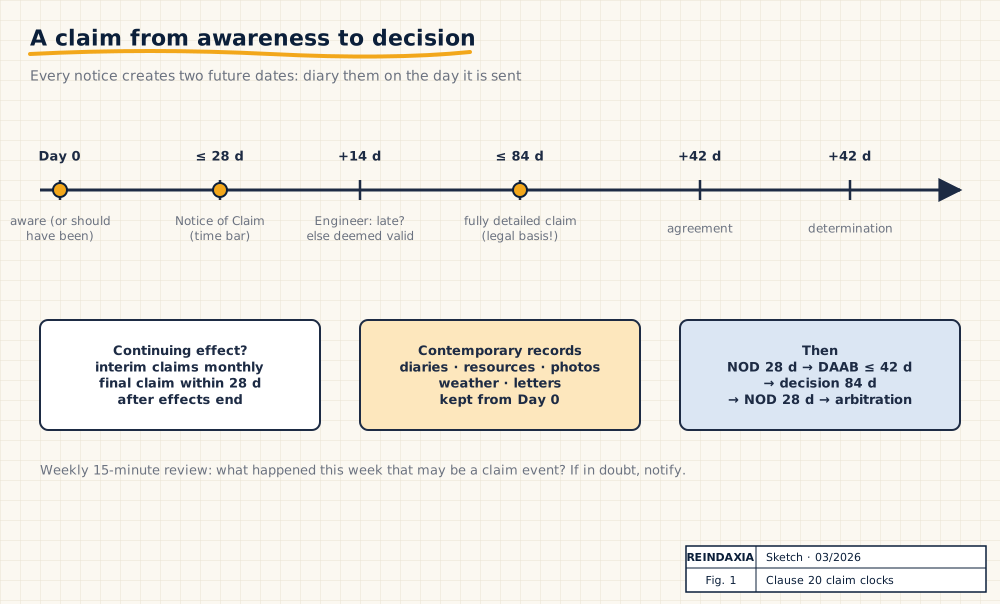 Figure 1. A claim from awareness to decision: the 28, 14, 84 and 42 + 42 day clocks.
Employers claim too
The 2017 edition puts employer claims under the same rules. Delay damages, costs of remedying defects the contractor failed to correct, back-charges for utilities or services, extensions of the Defects Notification Period: all require a timely Notice of Claim and a fully detailed claim. Public employers often apply deductions directly in payment certificates without following this route. Under the 2017 conditions, the employer’s entitlement to be paid, or to reduce the price, has to be established through the same procedure, agreed or determined by the Engineer, before it is reflected in a payment certificate; an unnotified employer claim is exposed to the same time bar as a contractor’s.
The claims register
A register is not a legal document; it is a management tool that makes time limits visible. We recommend that both parties keep one, and that the Engineer keep its own. A workable set of fields:
| Field | Purpose |
|---|---|
| Event reference and short title | One line per event, never merged |
| Date of event and date of awareness | The 28-day clock runs from awareness |
| Source | Site diary, letter, meeting, inspection, report |
| Clause(s) potentially relied on | Early view of entitlement |
| Notice of Claim: due date, date sent, reference | The time bar check |
| Engineer’s response on timeliness: due date, received | 14-day window |
| Records instructed or kept | Location of evidence |
| Fully detailed claim: due date, date sent | 84-day check |
| Continuing effect? Interim claims sent | Monthly rhythm |
| 3.7 dates: agreement deadline, determination deadline | The Engineer’s clock |
| Outcome: agreed / determined / NOD / DAAB | Status at a glance |
| Amount and days claimed / agreed | Exposure and settlement |
The register is reviewed weekly, in a short meeting between the site manager and the contract manager. The question is simple: what happened this week that may be a claim event? Anything uncertain is notified. A notice costs a letter; a missed notice may cost the entitlement.
Quality of notices, not quantity
The opposite failure exists. Some contractors notify every event, in vague terms, as a precaution. The Engineer’s office fills with hundreds of notices, none substantiated, and the useful ones are lost among them. A good notice is short, specific and timely: which event, when it occurred, which work it affects, and why it may give rise to an entitlement. Its credibility depends on the claims that follow it.
What we recommend
Separate operational and contractual communication. Minutes and reports inform; notices notify. Use the form and the wording the contract requires.
Train site managers to recognise claim events, not to draft claims. The contract manager does the drafting.
Set the calendar on day one: every notice creates two future dates, 84 days for the claim and 14 days for the Engineer’s response.
Keep records as if the claim will be read by a stranger. Eventually it may be, at the DAAB.
For employers: notify your own claims, and resist applying unnotified deductions.
Our view
The FIDIC claims procedure is demanding, but fair: it treats both parties alike and resolves matters while the works continue. The parties that suffer from it are those that treat it as a legal exercise for the end of the project. The parties that benefit are those that run it as a weekly management routine.
References
- FIDIC, Conditions of Contract for Construction (Red Book), Second Edition, 2017, Sub-Clauses 1.3, 3.7, 4.20, 8.3, 13.3, 14.6, 20.1, 20.2 and 21.4.
- FIDIC, FIDIC Golden Principles, First Edition, 2019 (Principle GP4 on reasonable time limits).
- Society of Construction Law, Delay and Disruption Protocol, Second Edition, 2017 (records and notices).
This article is a general commentary and not legal advice. The wording of the FIDIC forms is protected by copyright; refer to the official FIDIC publications and to the Particular Conditions of your contract.
Reindaxia sets up claims registers and notice procedures, prepares and reviews claims, and trains site and contract teams on FIDIC contracts. Talk to us.