In short. The 2017 FIDIC contracts replaced the ad hoc dispute board of many earlier projects with a standing Dispute Avoidance/Adjudication Board, appointed at the start and visiting the site regularly. Its decisions are binding unless overturned. But its most useful power is the one most rarely used: informal assistance, at the joint request of the parties, on issues that have not yet become disputes. This article explains how the board works and how to use it as a prevention tool, particularly on public projects where the board is often seen as an avoidable cost.
The board that met twice
The contract provided for a three-member board. It was appointed eight months late, after the contractor reminded the employer twice. It met once for an introductory visit. The parties, satisfied that “there was no dispute”, cancelled the next visits to save fees.
Eighteen months later the project had accumulated a delay claim, a disagreement on the valuation of a major variation and a defects dispute. All three were referred to the board within a few weeks of each other. The members, who had seen the site once at an early stage, had to learn the project from the submissions. The decisions took the full time allowed, were challenged by both sides, and the matter moved towards arbitration.
The members themselves said afterwards that two of the three issues could probably have been resolved with an informal discussion a year earlier, when they first appeared in the progress reports.
From adjudication to avoidance
Earlier FIDIC editions already used dispute boards, but the 1999 Red Book board was often set up only when a dispute arose. The 2017 edition makes three changes:
- the board is a standing body, appointed at the start of the contract and remaining in place until the end;
- its name reflects a dual role: avoidance first, adjudication if needed;
- its work is framed by detailed Procedural Rules and a tripartite DAAB Agreement, annexed to the conditions.
FIDIC’s Golden Principles insist on this point: disputes should go to a dispute board before arbitration, unless that conflicts with the governing law.
Appointment and costs
Under Sub-Clause 21.1, the parties jointly appoint the board within the time stated in the Contract Data, 28 days after the contractor receives the Letter of Acceptance if nothing is stated. The board has one or three members, as the Contract Data provide; three if they say nothing. For a three-member board, each party selects one member for the other’s agreement, and the parties agree the chair after consulting those two. Members are chosen from a list in the Contract Data when one is provided. The board is constituted when the parties and the members have all signed the DAAB Agreement. Each party pays half of the members’ fees.
If a party fails to agree an appointment, Sub-Clause 21.2 allows the appointing entity named in the Contract Data to appoint. If no board is in place when a dispute arises, Sub-Clause 21.8 allows the dispute to go directly to the final forum.
A practical point for public employers: the selection of board members should be prepared during tendering. A list of proposed members in the Contract Data, agreed procedures for fee approval and a budget line for the board avoid the months of delay we see when appointment begins only after contract signature.
How the board stays informed
The Procedural Rules ask the board to become and remain informed about the project and any actual or potential disagreement. Soon after appointment it holds a face-to-face meeting with the parties and sets a schedule of meetings and site visits. Visits take place at intervals of no more than 140 days and no less than 70 days, unless the parties and the board agree otherwise, and can be supplemented by video meetings. The parties send the board the documents it needs to follow the project, typically progress reports, programme updates and key correspondence.
These visits are not a formality. They are the board’s only way to understand the project before it is asked to decide something about it. Cancelling them to save money is the most expensive saving we know.
Informal assistance: the avoidance tool
Sub-Clause 21.3 allows the parties, if they agree, to jointly ask the board, in writing with a copy to the Engineer, to help them or to discuss informally any issue or disagreement. The board may itself invite them to do so when it becomes aware of an issue. The assistance may take place during a meeting, a site visit or otherwise, with both parties present. It may not be requested while the Engineer is dealing with the same matter under Sub-Clause 3.7, unless the parties agree.
Two features make this tool safe to use. The parties are not bound by any advice given. And the board is not bound by its informal views in any later decision. The informal discussion therefore costs little in legal terms: neither party gives anything away, and both hear how three experienced people read the contract and the facts.
In our experience, the issues best suited to informal assistance are those where the parties disagree on the reading of the contract rather than on facts: whether a ground condition was foreseeable, how a specification requirement should be interpreted, which delay analysis method applies, whether a performance shortfall justifies rejection or a price reduction. An hour of discussion often brings the parties close enough to settle through the Engineer.
When a dispute arises
If a disagreement becomes a dispute, the procedure of Sub-Clause 21.4 applies:
| Step | Time limit |
|---|---|
| Referral to the board after a Notice of Dissatisfaction with the Engineer’s determination | Within 42 days of the NOD, otherwise the NOD lapses |
| Board’s decision | Within 84 days of the referral, or another period proposed by the board and agreed |
| Notice of Dissatisfaction with the decision | Within 28 days of receiving it; without one, the decision becomes final and binding |
| Amicable settlement attempt | Arbitration may start from the 28th day after the NOD |
The decision is binding from the moment it is given. The parties must comply promptly, even if one of them gives a Notice of Dissatisfaction. An amount the board awards is immediately due, without certification. Where there are reasonable grounds to fear the payee could not repay if the decision were later reversed, the board may require security. A party that fails to comply may be taken directly to arbitration to enforce the decision under Sub-Clause 21.7.
The board’s proceedings are not an arbitration. They are faster, less formal and cheaper, and in many jurisdictions their decisions are respected in practice even when challenged.
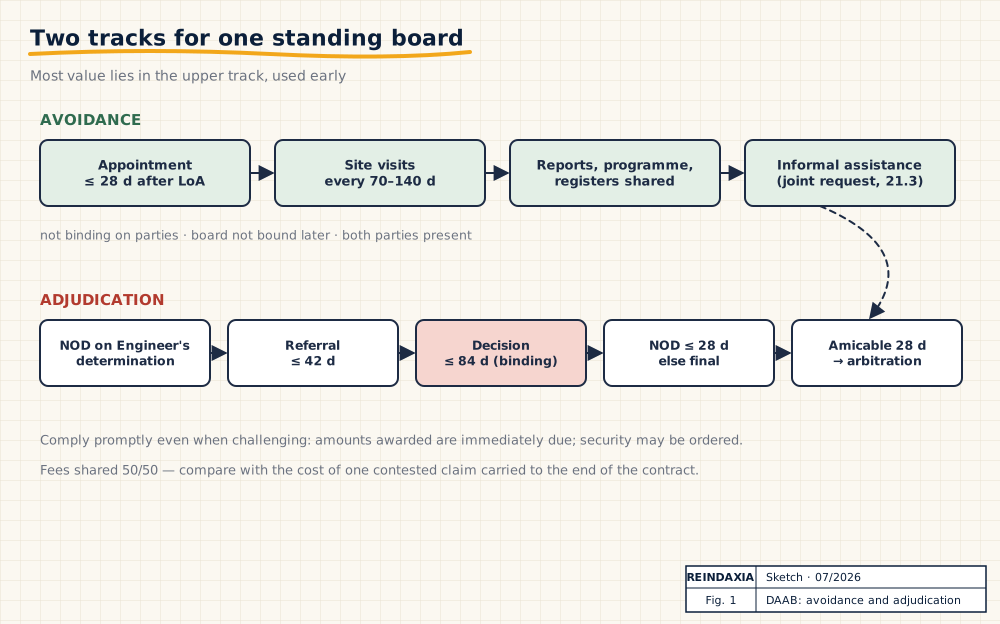 Figure 1. The two tracks of a standing DAAB: avoidance first, adjudication if needed.
Particular considerations for public employers
Public employers raise three recurring objections to the board.
“It costs too much.” The fees of a three-member board are typically a small fraction of the contract value, shared equally with the contractor. They should be compared with the cost of one contested claim taken to the end of the contract and then to court.
“Our law does not allow it.” Public procurement and arbitration rules vary between countries, and in some, public entities face restrictions on arbitration. The board itself is not an arbitral tribunal. Its decisions are contractual. The Particular Conditions should define the final forum (national courts or arbitration) in accordance with the governing law and any financing agreement, and fit the board and any national amicable settlement body into a clear sequence. Removing the board altogether breaches the Golden Principles and, on bank-financed projects, is usually not accepted by the lender.
“Decisions will be made by outsiders.” The opposite is true: a standing board that visits regularly knows the project better than any judge or arbitrator ever will, and its decisions can be challenged.
How to get value from the board
Appoint it on time. Prepare the list of members and the fee approval during tendering.
Keep it informed. Send monthly reports and programme updates; maintain the visit schedule.
Put avoidance on the agenda. At each visit, review the claims register and the early warning register together and ask: which of these could use the board’s informal view?
Use the Engineer first. The board does not replace the Engineer’s determinations. It helps where the Engineer’s process has stalled or where the parties need an independent reading.
Comply with decisions, even when you intend to challenge them. Non-compliance damages credibility and invites enforcement.
Our view
The DAAB is the 2017 edition’s most visible statement that disputes are better prevented than decided. Its value lies less in its decisions than in its presence: a small group of experienced people who know the project, visit it regularly and are available to discuss problems early. On the projects where we have seen boards used this way, few formal referrals were ever needed.
References
- FIDIC, Conditions of Contract for Construction (Red Book), Second Edition, 2017, Clause 21 and the appendix General Conditions of Dispute Avoidance/Adjudication Agreement with its Procedural Rules.
- FIDIC, FIDIC Golden Principles, First Edition, 2019 (Principle GP5).
- FIDIC, Conditions of Contract for Construction, MDB Harmonised Edition (Pink Book), 2010, Clause 20 (Dispute Board).
- Dispute Resolution Board Foundation, Practices and Procedures, for practical guidance on board operation.
This article is a general commentary and not legal advice. The wording of the FIDIC forms is protected by copyright; refer to the official FIDIC publications and to the Particular Conditions of your contract.
Reindaxia helps employers and contractors prepare dispute board provisions, keep boards informed, and present issues for informal assistance or decision on FIDIC contracts. Talk to us.