In short. Sub-Clause 3.7 is the engine of the Red Book: whenever the contract says the Engineer shall “agree or determine”, the parties get a structured, time-limited route to a decision that binds them unless challenged. The 2017 edition made the Engineer explicitly neutral for this purpose and put the process on two 42-day clocks. On public projects the clause often fails for practical reasons: an under-resourced supervision team, an employer that expects its consultant to side with it, and files built too late. This article explains how the process works and offers outline templates we use with Engineer teams.
Eleven determinations in one month
The supervision consultant had been on the project for two years without issuing a single determination. Claims arrived, were acknowledged, discussed in progress meetings and then left aside, “pending the employer’s position”. Then the contractor’s lawyer sent a short letter pointing out that, under the contract, the time limits had expired and the matters were now disputes that could go straight to the dispute board.
In the following month the Engineer issued eleven determinations, most of them hastily assembled. Three were challenged within days. The others became binding, including two that the employer would have contested had it read them carefully.
None of this was inevitable. The process was in the contract from the start; it simply had not been run.
What the clause asks of the Engineer
The Red Book has always given the Engineer a double role: acting for the employer in administering the contract, and deciding fairly when the parties disagree. The 2017 edition draws a clearer line. When carrying out duties under Sub-Clause 3.7, the Engineer must act neutrally between the parties and is not deemed to be acting for the employer. Sub-Clause 3.2 adds that no employer consent may be required before the Engineer agrees or determines.
The process has two stages.
Consultation. The Engineer consults the parties, jointly or separately, and encourages discussion with a view to reaching agreement. If agreement is reached, the Engineer gives both parties a notice recording it (the contract calls it a “Notice of the Parties’ Agreement”), with a copy of the agreement signed by both.
Determination. If no agreement is reached within the time limit, or both parties say it cannot be reached, the Engineer notifies them and then makes a fair determination in accordance with the contract, taking due regard of all relevant circumstances. The “Notice of the Engineer’s Determination” describes the decision in detail, with reasons and detailed supporting particulars.
The clocks
The 2017 edition replaced the old “reasonable time” with explicit limits, which the parties may extend by agreement:
| Step | Time limit | If the Engineer does not act |
|---|---|---|
| Consultation to agreement | 42 days from the commencement date for the matter | Deemed that no agreement was reached |
| Determination | 42 days after the Engineer’s obligation to proceed arises (end of the agreement period, or earlier if both parties say agreement is impossible) | For a claim: deemed rejected. For any other matter: deemed a Dispute, which may be referred to the DAAB without a Notice of Dissatisfaction |
| Correction of a clerical or arithmetical error | Reported within 14 days of the notice; corrected within 7 days | |
| Notice of Dissatisfaction | 28 days after receiving the determination | Determination becomes final and binding |
The commencement date depends on the matter. For a claim under Clause 20 it is the date the Engineer receives the fully detailed claim (or, for continuing events, an interim claim). For a variation it is the date the contractor’s particulars are received. For other matters it is the date stated in the sub-clause that calls for the agreement or determination.
Two features deserve attention. First, a party may dissatisfy only part of a determination; the rest becomes final and binding if it can stand alone. Second, an agreement or determination is binding on both parties unless and until it is corrected or revised under the disputes clause; where it concerns money, the amount goes into the next statement and payment certificate. A determination is therefore not an opinion: it moves money and time.
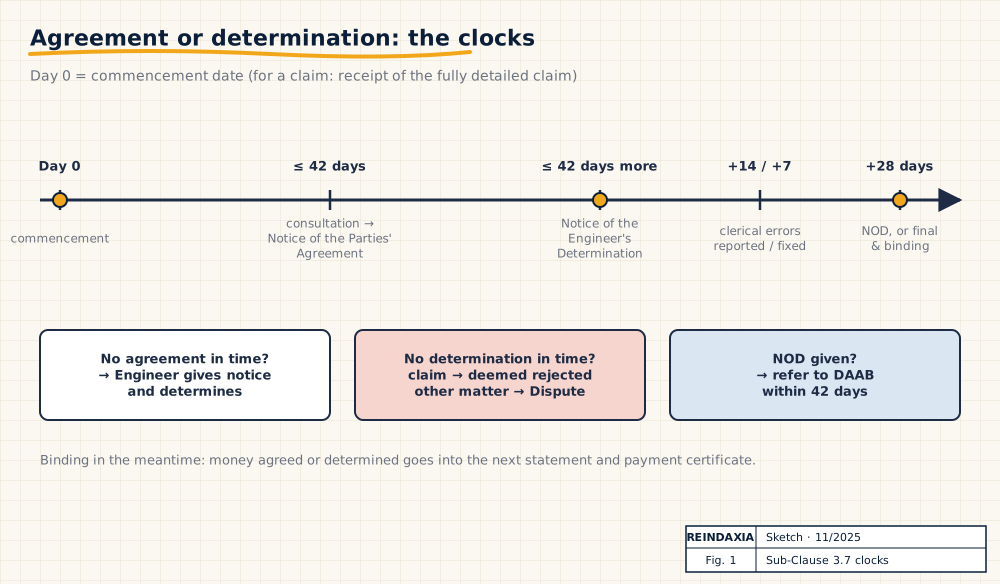 Figure 1. The 3.7 clocks: consultation, determination, error correction and Notice of Dissatisfaction, with the deemed outcomes.
Where it goes wrong on public projects
The Engineer is not independent in fact. Many public employers appoint a supervision consultant on a services contract they also manage. The consultant’s fees, extension and future work depend on the employer. Neutrality in the contract does not create neutrality in practice. The employer can help by stating clearly, at the kick-off meeting, that it expects fair determinations, and by keeping its own challenge route, the Notice of Dissatisfaction, rather than pressing the Engineer.
The team is too small. A determination on a delay claim requires programme analysis, records review and quantum checks. A supervision contract staffed for inspection rarely includes a planner or a quantity surveyor with time for this. The supervision terms of reference should say so.
Files are built when the clock is already running. If the Engineer starts collecting records on the day the fully detailed claim arrives, 84 days will not be enough. The groundwork, contemporary records, programme updates, daily reports, should already be organised.
Determinations are written like letters. A good determination reads like a short judgement: the issue, the parties’ positions, the contractual basis, the facts found, the analysis and the outcome. Anything less invites a challenge.
Outline templates
The FIDIC wording is protected and each contract has its own Particular Conditions, so these are structures rather than ready-to-sign texts. Adapt them to the contract in hand.
Template 1: Notice commencing the procedure (non-claim matters)
- Reference: “Notice under Sub-Clause 3.7”, contract, number, date.
- Matter: one paragraph identifying the issue and the sub-clause that calls for agreement or determination.
- Commencement date for the purposes of the time limits.
- Consultation arrangements: proposed meeting dates, joint or separate, documents each party is invited to provide by a stated date.
- Reminder of the time limit for agreement.
Template 2: Notice of agreement
- Reference: “Notice of the Parties’ Agreement” under Sub-Clause 3.7.1.
- Matter and commencement date.
- Terms agreed, stated precisely: amount, currency, extension of time in days, revised milestone dates, any conditions.
- Statement of what the agreement settles and what it does not (for example, time agreed, cost reserved).
- Signatures of both parties, then of the Engineer.
Template 3: Notice of no agreement
- Reference to the matter and the consultation held (dates, attendees).
- Statement that agreement has not been reached within the time limit, or that both parties have said it cannot be.
- Statement that the Engineer will proceed to a determination, with the date by which it will be issued.
Template 4: Notice of determination
- Heading: “Notice of the Engineer’s Determination” under Sub-Clause 3.7.2, matter, commencement date, dates of consultation.
- The issue: what is to be determined, in one or two sentences.
- Contractual basis: sub-clauses relied on, and any Particular Conditions.
- Positions of the parties: a fair summary of each, with references to their submissions.
- Facts found: chronology, records relied on, and where the Engineer preferred one version to another, why.
- Analysis: entitlement first, then time (with reference to the accepted programme and the critical path), then cost (method, rates, quantities, profit where applicable).
- Determination: the outcome, stated so that it can be implemented: amount in the next payment certificate, revised Time for Completion, conditions.
- Notices: the 14-day period for reporting clerical errors and the 28-day period for a Notice of Dissatisfaction.
- Annexes: list of documents relied on.
Template 5: Determination file checklist
A file opened as soon as a Notice of Claim is received, and completed before the 84-day fully detailed claim arrives:
- Notice of Claim and the Engineer’s response on timeliness (the Engineer has 14 days to notify a late notice under Sub-Clause 20.2.2);
- records instructed under Sub-Clause 20.2.3, and site diaries, photographs, weather and resource data for the period;
- accepted programme and the updates before and after the event;
- correspondence and meeting minutes on the subject;
- relevant measurement and cost data;
- internal log of consultation meetings and their outcome.
A word on the employer’s side
An employer who disagrees with a determination has a remedy: a Notice of Dissatisfaction within 28 days, followed by referral to the DAAB within 42 days. Using it is not a failure. What damages a project is the alternative we still see: pressure on the Engineer, determinations that never come, and claims that drift until the end of the contract and then arrive together. The employer gains nothing by delaying a determination; it only loses the chance to contest it on time.
Our view
Sub-Clause 3.7 turns disagreements into decisions while the works are still running, when facts are fresh and records are available. It asks three things of the Engineer: independence, method and resources. On public projects, the best investment we know is a supervision contract that funds a small contract team, planner, quantity surveyor and contract engineer, alongside the inspectors. It costs little against the value of a single badly handled claim.
References
- FIDIC, Conditions of Contract for Construction (Red Book), Second Edition, 2017, Sub-Clauses 3.2, 3.5, 3.7, 20.2 and 21.4.
- FIDIC, FIDIC Golden Principles, First Edition, 2019 (Principle GP1).
- FIDIC, Client/Consultant Model Services Agreement (White Book), Fifth Edition, 2017, for the supervision consultant’s appointment.
This article is a general commentary and not legal advice. The wording of the FIDIC forms is protected by copyright; refer to the official FIDIC publications and to the Particular Conditions of your contract.
Reindaxia supports Engineer teams and employers on FIDIC contracts: determination files, claims review, programme analysis and training of supervision staff. Talk to us.