In short. Under the 2017 Red Book, time is managed through three documents that are easy to treat as formalities: the programme, the monthly progress report and the advance warning. Used properly, they give both parties a shared baseline, an honest picture of where the works stand, and an early signal when something threatens the completion date. Used as paperwork, they produce exactly the opposite: a disputed baseline, reports nobody reads, and delay claims argued from memory at the end of the project.
Two programmes on the same wall
At a monthly meeting on a water infrastructure project, the contractor’s planner and the Engineer’s planner each brought a bar chart. Both claimed to show the “current programme”. They differed by five months on the completion date.
The contractor’s version was the initial programme, submitted in the first weeks, updated with actual dates but never formally resubmitted. The Engineer’s version was the same programme, which the Engineer had rejected by letter eight months earlier, with comments the contractor considered unfounded. Since then each side had maintained its own.
When the first extension of time claim arrived, there was no agreed baseline to measure the delay against. The claim took a year to settle.
What the contract requires of the programme
Sub-Clause 8.3 asks the contractor to submit an initial programme within 28 days of receiving the notice of commencement, using the software stated in the specification. The list of required content is long and deliberate. In substance, the programme must show:
- the Commencement Date and the Time for Completion, for the works and each Section;
- the dates of access to and possession of each part of the site;
- the intended sequence of the works, including Contractor’s Documents, procurement, manufacture, inspection, delivery, construction and testing;
- the review periods for submissions stated in the specification or the conditions;
- the sequence and timing of inspections and tests;
- all activities, logically linked, with early and late dates, float and the critical path;
- local rest days and holidays, and key delivery dates of plant and materials;
- for revised programmes, actual progress, delays and their effects, and any remedial work;
- a supporting report: main stages, methods, estimated resources per stage, significant changes and proposals to overcome delays.
The Engineer reviews it. If the Engineer gives no notice of non-compliance within 21 days for the initial programme, or 14 days for a revision, a Notice of No-objection is deemed given and the submission becomes the Programme, with a capital P. When the Engineer does give notice, the contractor has 14 days to resubmit. The contractor must also submit a revised programme whenever the current one no longer reflects actual progress.
Two sentences in the sub-clause are often overlooked. The employer’s personnel may rely on the Programme to plan their own activities, which makes it the reference for access dates, design approvals and interfaces with other contractors. And nothing in a programme or its supporting report counts as a Notice under the contract: a delay shown on a chart is not a claim.
What makes a programme reviewable
Our review checklist for an initial programme, built from many such reviews, is short:
- Logic, not dates. Every activity has a predecessor and a successor, except the start and finish. Hard constraints are few and justified.
- A credible critical path that runs from start to finish through work that really drives completion, not through an artificial constraint.
- Float that is visible and not hidden in inflated durations or preferential logic.
- Contract dates embedded: access dates, review periods, inspection and test hold points, milestones and Sections.
- Resources consistent with durations: quantities, productivity assumptions and crew numbers in the supporting report.
- A level of detail that matches the specification, typically fine enough to measure progress monthly, coarse enough to be maintained.
The Engineer’s review should state precisely what does not comply and why. A general rejection gives the contractor nothing to correct and leaves the project without a Programme, which is what happened in our example.
The monthly progress report
Sub-Clause 4.20 requires a progress report each month, within 7 days after the end of the month, until completion (or until outstanding work listed in the Taking-Over Certificate is finished). Its content, unless the specification says otherwise, covers progress at each stage from Contractor’s Documents to testing, photographs, manufacturing status of main plant items, personnel and equipment records, quality documents and test results, a list of variations and notices of claim, health, safety and environmental statistics, and a comparison of actual and planned progress with the events that may affect completion and the measures taken.
That last item is the heart of the report. Here too, the contract is explicit: nothing in a progress report constitutes a Notice.
In practice, we recommend that the report be built around a small set of stable indicators so that one month can be compared with the next:
| Indicator | What it shows |
|---|---|
| Planned versus actual physical progress, by area and discipline | Whether the gap is growing or closing |
| Critical path and float consumed since the last update | Whether the completion date is under threat |
| Contractor’s Documents submitted, under review, with no-objection | Upstream bottleneck for procurement and construction |
| Main plant items: manufacturing and delivery forecast | Supply-chain risk |
| Open non-conformities and inspection results | Quality debt that will surface at testing |
| Variations and notices of claim, with status | Commercial exposure |
The Engineer’s response to the report matters as much as the report itself. A short written commentary each month, agreeing or questioning the stated progress and the forecast, prevents the slow divergence that ends with two programmes on the same wall.
Advance warning: the sub-clause that changes behaviour
Sub-Clause 8.4 is short and new in the 2017 edition. Each party must advise the other, and the Engineer, and the Engineer must advise the parties, in advance, of known or probable future events that may adversely affect the contractor’s work, the performance of the completed works, the contract price, or the completion date. The Engineer may then request a proposal under the variation procedure to avoid or reduce the effect.
The duty applies to both parties and to the Engineer. An employer that knows a land expropriation will be late, or that a utility diversion has not been budgeted, is bound to say so. A contractor that sees a supplier failing must say so before the delivery date passes.
Advance warning is not a Notice of Claim. It does not start the 28-day clock under Clause 20 and does not replace it. Its purpose is to bring problems to the table while there is still time to act. The best projects we have seen handle it as a standing item: a short early warning register, reviewed at each progress meeting, with an owner and a decision for each line.
| Field | Content |
|---|---|
| Reference and date raised | Who raised it, and to whom |
| Description | The event or circumstance, and why it is expected |
| Potential effect | Work, performance, price, time: a first estimate |
| Proposed action | Mitigation, request for proposal, decision required |
| Owner and due date | One name |
| Link to Notice of Claim | If the event materialises and a claim is notified, its reference |
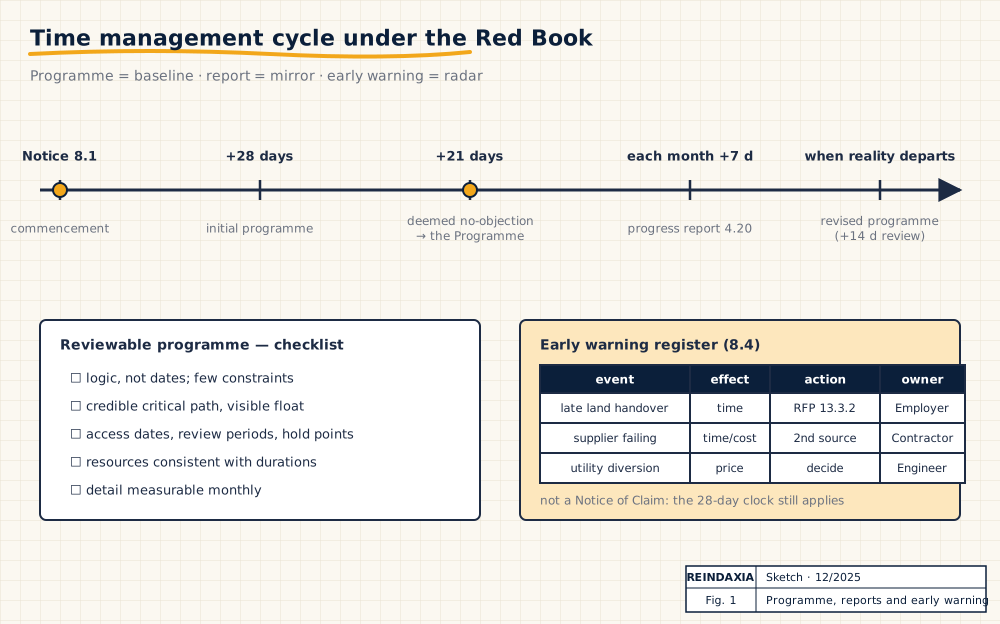 Figure 1. The time management cycle: programme dates, a reviewability checklist and an early warning register.
Delay, extensions and acceleration
The programme is what gives meaning to the other time provisions. Sub-Clause 8.5 lists the causes that entitle the contractor to an extension of time, subject to the claims procedure, except for variations, where no claim notice is needed. It also allows the Engineer, when measured quantities fall well below the estimates, to take account of the favourable effect on the critical path, without ever reducing the Time for Completion overall. On concurrent delay, the conditions defer to rules stated in the Special Provisions and otherwise to an assessment taking due regard of all relevant circumstances. A public employer should decide which delay analysis method it expects and write it into the Particular Conditions; leaving the point open guarantees a dispute about method before any dispute about facts.
Where progress is too slow for reasons that do not give rise to an extension, Sub-Clause 8.7 lets the Engineer instruct a revised programme showing how the contractor will recover, at its own cost. Without an accepted Programme, that instruction has no reference to work from.
What we recommend
For employers: state the programming software, the level of detail and the delay analysis method in the specification; staff the Engineer with a planner; and answer access and design obligations on the dates the Programme shows.
For Engineers: review programmes on time and in specific terms; respond to each monthly report in writing; run the early warning register.
For contractors: submit a programme that you would be prepared to defend in front of a dispute board; update it every time reality departs from it; never rely on a chart or a report in place of a Notice.
Our view
A Programme with a no-objection, kept current, is worth more than any delay analysis performed after the fact. It is the one document that both parties have accepted as a description of the future, and therefore the only fair yardstick when the future turns out differently.
References
- FIDIC, Conditions of Contract for Construction (Red Book), Second Edition, 2017, Sub-Clauses 4.20, 8.1, 8.3, 8.4, 8.5, 8.7 and 20.2.
- Society of Construction Law, Delay and Disruption Protocol, Second Edition, 2017.
- AACE International, Recommended Practice 29R-03, Forensic Schedule Analysis.
- ISO 21502:2020, Project, programme and portfolio management — Guidance on project management.
This article is a general commentary and not legal advice. The wording of the FIDIC forms is protected by copyright; refer to the official FIDIC publications and to the Particular Conditions of your contract.
Reindaxia reviews programmes, builds progress reporting and early warning systems, and supports delay analysis on FIDIC contracts. Talk to us.