In short. The 2017 Red Book made quality a contractual system rather than a set of inspections. Sub-Clause 4.9 requires the contractor to prepare a quality management system specific to the works, submit it within 28 days, audit it at least every six months, and run a compliance verification system that ends with a complete set of documents proving conformity. This article translates those obligations into the tools a quality engineer actually uses: a project quality plan, inspection and test plans, notices and records, and a dossier that is built from day one rather than reconstructed at the end.
The binder that arrived last
The works were finished. The taking-over inspection went well. Then the Engineer asked for the compliance verification documentation for the first Section, and the contractor’s quality manager asked for three weeks.
It took four months. Material certificates were in the procurement department, scattered by purchase order. Concrete test results were with the laboratory subcontractor. Inspection records existed, but many carried no reference to the drawing revision they had been checked against. Some hold points had been released by telephone. Nothing was missing in the sense that the work had not been done; a great deal was missing in the sense that it could not be proved.
The quality system on that project had been certified, audited and approved. It had not been designed for the contract.
What Sub-Clause 4.9 requires
The sub-clause has three parts.
The QM System (4.9.1). The contractor prepares and implements a quality management system specifically for the works, to demonstrate compliance with the contract, and submits it to the Engineer within 28 days of the Commencement Date, then every update. It must follow any details in the specification and include procedures for three things: tracing every notice, Contractor’s Document, as-built record, manual and contemporary record to the work it relates to, “with full certainty”; managing interfaces between stages of the work and between subcontractors; and submitting Contractor’s Documents for review.
The Engineer may review it and give notice of non-compliance; the contractor then has 14 days to revise it. Without a notice within 21 days, no-objection is deemed given. At any time, the Engineer may notify a failure to implement the system, which the contractor must remedy immediately. The contractor carries out internal audits at least every 6 months and sends a report within 7 days of each one, with corrective measures. If the contractor’s certification involves external audits, any failings identified must be notified to the Engineer.
The Compliance Verification System (4.9.2). The contractor runs a system to demonstrate that design (where applicable), materials, plant, work and workmanship comply in all respects. It includes a method for reporting the results of all its inspections and tests. Any non-compliance triggers the defects and rejection procedure of Sub-Clause 7.5. At the end, the contractor submits a complete set of compliance verification documentation for the works or each Section, compiled as the specification describes.
No relief (4.9.3). Complying with these systems does not relieve the contractor of any obligation. A signed inspection record does not make a defective weld acceptable.
From obligation to tools
The project quality plan
The QM System required by the contract is, in practice, a project quality plan in the sense of ISO 10005: a document that says how the organisation’s general system applies to this contract. ISO 9001 certification is a good starting point; it is not a substitute, because the contract asks for something specific to the works.
A plan that satisfies 4.9.1 typically covers:
| Section | What it must say for this contract |
|---|---|
| Scope and organisation | Works, Sections, key personnel, quality authority independent of production |
| Document control | Numbering, revision status, transmittals, review periods stated in the specification |
| Traceability | How each record is tied to an item, location, drawing revision and test |
| Interfaces | Between design, procurement, construction and testing; between subcontractors; with other contractors on site |
| Procurement and suppliers | Supplier qualification, shop inspection, release for shipment, receipt inspection |
| Inspection and testing | ITP list, hold and witness points, notification rules, calibration |
| Non-conformities | Recording, disposition, remedial proposal under 7.5, closure |
| Audits | Internal audit programme (at least every 6 months), reporting within 7 days |
| Compliance verification documentation | Structure of the final dossier, built progressively |
Inspection and test plans
The ITP is where the contract becomes a sequence of checks. For each work type (earthworks, concrete, steel, piping, electrical, instrumentation, equipment installation), it lists the activities, the acceptance criteria with their reference (specification clause, standard, drawing), the verifying document, and who intervenes at each step.
The three intervention codes most projects use deserve precise definitions in the plan itself:
- Hold point: work does not proceed beyond this step without the Engineer’s attendance or written release.
- Witness point: the Engineer is notified and may attend; work proceeds if the Engineer does not.
- Review point: the Engineer reviews records after the fact.
These codes must be read with the contract. Under Sub-Clause 7.3, the contractor gives notice whenever work is ready for inspection and before it is covered up; if the Engineer does not attend at the stated time, the contractor may proceed, and if the contractor fails to notify, it must uncover the work at its own cost when required. Under Sub-Clause 7.4, the Engineer gives at least 72 hours’ notice of intention to attend tests; if the Engineer does not attend, the tests are deemed to have been made in the Engineer’s presence and the readings accepted. A hold point that the contract does not support is unenforceable; a contract right that the ITP ignores is lost in practice. The ITP should reconcile the two, and the Particular Conditions or specification should give contractual force to any genuine hold points.
Notices and records
Every inspection request is a notice under the contract. It should identify the item, location, drawing and revision, ITP step and proposed time. The record that follows carries the same references and the result. This is what “traced with full certainty” means on site: a reviewer, years later, can go from a pipe spool to its weld map, welder qualification, NDT report, material certificate and test pack, and back.
Non-conformities
Sub-Clause 7.5 sets the sequence: the Engineer notifies the defect, the contractor promptly proposes remedial work, the Engineer may object (deemed no-objection after 14 days), and the remedied work may be retested at the contractor’s risk and cost. A non-conformity register that mirrors these steps, with dates, makes the contractual position visible at any time and feeds the monthly progress report, which under Sub-Clause 4.20 must include quality documents, inspection reports and test results.
Internal audits
The six-month minimum is a floor. On a project with several subcontractors and an intense construction phase, we plan audits by process and by subcontractor, at a rhythm that lets corrective actions take effect before the next phase. Each audit report reaches the Engineer within seven days. Treated honestly, these reports are the contractor’s best defence: they show a system that finds and fixes its own problems.
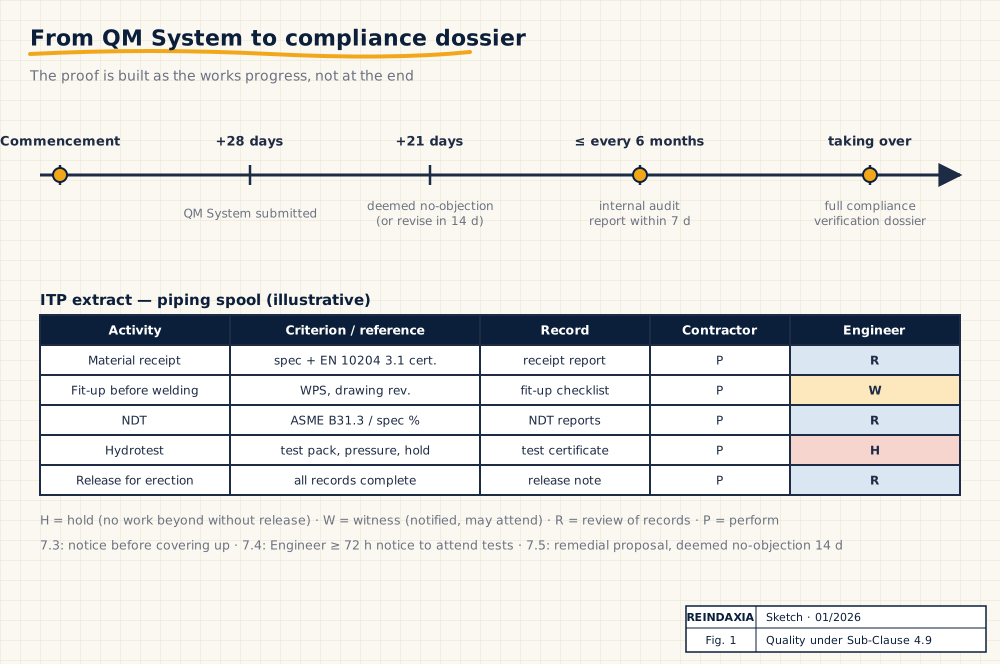 Figure 1. Sub-Clause 4.9 dates and an illustrative ITP extract with hold, witness and review points.
The compliance verification documentation
The final dossier is the reason for everything above. It should be built progressively, subsystem by subsystem or Section by Section, and reviewed as it grows. A practical structure follows the physical works rather than the organisation: for each area or system, the drawings at as-built status, the ITP with each step signed, the records and certificates in the order of the ITP, non-conformities and their closure, and test results.
The dossier also matters for taking over. Under Sub-Clause 10.1, taking over requires the works to be completed in accordance with the contract, including passing the Tests on Completion, and, where applicable, no-objection to the as-built records and to the operation and maintenance manuals. A compliance dossier that is 90 % complete at the end of construction makes those steps routine; one that starts at the end makes them the critical path.
What we recommend
Write the plan for the contract, not for the certificate. Start from the specification and the conditions, then map the corporate procedures onto them.
Reconcile ITPs with Clauses 7 and 4.9 before the first inspection. Agree the codes, the notice periods and the record formats with the Engineer.
Make traceability a field discipline. Drawing revision and ITP step on every record; no release by telephone.
Build the dossier as the works progress, and include its completeness in the monthly report.
Use audits to find problems early, and report them as the contract requires.
Our view
Sub-Clause 4.9 did not invent quality management; it gave it a place in the contract and a deadline. For a contractor, that is an opportunity: a well-run system shortens taking over, reduces disputes about defects and protects against claims. For an employer and its Engineer, it is a tool to require proof rather than promises. In both cases, the work is the same: plan the checks, record them so they can be traced, and assemble the proof as you go.
References
- FIDIC, Conditions of Contract for Construction (Red Book), Second Edition, 2017, Sub-Clauses 4.9, 4.20, 7.3, 7.4, 7.5, 7.6 and 10.1.
- ISO 9001:2015, Quality management systems — Requirements.
- ISO 10005:2018, Quality management — Guidelines for quality plans.
- ISO 19011:2018, Guidelines for auditing management systems.
- ISO 10006:2017, Quality management — Guidelines for quality management in projects.
This article is a general commentary and not legal advice. The wording of the FIDIC forms is protected by copyright; refer to the official FIDIC publications and to the Particular Conditions of your contract.
Reindaxia prepares project quality plans and ITPs, sets up compliance verification systems, audits contractors and assembles handover dossiers on FIDIC projects. Talk to us.