In short. The last phase of a FIDIC contract is governed by three clauses that are often read separately: Clause 9 on Tests on Completion, Clause 10 on taking over, and Clause 11 on defects. For a quality engineer they form a single sequence: prove performance, accept the works with a controlled list of reservations, then follow those reservations and any new defects until the Performance Certificate. The 2017 edition adds firm time limits and documentary preconditions at each step. Projects that prepare this sequence from the start hand over in weeks; those that discover it at the end can take months.
Accepted, but not quite
The pumping station had passed its tests. The Engineer issued the Taking-Over Certificate, and attached to it a list of outstanding work and defects: 340 items. Some were cosmetic, a few were not, including a vibration level on one pump close to the acceptance limit and a missing set of as-built drawings for the electrical room.
A year later, at the end of the Defects Notification Period, 60 items were still open. Nobody had tracked the list after the certificate was signed. The site team had demobilised, the contractor’s warranty team worked from its own list, the operator from another. The Performance Certificate was delayed by eight months, the final guarantee was retained, and the pump with the borderline vibration had in the meantime damaged its bearings.
The contract had all the tools needed. They were used one at a time, by different people.
Clause 9: proving performance
The test programme
Under Sub-Clause 9.1, Tests on Completion are carried out after the as-built records and the operation and maintenance manuals have been submitted, where the contract requires them. At least 42 days before the tests are due to start, the contractor submits a detailed test programme with timing and resources. The Engineer may give notice of non-compliance; the contractor then revises it within 14 days. Silence for 14 days is a deemed no-objection, and the tests cannot start without one.
The contractor then gives at least 21 days’ notice of the date after which it will be ready for each test, and starts within 14 days of that date. Once the tests are passed, it submits a certified report. The Engineer has 14 days to give notice that the results do not comply, failing which a no-objection is deemed given. When assessing the results, the Engineer must allow for the effect of any use of the works by the employer.
From a quality perspective, the test programme is the moment to verify that each test has a written procedure, a defined acceptance criterion, calibrated instruments and a record format, and that the procedures refer to the specification and standards actually in the contract. A test without an agreed criterion is not a test; it is a demonstration.
Delays, retests and failure
If the employer unduly delays tests, Sub-Clause 10.3 applies: where the contractor is prevented from testing for more than 14 days, the works are deemed taken over on the date the tests would otherwise have been completed, and the tests are carried out later, before the end of the Defects Notification Period. If the contractor delays them, the Engineer may require them to be carried out within 21 days of a notice, and the employer may ultimately carry them out at the contractor’s risk and cost.
If the works fail, Sub-Clause 9.3 allows either party to require a retest under the same conditions. If the retest also fails, Sub-Clause 9.4 gives the Engineer four options: order another retest; reject the works if the failure deprives the employer of substantially the whole benefit; reject a Section if it cannot be used for its intended purpose; or issue a Taking-Over Certificate at the employer’s request, with a reduction in the contract price to be agreed or determined.
The last option is the one most often used and least often documented. A price reduction for a performance shortfall should be based on a clear analysis: the shortfall measured, its effect on the employer, and the method of valuation.
Clause 10: taking over
The preconditions
Sub-Clause 10.1 lists the conditions for taking over, which go beyond physical completion:
- the works are completed in accordance with the contract, including passing the Tests on Completion, except for minor outstanding work and defects;
- where applicable, the Engineer has given (or is deemed to have given) a no-objection to the as-built records;
- where applicable, the same for the operation and maintenance manuals;
- where applicable, the contractor has carried out the training required;
- a Taking-Over Certificate has been issued or deemed issued.
The documentary conditions are new in 2017 and, in our experience, the most frequent cause of late taking over. As-built drawings and manuals require Engineer review time, typically defined in the specification. They need to be submitted, reviewed and corrected before the contractor applies for taking over, not after.
The application and the certificate
The contractor may apply by notice no more than 14 days before it expects the works to be complete. The Engineer then has 28 days either to issue the certificate, stating the date of completion and listing the minor outstanding work and defects, or to reject the application with reasons, specifying what remains to be done. If the Engineer does neither and the conditions are met, the certificate is deemed issued, and the works deemed complete on the fourteenth day after the application.
The phrase that matters most for quality is the one that limits the list: the outstanding work and defects must not substantially affect the safe use of the works for their intended purpose. That is the test to apply to every item proposed for the list, and it is very close to the logic of punch list categories used in industrial mechanical completion: an item that prevents safe use is not a reservation, it is a reason to refuse.
Sections and parts
Where the contract defines Sections, each is taken over separately, with its own Date of Completion and its own Defects Notification Period. Under Sub-Clause 10.2, the employer may also take over parts of the works at its discretion. If it uses a part before taking over, other than as a temporary measure provided for in the specification or agreed, that part is deemed taken over from the date of use. Public employers that open a road or a building to the public “temporarily” should be aware of this effect.
Clause 11: outstanding work, defects and the Performance Certificate
Two obligations, one list
Sub-Clause 11.1 requires the contractor to complete the outstanding work listed in the Taking-Over Certificate within the time stated or instructed, and to remedy defects or damage notified before the end of the Defects Notification Period. When a defect appears, the parties inspect it jointly, the contractor proposes remedial work, and the procedure of Sub-Clause 7.5 applies.
The Defects Notification Period is stated in the Contract Data, and is one year if nothing is stated. It runs from the Date of Completion of the works, Section or part.
Who pays
Under Sub-Clause 11.2, remedial work is at the contractor’s cost to the extent it results from contractor design, non-conforming plant, materials or workmanship, improper operation or maintenance attributable to the contractor (including deficient as-built records, manuals or training), or any other breach. If the contractor considers the cause lies elsewhere, it gives notice and the Engineer agrees or determines the cause; work found not attributable to the contractor is treated as a variation.
Extension, failure and access
Sub-Clause 11.3 allows the employer, subject to the claims procedure, to extend the period for any part of the works that cannot be used because of a defect for which the contractor is responsible, by no more than two years beyond the period stated in the Contract Data. Sub-Clause 11.4 lets the employer fix a date for unduly delayed remedial work and, if it is missed, carry out the work at the contractor’s cost, obtain a price reduction, or, in serious cases, terminate for the affected part.
The Performance Certificate
Under Sub-Clause 11.9, the Engineer issues the Performance Certificate within 28 days after the latest expiry of the Defects Notification Periods, or as soon as the contractor has supplied all Contractor’s Documents and completed and tested all the works, including remedying defects. If the Engineer fails to do so, it is deemed issued 28 days after the date it should have been. Only the Performance Certificate constitutes acceptance of the works. Each party remains liable for obligations still unperformed, with a limit, for plant, of two years after the end of the defects period except in cases of fraud, gross negligence, deliberate default or reckless misconduct, or where the law provides otherwise.
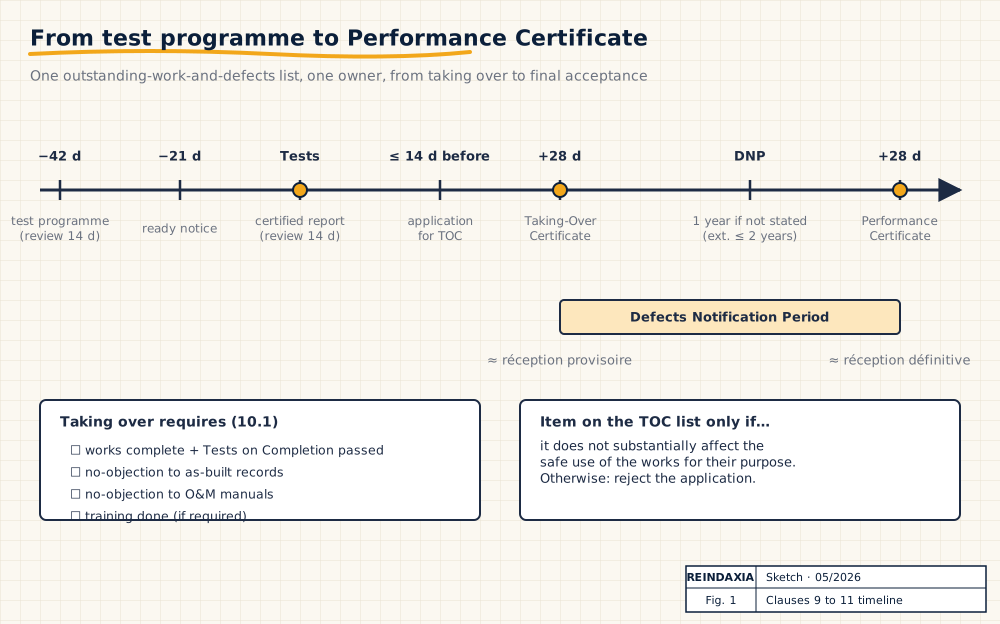 Figure 1. From the test programme to the Performance Certificate, with the conditions for taking over.
A note on Tunisian public contracts
Public works contracts in Tunisia traditionally speak of réception provisoire and réception définitive, with a guarantee period between them and the release of the definitive guarantee within the time fixed by the procurement regulations. In a FIDIC-based public contract, the Taking-Over Certificate plays the role of provisional acceptance and the Performance Certificate that of final acceptance. The Particular Conditions should say so explicitly, align the Defects Notification Period with the guarantee period required by the applicable administrative conditions, and link the release of the performance security and retention money to the Performance Certificate. Two vocabularies without a correspondence table produce two sets of dates.
The quality engineer’s toolkit for the last phase
| Moment | Tool | Purpose |
|---|---|---|
| Six months before tests | Test matrix | Every test in the specification, with procedure, criterion, instruments, responsibility |
| 42 days before tests | Test programme and procedures | Contractual submission under 9.1 |
| Before applying for taking over | Documentation tracker | As-built records, manuals, training records, compliance verification dossier |
| At taking over | Single outstanding work and defects list | One list, categorised by safe-use test, with target dates |
| During the defects period | Defects register | Notification, joint inspection, proposal, remedy, retest, closure |
| Before the end of the period | Close-out review | Open items, extension of period if justified, Contractor’s Documents complete |
The single list is the most important. It starts as the attachment to the Taking-Over Certificate, is shared by the Engineer, the contractor and the operator, and is closed line by line with evidence. Defects notified during the period are added to it. When it is empty and the documents are complete, the Performance Certificate follows.
Our view
Clauses 9 to 11 are where a contract becomes an asset in operation. They reward the parties that treat testing as a planned quality activity, taking over as a documented decision, and the defects period as a managed process rather than a waiting period. The pumping station in our example did not lack a good contract; it lacked one list and one owner.
References
- FIDIC, Conditions of Contract for Construction (Red Book), Second Edition, 2017, Sub-Clauses 1.1.27, 4.4, 4.5, 7.4, 7.5, 9.1 to 9.4, 10.1 to 10.3 and 11.1 to 11.11.
- ISO 9001:2015, clauses 8.6 (release of products and services) and 8.7 (control of nonconforming outputs).
- ISO 10005:2018, Quality management — Guidelines for quality plans.
- Décret n° 2014-1039 du 13 mars 2014 portant réglementation des marchés publics (Tunisia), provisions on guarantees, acceptance and final settlement.
This article is a general commentary and not legal advice. The wording of the FIDIC forms is protected by copyright; refer to the official FIDIC publications and to the Particular Conditions of your contract.
Reindaxia prepares test programmes, manages taking-over documentation and runs defects registers for employers and contractors on FIDIC projects. Talk to us.