In short. On a construction site, approved-for-construction drawings never stay untouched. That is not a problem as long as every deviation is decided by the right person and leaves a trace. The problem starts when a change exists in the field and nowhere else. This article describes the three-level arrangement we have seen work on large EPC projects, and how it shapes mechanical completion, operations and the contract.
The third rack
A mechanical completion walkdown on a piping subsystem. The commissioning team, the contractor’s supervisor and the owner’s inspector follow the line on the isometric. At the third pipe rack it no longer runs where the drawing says. It climbs over a cable tray, with two extra elbows and a high point that has no vent.
Someone asks who approved it. The supervisor remembers: a clash with the electrical installation, sorted out on the spot with the subcontractor. Is there a technical query, a marked-up copy? No. The decision was probably sound. It simply does not exist in any document.
The subsystem cannot be declared mechanically complete. Engineering has to check the line’s flexibility, a vent has to be added, the isometric revised, the test pack reworked. Three weeks and a contractual discussion for a change that would have needed ten minutes of paperwork.
Where changes come from
On an EPC project, design, procurement and construction overlap by nature. Documents are issued Approved for Construction (AFC) while some vendor data is still moving. The design change procedure of a gas processing project we worked on listed the usual sources: vendor information received late, recommendations from the independent verification body or a third party, owner comments, constraints discovered during erection.
These changes are normal. They become dangerous when they escape control, for four reasons:
- safety and integrity: a routing change can alter a line’s flexibility, a drain point, a separation distance, access to a valve or the classification of an area;
- acceptance: mechanical completion is verified against documents; an installation that does not match them cannot be accepted;
- operations: the operator will work for decades from the as-built records, and every error they contain will one day become a badly prepared intervention;
- the contract: every change may carry cost and time, and neither can be claimed nor contested without a written record.
A three-level arrangement
The site needs quick answers; the project needs control. The only way to reconcile the two is to scale the decision route to the impact of the change.
| Level | Typically | Who decides | What remains |
|---|---|---|---|
| Management of change (MoC) | Effect on safety, process, performance or scope; technical disagreement not settled at working level | Project management, with the owner | MoC file, risk assessment, formal approval |
| Technical query (TQ) | Routing, support, material, erection detail; deviation from an owner standard | Contractor’s engineering; the owner for deviations from its standards | Numbered TQ, written reply, document revision |
| Red-line mark-up | Final position of an instrument, routing adjustment with no functional effect, measured dimensions | Contractor’s supervisor, after engineering advice when in doubt | Stamped and signed master copy |
Management of change
This route is reserved for anything that touches safety, the process, performance or contract scope. It requires a risk assessment, often a partial HAZOP review, a decision by project management and the owner’s agreement. It is the heaviest route, deliberately so. The classic trap is to split a significant change into several technical queries to avoid it; the quality team has to watch for that.
Technical query
This is the default route for any change to an AFC document. The site asks a written question; engineering checks design integrity, functionality and compliance with codes and standards, then replies in writing. If the reply departs from an owner standard, it goes to the owner. On the project mentioned above, every design change was also entered in a register kept by engineering: origin of the request, the document in which it was raised, summary, technical evaluation, the contractor’s decision where there was a commercial impact, and the documents affected. The technical evaluation was explicitly separated from the commercial question. That detail is valuable: it stops a good solution being rejected because it costs money, or a bad one being accepted because it is convenient.
Red-line mark-up
For minor adjustments, going through engineering would be out of proportion. The supervisor decides with the subcontractor, and the change is marked in red on a master copy of the document, unambiguously, with a stamp, a date and a signature.
Experience shows that this step, the simplest of the three, is also the one most often neglected. On one large project the main contractor had to send a formal instruction to some twenty subcontractors reminding them of their duties: keep a single master copy per work package in a known place, update it as the work progresses, and hand it over complete before mechanical completion. When that reminder arrives halfway through construction, part of the information is already gone.
As-built records
At the end of the work, mark-ups and technical query replies are incorporated into the documents by their originator or by engineering. The result, the as-built set, describes the plant as it really is. It is the document that will outlive the project longest.
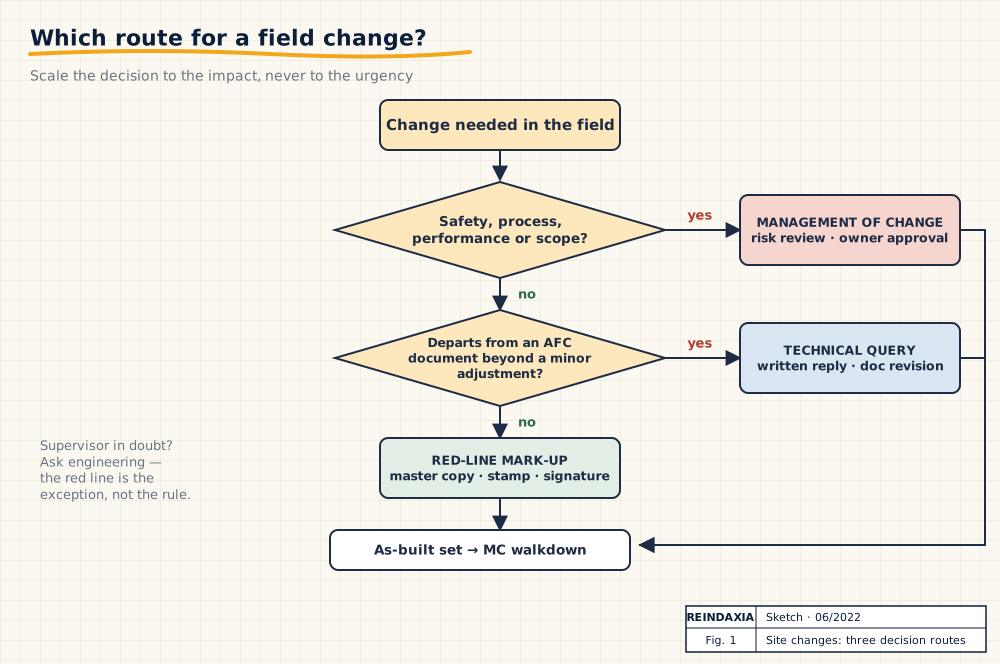 Figure 1. Choosing the route for a field change: management of change, technical query or red-line mark-up, all ending in the as-built set checked at mechanical completion.
The foundation: the right revision in the right place
No change route works if the site is not using the right revision. Document control is not spectacular, but everything rests on it:
- a register that tracks, package by package (civil, racks and piping, electrical and instrumentation, mechanical, skids, commissioning preparation), the status of each document up to AFC issue;
- distribution to subcontractors by transmittal through the project document platform, with acknowledgement of receipt;
- regular reports on outstanding documents, weekly during engineering and monthly afterwards;
- field checks by supervisors and the quality team: which revision is the erection crew actually using?
This is what ISO 10007 calls configuration management: identify what is the reference, control changes to it, record the actual status and verify that the physical item and its documentation agree. ISO 9001 sets the principle in its requirements on documented information and on control of changes.
The moment of truth: mechanical completion
Two formal checks put the arrangement to the test. At mechanical completion of each subsystem, the installation is compared with the latest revision of the AFC documents, red-lines included, and the owner signs the check sheets. At provisional acceptance, the whole is checked against the latest revision, or against the as-built set if it is available.
That is where untracked changes surface, and where they cost most. It is also where new requirements appear. On one of our projects the owner asked, midway through mechanical completion, for every drawing in a subsystem to be reissued at its latest revision, not just the boundary drawings, which the procedure did not foresee. The request had its logic; arriving late, it disrupted the first weeks of the phase. How mark-ups are treated in mechanical completion dossiers is one of the points to settle before the first dossier is compiled.
The contractual angle
In works contracts, and particularly those based on FIDIC conditions, a change instructed or accepted by the employer is a variation, which may entitle the contractor to an adjustment of price and time. A contractor who considers itself entitled to additional payment or time for some other event must notify it within a strict contractual period, failing which the claim is barred: in both the 1999 and the 2017 editions, that period is 28 days from when the contractor became aware, or should have become aware, of the event.
Rigorous change management therefore produces the evidence the contract needs: who asked for what, when, on what basis and with what reply. Conversely, decisions taken verbally in the field feed claims in both directions that nobody can settle on the documents.
What we recommend
Write before you build. No change without a technical query or a signed mark-up, except for a safety emergency, regularised the same day.
Grade by impact, never by urgency. A rushed process change is still a process change.
Train supervisors to recognise what is not minor. Line flexibility, vents and drains, separation distances, maintenance access, hazardous areas: these are the subjects that turn a field adjustment into an engineering question.
Keep one master copy per package, and check it. A known location, a named person, a check during site audits.
Incorporate mark-ups as you go. An as-built set rebuilt six months after the end of the works is rarely reliable.
Link every change to its contractual effect, and notify within the time limits.
Track a few simple indicators: open technical queries and their age, mark-ups not yet incorporated, deviations found during completion walkdowns. They announce acceptance difficulties months in advance.
To conclude
The line that climbed over the cable tray was not a technical fault. It was a decision without a trace. On an EPC project, quality is not only about whether what is built conforms; it is about being able to prove it, document by document. A proportionate change route, applied consistently and checked at every mechanical completion, protects the plant, its future operator and the contract at the same time.
References
- ISO 10007:2017, Quality management — Guidelines for configuration management.
- ISO 9001, requirements on documented information and on control of changes.
- IEC 61882, Hazard and operability studies (HAZOP studies) — Application guide.
- FIDIC, Conditions of Contract for EPC/Turnkey Projects (Silver Book) and Plant and Design-Build (Yellow Book), 1999 and 2017 editions: clauses on variations and claims.
Reindaxia supports owners and contractors in project control, document and contract management, and the preparation of mechanical completion and handover dossiers. Talk to us.