In short. Public works in North Africa and sub-Saharan Africa are increasingly let on FIDIC conditions, often because a development bank requires it. Yet the contracts that reach site are rarely pure FIDIC: national procurement law, the employer’s administrative habits and a heavy hand on the Particular Conditions reshape them. FIDIC’s own answer to this drift is a short list of five Golden Principles. This article explains them, shows where they collide with typical public procurement practice, and walks through the handful of Red Book mechanisms that, in our experience, decide whether a project is controlled or merely recorded.
A contract that looked like FIDIC
The tender documents said “FIDIC Conditions of Contract for Construction, 2017 edition”. The General Conditions were attached in full. The trouble was in the forty pages of Particular Conditions that followed.
One amendment required the Engineer to obtain the employer’s written approval before issuing any determination. Another left the payment period for interim certificates unchanged, but made every payment subject to “budget availability”. A third replaced the dispute board with a referral to the ministry’s legal department. Each change had a reason: an internal control rule, a cash-flow constraint, a reluctance to pay three experts. Taken together, they produced a contract that kept FIDIC’s name and lost most of its mechanics.
Nobody noticed at tender stage. Two years later, with a claim for disrupted access and a disputed variation on the table, everyone did.
The FIDIC family in two paragraphs
FIDIC publishes several standard forms for works. The Red Book (Conditions of Contract for Construction) is for works designed by the employer and paid on measured quantities. The Yellow Book (Plant and Design-Build) shifts design to the contractor. The Silver Book (EPC/Turnkey Projects) transfers most risks, including ground conditions, to the contractor for a fixed price. All three were reissued in second editions in 2017. Many development-bank-financed projects still use the MDB Harmonised Edition, often called the Pink Book, derived from the 1999 Red Book.
The 2017 editions are longer and more procedural than their predecessors. They make obligations symmetrical between the parties, tighten time limits, strengthen the Engineer’s neutrality, add explicit provisions on quality management and advance warning, and turn the dispute board into a standing body meant to avoid disputes, not only decide them.
The five Golden Principles
In 2019 FIDIC published a short document setting out what it considers the essential features of its contracts, the ones that should survive any adaptation. In substance:
- The roles, rights and obligations of all participants should stay broadly as the General Conditions describe them, adapted to the project but not reinvented. The Engineer must remain the Engineer.
- The Particular Conditions must be clear and unambiguous. Ambiguity in amendments is the most reliable source of later disputes.
- The Particular Conditions must not upset the balance of risk and reward built into the General Conditions. If the employer wants the contractor to carry a risk the form does not give it, a different form is the honest answer.
- Time limits imposed on the parties must be reasonable. A notice period of a few days, or an approval period of several months, defeats the purpose.
- Formal disputes should go to a dispute board for a provisionally binding decision before arbitration, unless this conflicts with the governing law.
FIDIC’s guidance gives examples of amendments that breach these principles. Requiring the employer’s approval before the Engineer determines a claim or an extension of time is one of them: the Engineer’s duty is to determine fairly, and an employer who disagrees has the dispute board. Transferring unforeseeable ground conditions to the contractor under a Red or Yellow Book is another: that is what the Silver Book is for.
Where FIDIC meets public procurement law
FIDIC was written to work in any jurisdiction, and the General Conditions expressly yield to mandatory law. In public works, that law is substantial. A Tunisian public contract, for example, sits within the procurement decree of 2014, the applicable general administrative conditions and the oversight of control commissions. Similar frameworks exist across the region.
Some adjustments are legitimate and expected: the form and amount of guarantees, the procedure for amendments approved by a control commission, the language and governing law, the rules on taxes and customs exemptions. Others go further than the law requires and quietly breach the Golden Principles: subordinating the Engineer, making payment conditional, compressing notice periods, removing the dispute board.
Our practical rule, when we review Particular Conditions for a public employer or a bidder, is to ask of each amendment two questions. Does the law require it? If yes, draft it precisely and check its effect on the risk balance. If not, what problem does it solve? Most unnecessary amendments solve an internal administrative problem by creating a contractual one.
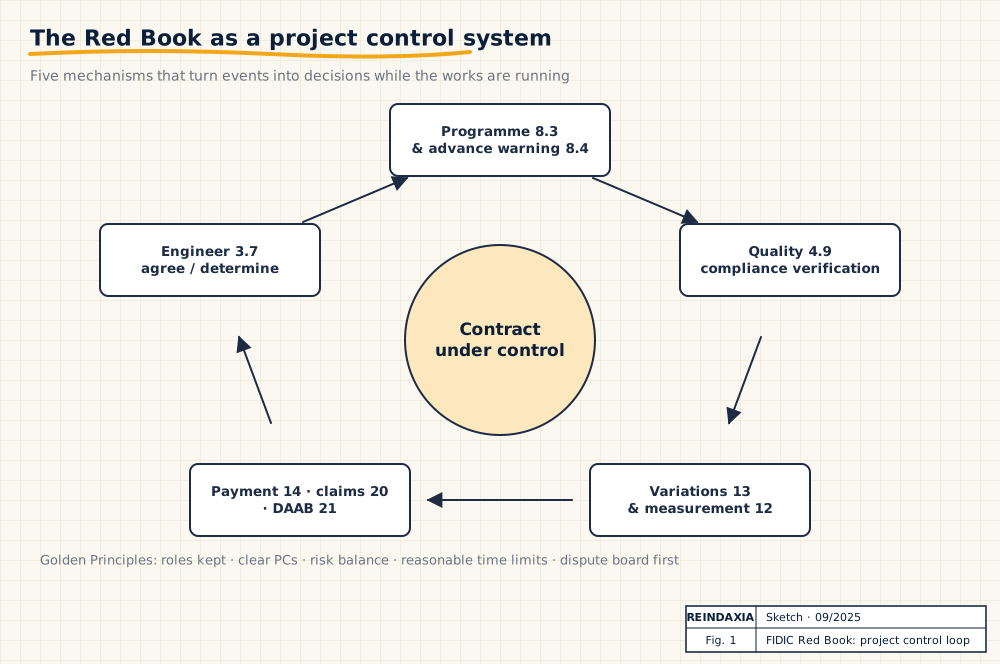 Figure 1. Five Red Book mechanisms working as one project control loop.
Five Red Book mechanisms that make or break project control
A FIDIC contract is, among other things, a project control system written in legal language. Five mechanisms deserve the attention of anyone responsible for cost, time or quality.
1. The Engineer and Sub-Clause 3.7
Under the Red Book the Engineer administers the contract and, when the parties disagree, first consults them to reach agreement and then makes a fair determination. The 2017 edition puts this on a clock: a period of 42 days for consultation and a further 42 days for the determination, unless agreed otherwise. A determination that is not challenged in time becomes final and binding. For project control this is the single most useful feature of the form: disagreements on time and money are resolved, or at least priced, during the works rather than at the end. It only works if the Engineer is staffed, competent and allowed to act.
2. The programme and advance warning
The contractor must submit an initial programme within 28 days of receiving the notice of commencement, in the software stated in the specification, and revise it whenever it no longer reflects actual progress. The Engineer reviews it and may give notice that it does not comply. Sub-Clause 8.4 adds a duty on each party to warn the other of known or probable future events that may adversely affect the work, the price or the completion date.
A programme that is accepted and kept up to date is the baseline for every later discussion of delay. A programme that was never accepted, or not revised for months, leaves both parties arguing from memory.
3. Quality management and compliance verification
Sub-Clause 4.9, new in 2017, requires the contractor to prepare and implement a quality management system and a compliance verification system, to audit it internally, and to submit compliance verification documentation for each part of the works. It does not replace the employer’s inspections; it makes the contractor responsible for proving conformity. Read with the testing and rejection provisions of Clause 7, it gives the Engineer a structured basis for requiring a quality plan, inspection and test plans and records, the very documents that make taking over and the defects period manageable.
4. Variations and measurement
Clause 13 gives the Engineer the right to instruct variations and sets out the procedure, including variations by request for proposal. Clause 12 governs measurement and valuation. In a measured contract, quantities drift; the question is whether the drift is captured, valued and agreed as it happens. In public works, where a variation may also require an amendment approved by a control commission, the two processes must be aligned from the start, or the contractor will be instructed to carry out work that the employer is administratively unable to pay.
5. Payment, claims and the DAAB
The Engineer issues an interim payment certificate within 28 days of receiving the contractor’s statement, and the employer pays within 56 days of that receipt. Late payment carries financing charges. On claims, the 2017 edition applies the same rules to both parties: a Notice of Claim no later than 28 days after the claiming party became or should have become aware of the event, failing which the claim is barred, followed by a fully detailed claim within 84 days. Disputes then go to the standing Dispute Avoidance/Adjudication Board, whose informal assistance can be sought at any time, before anyone reaches arbitration.
The time bar is the provision public employers and contractors most often misunderstand. It is not a formality: a valid claim notified late is, in principle, lost. Equally, a contractor who notifies everything, without substance, floods the Engineer and devalues its own notices. Good contract management sits between the two: a register of events, a weekly review, and notices that are timely, specific and supported.
The series
The Red Book deserves more than one article. This overview is followed by a series that looks at each mechanism in detail:
- Particular Conditions for public employers (in French): drafting amendments that respect national law without breaching the Golden Principles.
- The Engineer in practice under Sub-Clause 3.7: consultations and determinations, with templates.
- Programme, progress reports and advance warning: Sub-Clauses 8.3, 4.20 and 8.4.
- Quality under Sub-Clause 4.9: quality plan, ITPs and compliance verification.
- Notices and claims under Clause 20: a claims register and the 28 and 84 day limits.
- Variations and amendments in public works (in French): aligning Clause 13 with control commissions.
- Tests, taking over and the defects period: Clauses 9 to 11 from a quality engineer’s point of view.
- The DAAB as a dispute avoidance tool: using the board before positions harden.
Our view
FIDIC contracts work because they distribute risk sensibly and give the parties a procedure for disagreeing without stopping the works. Most of the problems we see on public projects do not come from FIDIC, but from amendments that remove that procedure, and from teams that do not use the tools the contract gives them. A well-kept programme, a working Engineer, a disciplined claims register and a dispute board that actually meets are worth more than any number of clauses.
References
- FIDIC, Conditions of Contract for Construction for Building and Engineering Works Designed by the Employer (Red Book), Second Edition, 2017.
- FIDIC, Conditions of Contract for Plant and Design-Build (Yellow Book) and Conditions of Contract for EPC/Turnkey Projects (Silver Book), Second Editions, 2017.
- FIDIC, Conditions of Contract for Construction, MDB Harmonised Edition (Pink Book), 2010.
- FIDIC, FIDIC Golden Principles, First Edition, 2019.
- Décret n° 2014-1039 du 13 mars 2014 portant réglementation des marchés publics (Tunisia).
This article is a general commentary and not legal advice. The wording of the FIDIC forms is protected by copyright; refer to the official FIDIC publications and to the Particular Conditions of your contract.
Reindaxia supports public employers and contractors on FIDIC-based contracts: review of Particular Conditions, Engineer’s support, programme and progress control, claims registers and contract training. Talk to us.